

On this page
If you have ever cooked a meal on a gas stove and later lit a candle on the dining table, you have probably noticed the stark difference in their flames. The gas stove burns with a crisp, blue heat, while the candle flickers with a bright yellow glow.
Both are examples of combustion—a chemical reaction between a fuel and oxygen that releases heat and light. However, the colours tell a hidden story about how efficiently the fuel is burning and what exactly is left behind.
Why is a gas stove flame blue?
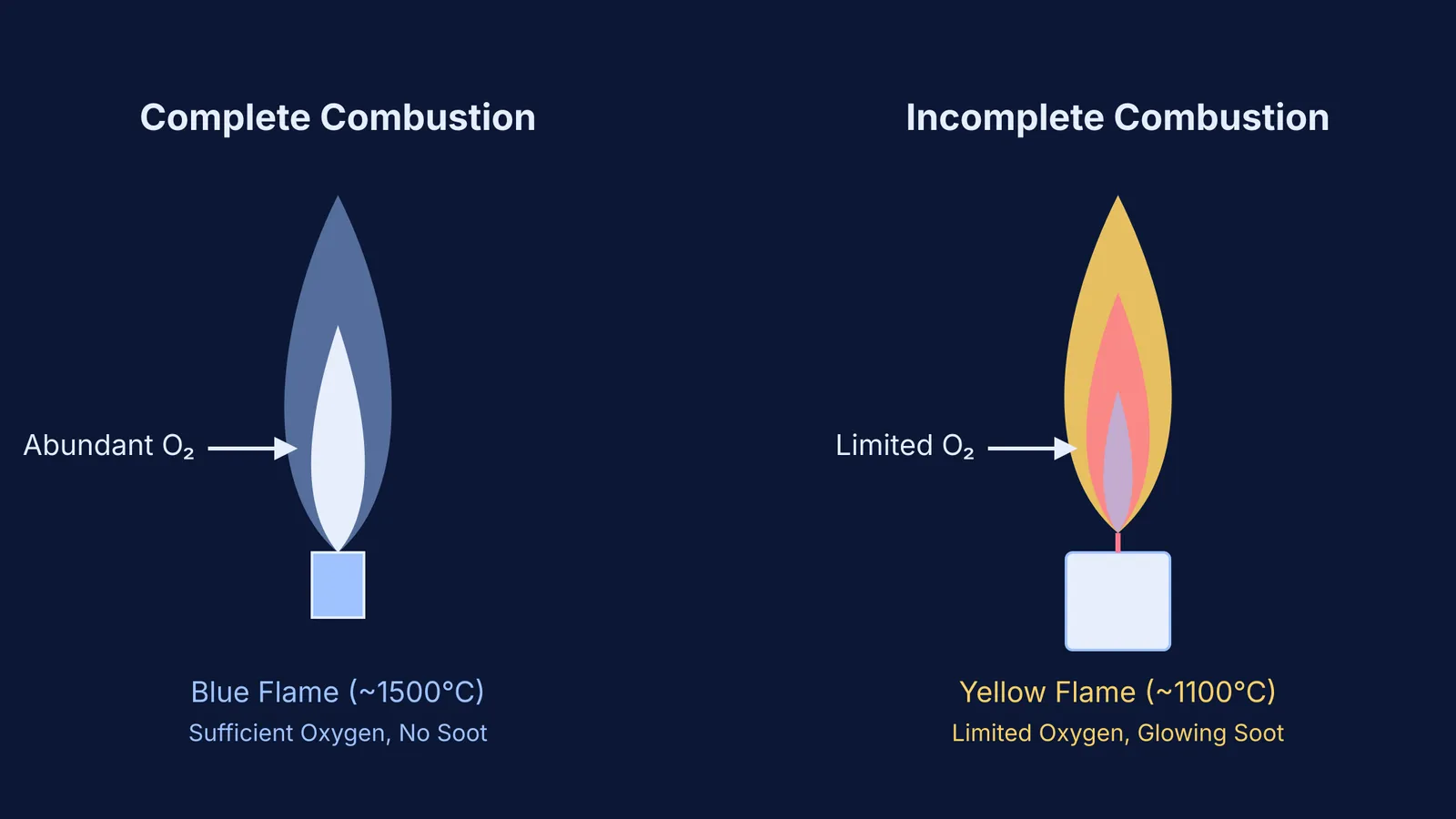
A gas stove produces a blue flame because it undergoes complete combustion. Stoves are designed to pre-mix the fuel (like methane or liquid petroleum gas) with a plentiful supply of oxygen before it even reaches the burner.
Because there is abundant oxygen, every carbon atom in the fuel reacts fully to form carbon dioxide and water vapour. A blue flame occurs when there is a sufficient supply of oxygen for complete combustion, producing no soot (Wikipedia). The blue colour itself does not come from burning solid particles. Instead, it arises from the emission of excited molecular radicals, specifically methylidyne (CH) and diatomic carbon (C₂). As these radicals lose energy and drop back to their ground state, they release photons in the blue and green regions of the visible spectrum.
Why does a candle flame burn yellow?
A candle flame, on the other hand, relies on the air immediately surrounding it. As the wax melts, travels up the wick, and turns into vapour, it does not mix perfectly with oxygen. This limited oxygen supply leads to incomplete combustion.
Without enough oxygen to bind with every carbon atom, the reaction leaves behind fine, unburnt carbon particles known as soot. The yellow colour in common hydrocarbon flames is caused by incandescence, where these fine soot particles are heated to the point that they glow (Wikipedia). Much like the heating element in a toaster or the filament in an old light bulb, these solid particles emit thermal radiation. At these specific temperatures, the peak of this black-body radiation falls in the yellow and orange part of the spectrum, completely masking the much fainter blue light at the base of the wick.
Visualising the difference between excited molecules emitting light and solid soot particles glowing can be tricky. The Fermi Simulation Lab provides interactive simulations for the ideas that are easier to see than to read, letting you adjust oxygen mixtures to watch a virtual flame change colour.
What is the temperature of blue and yellow flames?
The efficiency of the combustion directly dictates the heat produced. Because complete combustion extracts the maximum possible energy from the fuel, blue flames are significantly hotter. A blue flame from a typical gas burner ranges from 900 °C to 1,600 °C (Wikipedia).
In contrast, the incomplete combustion of a candle wastes some of the fuel's potential energy as unburnt soot. The majority of a candle flame sits at approximately 1,100 °C (Wikipedia). While still hot enough to cause a severe burn, it is noticeably cooler than a stove burner.
When you study Enthalpies of atomisation, sublimation and phase change compared, you see how breaking different bonds releases varying amounts of energy. The same principle applies here: oxidising carbon all the way to carbon dioxide releases more heat than leaving it as elemental carbon.
Class 8 Science: Combustion and Flame
Students in India formally encounter these principles in the Class 8 Science syllabus. The chapter "Combustion and Flame" outlines the three zones of a flame: the outer blue zone of complete combustion, the middle yellow zone of partial combustion, and the innermost black zone of unburnt wax vapours (NCERT).
This foundational chemistry scales up quickly. By the time students reach secondary school, they explore deeper topics like Corrosion and rancidity: everyday oxidation in Class 10 science. If you find your child struggling to connect the Class 8 basics to these higher-level oxidation concepts, Fermi's AI tutor can work out what they already know and build a plan for the session to teach through them.
A practical framework for spotting combustion
You can test these principles safely at home with a simple observation exercise:
Check the bottom: Look closely at the very base of a candle flame. You will spot a faint blue sliver where oxygen first meets the wax vapour, creating a tiny zone of complete combustion before the oxygen runs out higher up.
Check the byproduct: Hold a clean, dry, heat-safe ceramic plate briefly over a candle flame, using tongs. It will quickly develop a black smudge. This is the unburnt soot.
Compare the stove: Do the same over a blue gas stove flame. The plate will remain clean, proving that complete combustion leaves no carbon waste behind.


