

On this page
Shine a UV torch on a glass of tonic water in a dark room and the clear drink turns a ghostly blue. You are watching fluorescence: a molecule takes in light you cannot see and gives out light you can. The same idea explains why some sweets glow and others stay dark, and it puts E = hc/λ from Class 11 chemistry and Class 12 physics to work.
Why does tonic water glow under UV light?
Tonic water contains quinine, the compound that gives it its bitter taste. UCAR's science education team says quinine "absorbs UV and releases it, causing it to glow blue".
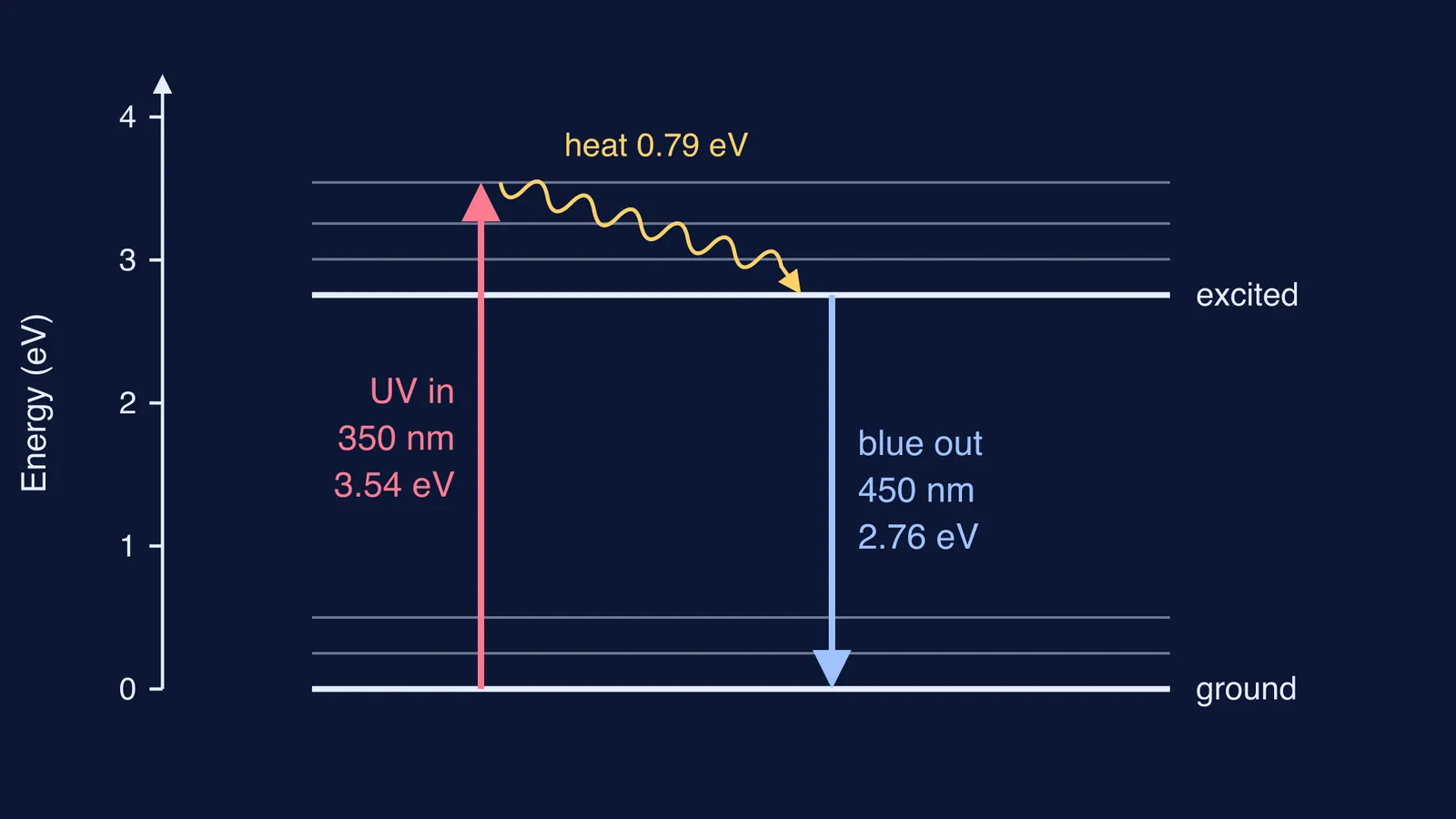
Quinine absorbs ultraviolet light at about 350 nm and emits blue light at about 450 nm, the settings used in a 2025 study of commercial tonic waters in Methods and Protocols. That study measured about 64.5 ppm of quinine in each of two brands, below the US FDA limit of 83 ppm that the authors cite.
The 350 nm light sits inside the UVA band, which the WHO defines as 315 to 400 nm), so the quinine turns invisible light into visible light.
What is fluorescence, exactly?
Fluorescence is light given out by a substance while it is being lit. According to the Florida State University Molecular Expressions primer, John Herschel reported the glow of a quinine solution in sunlight in 1845, and George Gabriel Stokes later coined the word "fluorescence". Stokes set out his findings in 1852 in "On the change of refrangibility of light" in the Philosophical Transactions of the Royal Society. The rule that fluorescent light has a longer wavelength than the light that excites it is known as Stokes' law, and the shift itself as the Stokes shift.
Inside the molecule, three things happen:
A UV photon lifts the molecule from its ground state to a high excited level.
The molecule quickly loses a little of that energy as heat, as vibrations jostle its neighbours, and settles at the lowest excited level.
It drops back to the ground state and gives out a photon, which now carries less energy, so it has a longer wavelength: blue instead of UV.
How much energy does the blue light lose?
The energy of one photon is E = hc/λ, where h is the Planck constant, exactly 6.62607015 × 10⁻³⁴ J s (NIST) and c is the speed of light. Converted to electronvolts and nanometres, hc comes to about 1240 eV nm.
Worked example for quinine:
UV photon in: E = 1240 / 350 = 3.54 eV.
Blue photon out: E = 1240 / 450 = 2.76 eV.
Energy lost as heat: 3.54 − 2.76 = 0.79 eV per photon (rounded).
Fraction lost: 1 − 350/450 = 0.22, so about 22% of each absorbed photon's energy never becomes light.
Not every absorbed photon comes back out either. The PhotochemCAD database at the Oregon Medical Laser Center lists a fluorescence quantum yield of 0.546 for quinine sulfate in 0.5 M sulfuric acid, meaning roughly 55 photons emitted for every 100 absorbed.
The arithmetic also rules out the reverse: turning a 2.76 eV blue photon into a 3.54 eV UV photon would create energy. That is why the glow needs UV going in.
If an energy-level picture is hard to hold in your head, the Fermi Simulation Lab has interactive simulations for ideas that are easier to see than to read.
Why do some sweets glow and others don't?
A sweet glows under UV only if one of its ingredients fluoresces in the visible range. Quinine gives a blue glow. Riboflavin (vitamin B2) glows yellow-green: the AAT Bioquest spectrum viewer lists its excitation peak at 349 nm and emission peak at 532 nm. Same UV torch, different molecule, different colour, because each molecule has its own gap between energy levels.
Fluorescence also stops almost instantly when the UV goes off. If a sticker keeps shining for minutes after lights out, that is a different process, explained in our post on why glow-in-the-dark stars keep glowing after lights out.
How can you test this at home?
You need a UV torch (often sold as a black light), a dark room, two glasses and a few sweets. Never shine the torch into anyone's eyes.
Pour tonic water in one glass and plain water in the other. Predict which will glow, and what colour, before you switch on.
Line up the sweets and sort them: glows blue, glows yellow-green, no glow. Read the ingredient lists for quinine or riboflavin.
Switch the torch off. If the glow vanishes at once, it was fluorescence.
For each colour you saw, estimate the wavelength and work out E = 1240/λ. Compare it with 3.54 eV for the UV going in.
The same arithmetic explains why UV causes sunburn but infrared doesn't, and chemistry questions often scale it up to the energy of one mole of photons in kJ/mol. If the idea of energy levels itself feels shaky, the Fermi Concept Library gives every concept in physics and chemistry its own lesson, so you can fill that gap before the next numerical.


