On this page
At 7 pm, some flowers that were wide open at noon look like closed fists. They are not wilting. The flower is actively moving its petals.
Why do some flowers close at night?
They are making a nastic movement. Nastic movements are non-directional responses to stimuli such as light, temperature and humidity, as the overview of nastic movements on Wikipedia defines them. Darkness or cold triggers it; the flower's structure sets which way petals bend.
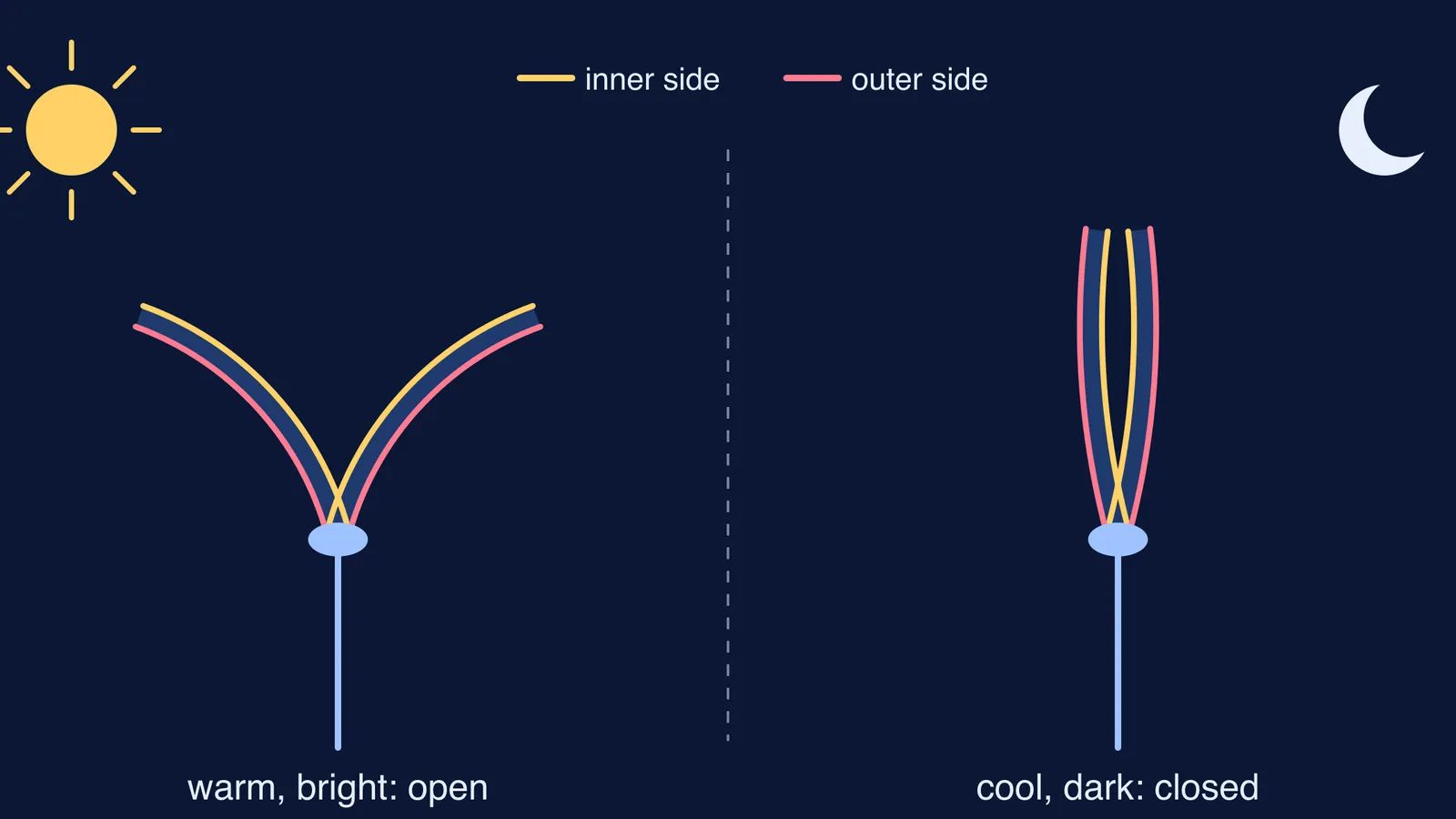
Wouter van Doorn and Uulke van Meeteren wrote a review of flower opening and closure in the Journal of Experimental Botany (2003). In most of the species studied, they report, petals move because the two sides of the petal grow at different rates. When the inner face grows faster, the petal curves outward and the flower opens; when the outer face grows faster, the petal curves back in.
Some flowers react mainly to temperature. The same van Doorn and van Meeteren review notes that a warming of just 0.2 °C was enough to start a detectable opening movement in crocus, while in tulips the minimum was 1 °C. In tulips, the cells on the outer side grow best at a temperature about 10 °C lower than the cells on the inner side, so cooling favours growth of the outer side and the bloom shuts. Others, including several in the daisy family, respond mainly to light.
How is a nastic movement different from a tropism?
NCERT's Class 10 Science chapter Control and Coordination says plants show two different types of movement, "one dependent on growth and the other independent of growth". Its example of the second kind is the *chhui-mui*, whose leaves fold when touched. Its examples of the first are shoots bending towards light and roots growing down with gravity, directional movements that "can be either towards the stimulus, or away from it".
Flower closing sits awkwardly in that split. Like a tropism, it usually involves growth. Like the *chhui-mui*, its direction has nothing to do with where the stimulus comes from. So tell them apart by direction:
Tropism: the direction of the response follows the direction of the stimulus. Light from the left, shoot bends left.
Nastic movement: the response has a fixed direction. A closing tulip folds inward whichever side the cold air comes from.
Speed: nastic movements are generally faster than tropisms, according to the same nastic movements overview.
Mechanism: either kind can use growth; the touch-me-not uses water moving in and out of cells instead.
For phototropism and geotropism, see our guide to tropic movements in Class 10. For the fast, water-driven case, read why touch-me-not leaves fold when touched.
Why would a flower bother closing?
The van Doorn and van Meeteren review lists several possible reasons: to keep pollen from getting wet, to protect against cold, to keep out insects, to limit water loss and to limit the entry of harmful microbes.
A 2025 field experiment tested the first idea. Pavol Prokop and colleagues wired open the flowers of lesser celandine so they could not close, then exposed them to simulated and natural rain. The wired flowers kept significantly fewer pollen grains than normal flowers and had fewer viable pollen grains. The authors also suggest that these flowers cannot tell the low light of a cloudy day from night, so they close for both.
So for your own observations, a closed flower at 2 pm on an overcast day is data, not a mistake.
How do you run a week-long flower observation log?
You need a notebook, a phone and two or three flowering plants you can reach often.
Day 1: Pick your plants, ideally one you have seen shut in the evening, and find their names.
Days 1 to 7: Check each plant at three fixed times, such as 7 am, 1 pm and 7 pm. Each time, write the time, the sky (sunny, cloudy, dark), the temperature from your phone's weather app and the flower's state (open, half, closed).
Day 3: Add a check 30 minutes after sunset to catch the closing in progress.
Day 5: Light test. On a sunny afternoon, cover one open flower with an upturned paper cup for an hour and leave a neighbouring flower uncovered. Compare them, noting that the cup changes temperature too.
Day 6: Note the direction. Did the petals fold the same way regardless of where the sun was? If yes, that is your evidence for a nastic, not tropic, movement.
Day 7: Analyse. For each plant, did closing follow the clock, the light or the temperature? Write three sentences using stimulus, direction and growth.
If the timing looks clock-like, the story of how biologists found the first clock gene in fruit flies shows how such rhythms are studied.
If tropism, turgor and growth blur together as you write up, the Fermi Concept Library gives each biology concept its own lesson and its place in the map, so you can see plant movements side by side.
Start tonight: note which flowers near you are open at 7 pm, and check them again at 7 am.