

On this page
Every living thing has a rhythm. Your body knows when to prepare for sleep, when to release specific hormones, and when to drop your blood pressure at night. This 24-hour cycle is known as the circadian rhythm.
For a long time, biologists knew this internal clock existed, but they did not know what the gears were made of. The 2017 Nobel Prize in Physiology or Medicine was awarded to Jeffrey Hall, Michael Rosbash and Michael Young for their discoveries of the molecular mechanisms controlling the circadian rhythm.
How did Jeffrey Hall and Michael Rosbash find the period gene?
The story begins with a small insect: the fruit fly (*Drosophila melanogaster*). In the 1970s, researchers Seymour Benzer and Ronald Konopka demonstrated that mutations in an unknown gene disrupted the flies' 24-hour rhythm. They named it the *period* gene, but its chemical structure remained a mystery for over a decade.
In 1984, working in close collaboration at Brandeis University, Jeffrey Hall and Michael Rosbash isolated the *period* gene. Around the same time, Michael Young at Rockefeller University independently isolated the same gene.
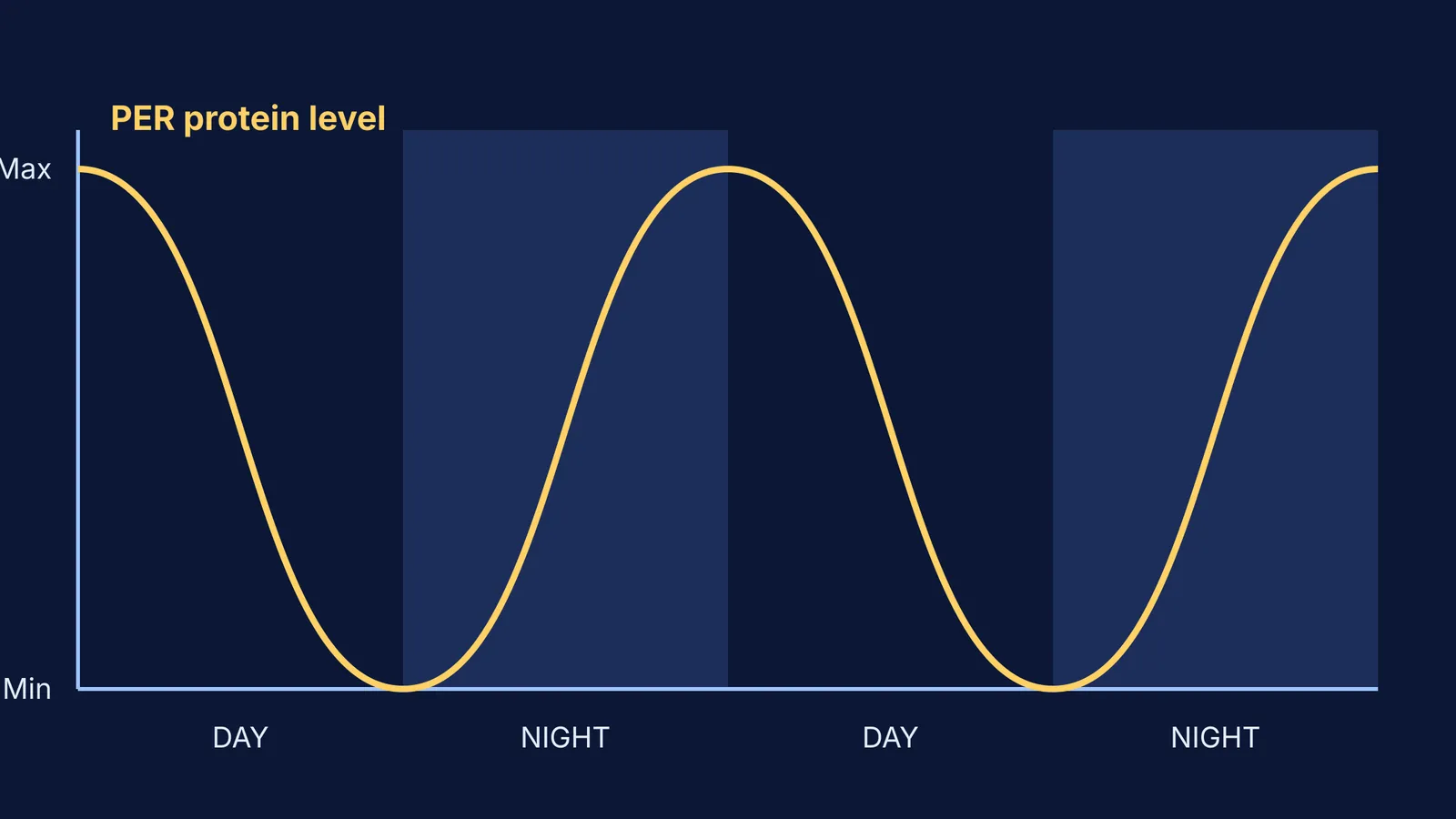
Finding the gene was a key step, but they still needed to understand how it kept time. Hall and Rosbash looked at the protein the gene produced, which they called PER. The level of PER protein in the cell oscillates in a 24-hour cycle, accumulating during the night and breaking down during the day.
How does the circadian clock work in a fruit fly?
Hall and Rosbash proposed a mechanism based on an inhibitory feedback loop. They reasoned that the PER protein builds up in the cell and then enters the nucleus to block the *period* gene from making more of itself.
When the sun comes up, the PER protein degrades, lifting the block on the gene. As night falls, the gene becomes active again, and the protein starts to accumulate, starting the 24-hour cycle anew.
If you are studying genetics or transcription feedback loops, the Fermi Concept Library has every concept in physics, chemistry, biology, mathematics and computing, each with its own lesson and its place in the map.
What did Michael Young discover about the biological clock?
The feedback loop explained the daily cycle, but it left a puzzle: how did the PER protein get into the nucleus to block the gene in the first place?
In 1994, Michael Young found a second clock gene, which he called *timeless*, that produces the TIM protein. He showed that when TIM binds to PER, the two proteins can cross into the cell nucleus together and shut down the *period* gene.
Young also identified a third gene, *doubletime*, which produces a protein that delays the accumulation of PER. This fine-tuning ensures that the entire cycle takes exactly 24 hours. (This parallels how Obaid Siddiqi mapped fruit fly genes to specific behaviours, and how Christiane Nüsslein-Volhard traced the genes that lay out an embryo.)
Why is the period gene important for humans?
The molecular clock isolated in the fruit fly operates in the cells of all multicellular organisms, including humans. Our clock genes regulate critical functions including sleep patterns, metabolism, hormone release and body temperature.
When there is a sudden mismatch between our lifestyle and our internal clock—like taking a long flight across multiple time zones—we experience jet lag. Chronic misalignment is linked to a higher risk of sleep disorders, metabolic issues and cardiovascular disease.
How to study with your circadian rhythm
You can use the science of the circadian rhythm to organise your day and improve your exam preparation.
Find your peak window: Track when you naturally feel most alert. For many students, this is in the late morning; for others, it is the late afternoon or early evening.
Schedule deep work: If you are tackling a hard physics problem or a new maths concept, do it during your peak alertness window. When you sit down to tackle these hard topics, Fermi's AI tutor works out what you already know and builds a plan for the session.
Use the troughs for review: Save low-energy periods for passive tasks, like sorting notes, reading over past mistakes, or reviewing flashcards.
The next time you wake up just before your alarm sounds, you know who to thank: the PER and TIM proteins, quietly keeping time in almost every cell in your body.


