

On this page
A fertilised egg is one cell. A few days later it is an animal with a head, a tail and a row of body segments. Which genes decide that layout? In the late 1970s, nobody knew how many there were or whether they could be found at all. Christiane Nüsslein-Volhard set out to find them. This post explains her approach, what she found, and what it teaches about tackling a big problem.
Who is Christiane Nüsslein-Volhard?
Her Nobel Prize facts page gives her birth date as 20 October 1942 and says she was one of five children in a family interested in art and music. It notes that at just 12 she decided to pursue a career in biology. She studied biology at Goethe University in Frankfurt, then biochemistry in Tübingen, did graduate work at the Max Planck Institute, worked at the European Molecular Biology Laboratory (EMBL) in Heidelberg, and returned to the Max Planck Institute in Tübingen in 1984.
She shared the 1995 Nobel Prize in Physiology or Medicine with Edward B. Lewis and Eric F. Wieschaus "for their discoveries concerning the genetic control of early embryonic development".
Why did she choose the fruit fly?
The 1995 Nobel press release explains that Nüsslein-Volhard and Wieschaus got their first independent research posts at EMBL at the end of the 1970s. Both wanted to know how a newly fertilised Drosophila egg becomes a segmented embryo. The fly develops fast: within 9 days of fertilisation the egg becomes an embryo, a larva and then an adult fly. Fruit flies were also the classic animal of genetics, going back to Thomas Hunt Morgan's fly room.
What was the experiment?
The press release calls it "a brave decision by two young scientists". The number of genes involved might have been huge, and nobody had tried anything like it. Their plan was a saturation screen. They treated flies with chemicals that cause mutations, damaging roughly half of the fly's genes at random, then looked for embryos whose body axis or segment pattern went wrong.
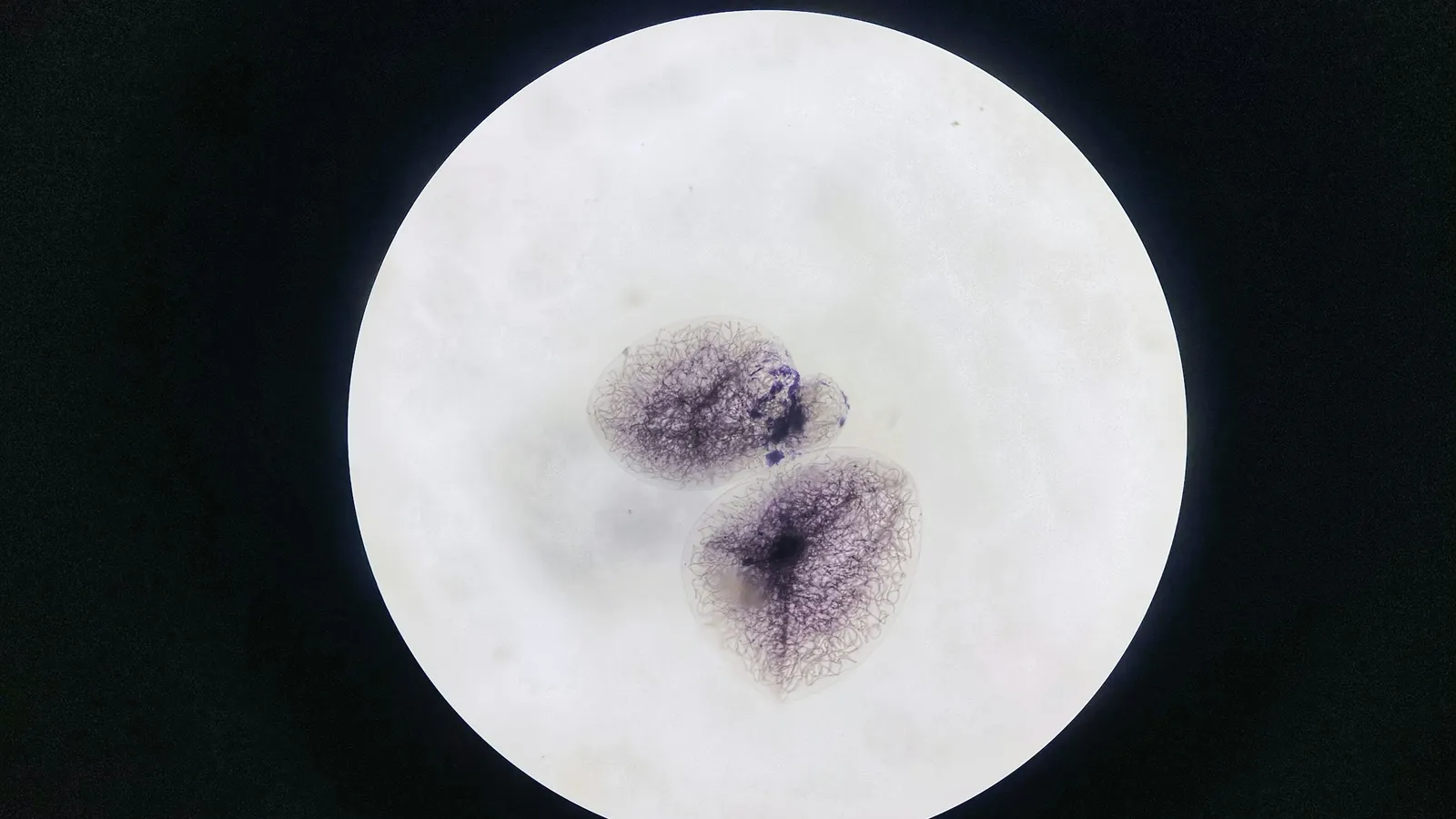
They used a microscope that let two people look at the same embryo at once. For more than a year they sat opposite each other examining embryos from genetic crosses of mutant flies, sorting the defects into types.
What did they find?
Their 1980 Nature paper reports 15 loci that, when mutated, change the segment pattern of the larva. The abstract says these "probably represent the majority of such genes" and that segmentation works at three levels: the whole egg, a repeat unit two segments long, and the single segment.
The press release names the three groups that match those levels:
Gap genes set up the body plan along the head-to-tail axis. Lose one and a block of segments is missing.
Pair-rule genes act on every second segment. The press release says that losing the gene even-skipped leaves an embryo made only of the odd-numbered segments.
Segment polarity genes give each segment its own head-to-tail direction.
Here is the arithmetic in the press release's description. The pair-rule genes help specify the embryo's 14 final segments. If only the odd-numbered ones remain, that is segments 1, 3, 5, 7, 9, 11 and 13: 7 out of 14, or half.
What came after the 1980 screen?
According to the press release, similar or identical genes were soon found in other animals and in humans, doing similar jobs in development. In 1988, Driever and Nüsslein-Volhard showed a gradient of the protein Bicoid across the fly embryo. A 2004 Cell commentary describes their back-to-back papers as the first molecular demonstration of two old ideas in the field: localised cytoplasmic determinants and morphogen gradients.
She later applied the same screening logic to a vertebrate. Her Tübingen group's 1996 zebrafish screen scored 3857 mutagenised genomes, kept 1163 mutants, and assigned 894 of them to 372 genes. Dividing 894 by 372 gives about 2.4 mutants per gene, the average allele frequency the paper reports.
What can a student take from her way of working?
Pick a system that gives fast answers. A fly that goes from egg to adult in days lets you test many ideas. In study terms, choose practice that gives quick feedback, such as short self-tests, over long sessions with no check.
Be systematic instead of lucky. They did not hunt for one famous gene; they screened broadly and classified everything. A full error log of your mock tests works the same way.
Sort before you explain. Gap, pair-rule and segment polarity came from grouping defects by pattern. Grouping your own mistakes by type shows you which "gene" in your preparation is broken.
Work with a partner. Two people at one microscope caught what one might miss. Explaining a solution to a friend does the same job.
If the idea of genes switching other genes on and off feels abstract, the Fermi Concept Library has every concept in physics, chemistry, biology, mathematics and computing, so you can look up gene regulation on its own before returning to this story.
Next step: sketch a 14-segment embryo and shade what a gap, a pair-rule and a segment polarity mutant would each lose.


