On this page
Stand on the Moon at lunar noon and you would see something that feels wrong: a blazing Sun in a pitch-black sky. The black comes from what is missing, and once you see why, you also understand why Earth's sky is blue.
Why does the sky look black from the Moon?
You only see the sky glow when something in it sends sunlight sideways into your eyes. On Earth, air molecules do that job. On the Moon, there is almost nothing there to do it.
NASA's StarChild page puts it simply: "If you were on the Moon, which has no atmosphere, the sky would be black both night and day."
Strictly, the Moon does have a very thin layer of gas called an exosphere, made almost entirely of helium, neon and argon, according to NASA's page on the lunar atmosphere. The same page says the Moon's atmosphere has about 10^15 (a million billion) times fewer molecules per cubic centimetre than Earth's. With so few molecules in the way, sunlight streams straight past your line of sight and almost none of it is redirected towards you. If no light comes to your eye from a direction, that direction looks black.
Why is Earth's sky blue in the first place?
Sunlight is a mix of all colours. When it passes through air, tiny molecules (much smaller than the wavelength of light) scatter some of it in all directions. This is Rayleigh scattering, named after Lord Rayleigh, who published his explanation, as J. W. Strutt, in "On the light from the sky, its polarization and colour" (Philosophical Magazine, 1871).
The key rule is that for particles much smaller than the wavelength, the amount of light scattered is inversely proportional to the fourth power of the wavelength, as the UC Riverside physics FAQ on the blue sky states. Shorter waves (blue) scatter far more than longer waves (red). NASA Space Place says the same in plain words: blue light is scattered more because it travels as shorter, smaller waves.
Look away from the Sun on Earth and the light reaching you is mostly scattered blue. Remove the air and that light disappears. For a fuller history of the law, read our explainer on Rayleigh's 1/λ⁴ law and the blue sky.
How much more is blue light scattered than red?
Here is a worked example you can redo in an exam. Take blue light at 450 nm and red light at 700 nm.
Write the ratio: I(blue) / I(red) = (λ_red / λ_blue)⁴ = (700 / 450)⁴.
Divide first: 700 / 450 = 1.556.
Square it: 1.556² = 2.420.
Square again: 2.420² = 5.86.
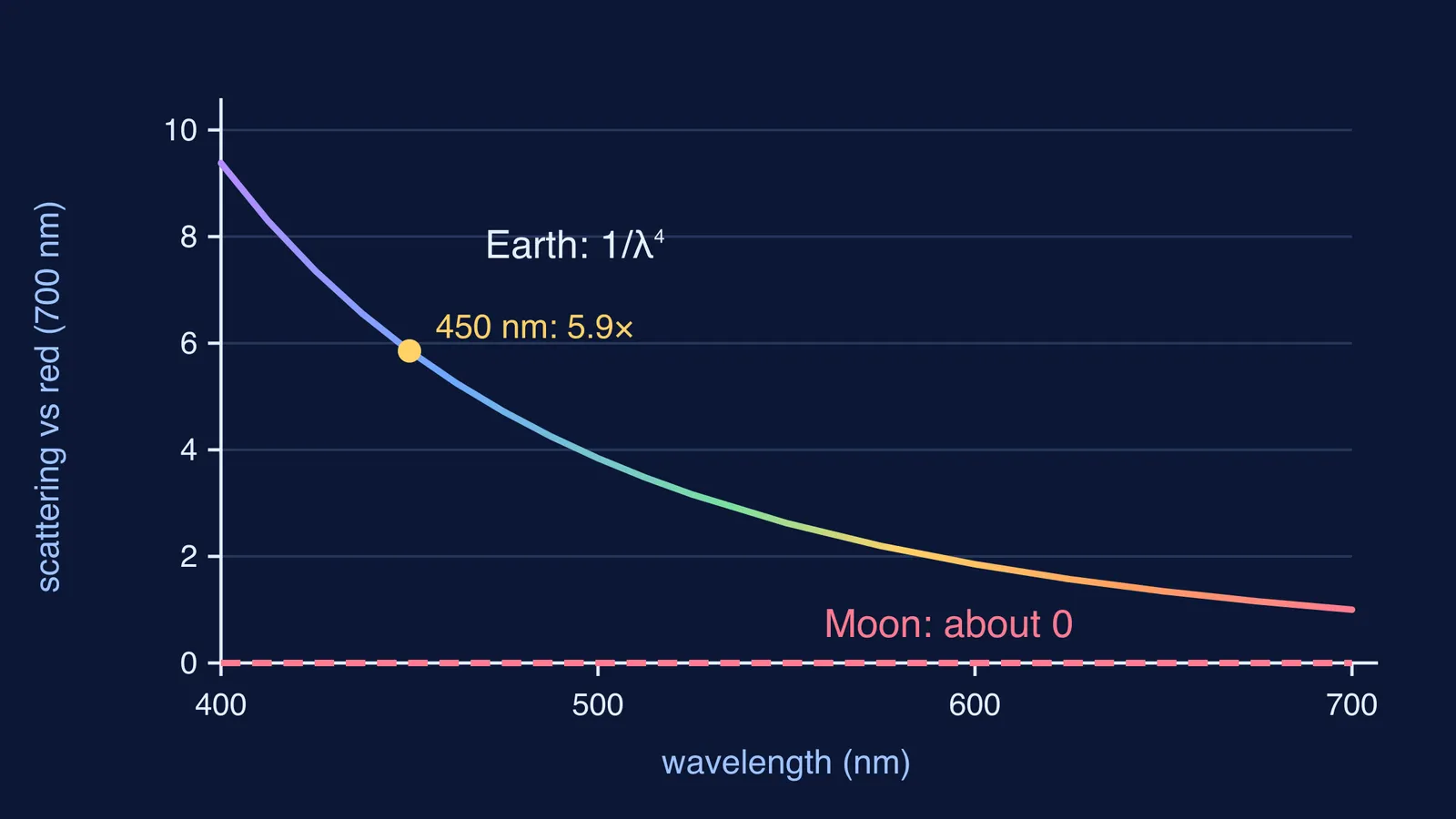
So blue light at 450 nm is scattered about 5.9 times as strongly as red at 700 nm. Push it to violet at 400 nm and you get (700/400)⁴ = 1.75⁴, about 9.4; the UC Riverside FAQ rounds this to a factor of about 10. The same FAQ explains why the sky still looks blue, not violet: sunlight has less violet to begin with, some is absorbed high in the atmosphere, and our eyes are less sensitive to it.
Now apply the Moon's numbers. The 1/λ⁴ law still holds for each molecule, but there are about 10^15 times fewer molecules in each cubic centimetre, according to NASA. The ratio between colours stays the same; the total glow drops to almost nothing. That is the curve in the diagram above: Earth's rises steeply towards blue, the Moon's sits flat at almost zero.
If a step like this trips you up, the Fermi Problem Library has worked problems with a step-by-step solver that explains the reasoning rather than printing an answer.
What else changes when there is no air to scatter light?
Scattered skylight is also what softens shadows on Earth. Without it, the Moon is a place of extremes. NASA's Ames Research Center notes that because there are no particles in the air to scatter sunlight, you get "dark shadows and very bright regions", which is why early lunar missions mostly waited until the lunar "afternoon" to explore. Why the Moon lost its air in the first place is its own story: see why the Moon has no atmosphere. Different particles give a different sky again: dust is why sunsets on Mars look blue.
How do you write this as a three-mark answer?
Use this four-point checklist, one sentence each:
Sky colour comes from sunlight scattered towards the observer by particles in the air.
On Earth, air molecules cause Rayleigh scattering, with intensity proportional to 1/λ⁴, so blue is scattered most and the sky looks blue.
The Moon has almost no atmosphere, so there are almost no particles to scatter sunlight.
With no scattered light reaching the eye from the sky, it looks black, even when the Sun is up.
To connect scattering with refraction and sunset colours, each concept in the Fermi Concept Library has its own lesson and its place in the map.