

On this page
You spend an afternoon at a cricket match or on a beach in Goa, your shoulders turn red and sore, and a few days later the skin starts coming off in thin, papery sheets. That peeling is not the burn itself. It is your skin throwing away cells that ultraviolet (UV) light damaged too badly to keep, while new skin forms underneath.
What does UV radiation do to skin cells?
The outer layer of your skin, the epidermis, is built mostly from cells called keratinocytes. A 2023 review in the International Journal of Molecular Sciences describes the layers, from the deepest up: stratum basale, spinosum, granulosum, lucidum (only on palms and soles) and corneum (Pondeljak and colleagues, 2023). New keratinocytes form in the basal layer and move up, flattening and dying near the surface.
UVB is ultraviolet light with wavelengths of 280 to 315 nm, and it mostly damages DNA directly (Hegedűs and colleagues, Redox Biology, 2020). One of the main forms of damage is the cyclobutane pyrimidine dimer: two neighbouring pyrimidine bases on the same DNA strand become chemically cross-linked to each other.
For the physics, see why UV causes sunburn but infrared doesn't, which works through the photon energy maths.
Why does sunburned skin peel instead of just healing?
A cell with damaged DNA either repairs it or dies in a controlled way, which protects the body from cells copying faulty DNA. The World Health Organization lists DNA damage and sunburn among the acute effects of UV, and skin cancers and premature skin ageing among the long-term ones (WHO fact sheet on ultraviolet radiation).
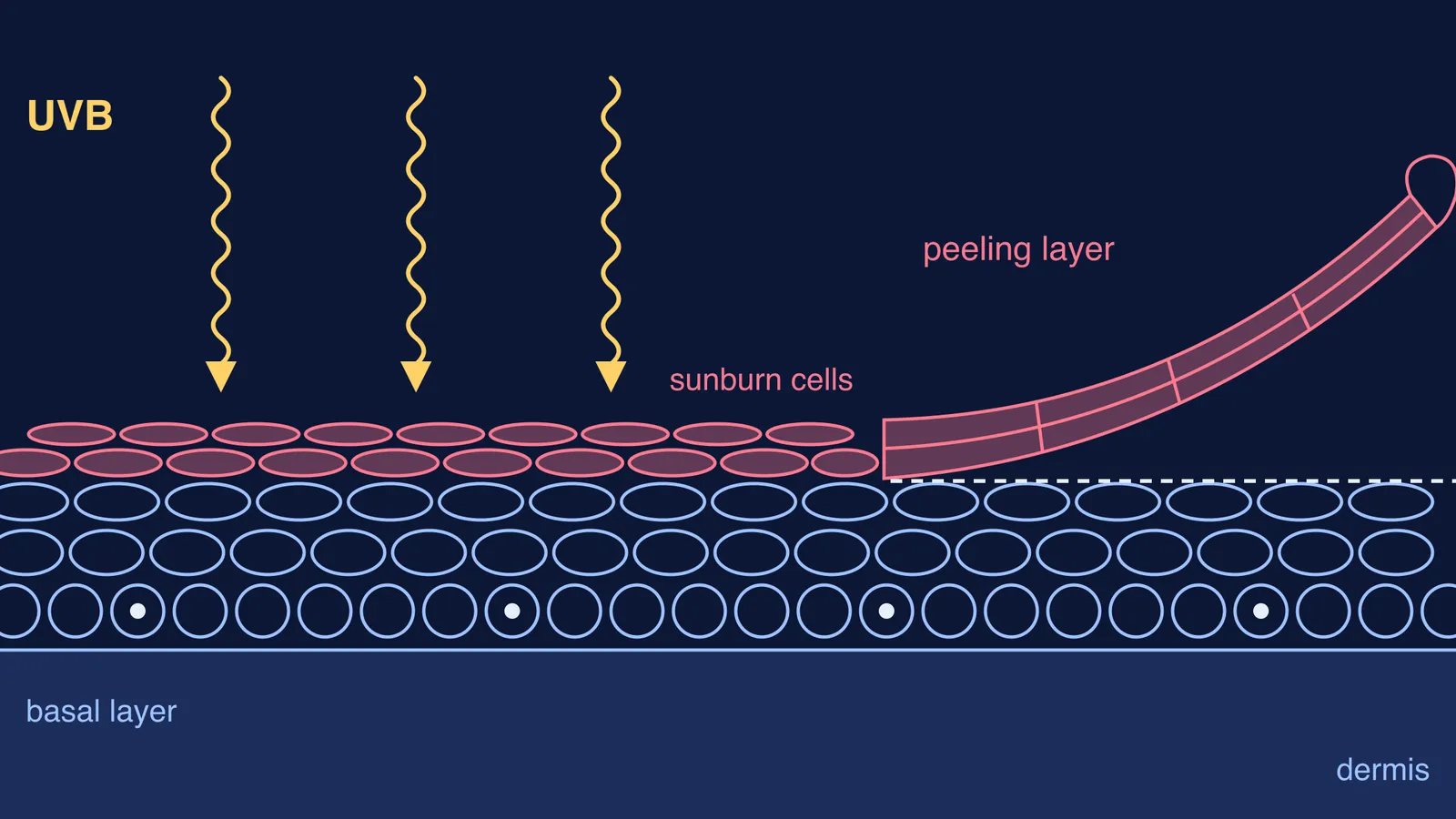
Keratinocytes that switch on this programmed cell death (apoptosis) after a heavy UVB dose are called sunburn cells. A 2024 study in mice in the European Journal of Immunology defines them as keratinocytes that undergo apoptosis because UVB caused severe DNA damage they could not repair (Ortner and colleagues, 2024). In that study, the researchers gave mice a single dose of 1000 J/m² of UVB and counted sunburn cells at 4, 24 and 48 hours; the count was highest at 24 hours.
So a sunburn leaves a band of dead and damaged cells near the surface. Peeling is the skin shedding that layer together, rather than losing a few surface cells at a time as it normally does.
How long after a sunburn does skin peel?
The NHS says sunburned skin may flake or peel, and that this usually happens a few days after the burn; most sunburn gets better within 7 days (NHS: Sunburn). A rough sequence:
Exposure: UVB reaches the skin and DNA damage begins.
Next: the skin becomes sore and hot to the touch.
Around day 1: damaged keratinocytes are dying; in the mouse study, sunburn cells were most numerous at 24 hours of the time points measured (Ortner and colleagues, 2024).
A few days later: the dead layer loosens and peels.
Within about a week: most sunburn has settled (NHS).
Underneath, the basal layer keeps making cells. The 2023 keratinization review notes that the entire epidermis, from the stratum basale to the stratum corneum, changes within 14 days (Pondeljak and colleagues, 2023). For a labelled picture of these layers, see our guide to the structure of human skin.
Should you pull off peeling skin?
No. The NHS says not to scratch or try to remove peeling skin, and not to pop blisters (NHS: Sunburn). The same page lists self-care steps and the signs that mean you should get urgent help, such as blistered or swollen skin, a very high temperature, dizziness or a sunburned baby or young child. For anything about your own skin, ask a doctor or pharmacist.
Prevention is simpler: the WHO advises sun protection whenever the UV index is 3 or above (WHO). Our explainer on what the UV index on your weather app means shows how to read that number for your city.
How do you explain sunburn peeling in a biology answer?
In a class test or viva, give the cause-and-effect chain in order, using the sources above (Hegedűs and colleagues, 2020; Ortner and colleagues, 2024):
Cause: UVB (280 to 315 nm) is absorbed by DNA in keratinocytes.
Damage: neighbouring pyrimidine bases on the same strand cross-link into dimers.
Decision: the cell repairs the damage or, if it is too severe, undergoes apoptosis and becomes a sunburn cell.
Response: redness and pain; dead cells collect near the surface.
Renewal: new keratinocytes from the stratum basale push up, and the dead layer is shed as peeling.
A common mistake is saying UV "burns" skin like heat. It damages DNA, and the cells respond.
If picturing photons, DNA and cell layers at once is the hard part, the Fermi Simulation Lab has interactive simulations for ideas that are easier to see than to read, and the Fermi Concept Library gives each biology concept its own lesson and its place in the map, so you can follow the link from light to cells to tissue.


