On this page
If you have ever sung under the shower and thought you sounded like a playback singer, you are not imagining it. The reasons are three ideas from your Class 9 sound chapter: reflection, reverberation and resonance.
Why does my voice sound better in the bathroom?
Start with reflection. When sound hits a wall, some of its energy is absorbed and the rest bounces back.
The absorption coefficient is the fraction of sound energy a surface absorbs, a number between 0 and 1 that changes with frequency (Simon Fraser University Handbook for Acoustic Ecology).
At 1000 Hz, poured concrete has an absorption coefficient of about 0.02, while heavy carpet on concrete has about 0.4 (HyperPhysics, Georgia State University). HyperPhysics has no row for glazed tile, but tiles are hard and smooth like concrete, so nearly all of your voice comes back off every wall, the floor and the ceiling.
Next comes reverberation. Your Class 9 notes say a distinct echo needs the reflection to arrive at least 0.1 s after the original sound, which means the reflecting wall must be at least 17.2 m away (NCERT-based Class 9 Sound notes). In a bathroom 2 m long, sound goes to the far wall and back (4 m) in 4 ÷ 344 = 0.012 s, taking the speed of sound in air at 20 °C as 344 m/s (HyperPhysics). That is far under 0.1 s, so there is no separate echo: many reflections merge with your voice, and each note lasts longer and sounds fuller.
The third idea is resonance. Between two parallel walls a distance L apart, sound forms standing waves, and the lowest one has frequency f = c ÷ 2L, where c is the speed of sound (Jeffrey Hass, Indiana University). Hass writes that in listening and recording rooms "certain resonant frequencies are unduly enhanced at certain spots". For a 2 m by 1.5 m bathroom with a 2.7 m ceiling, those lowest frequencies come to about 86 Hz, 115 Hz and 64 Hz, plus their multiples. Notes near them can ring louder, which can add body to a deep voice.
How long does sound ring in a tiled bathroom?
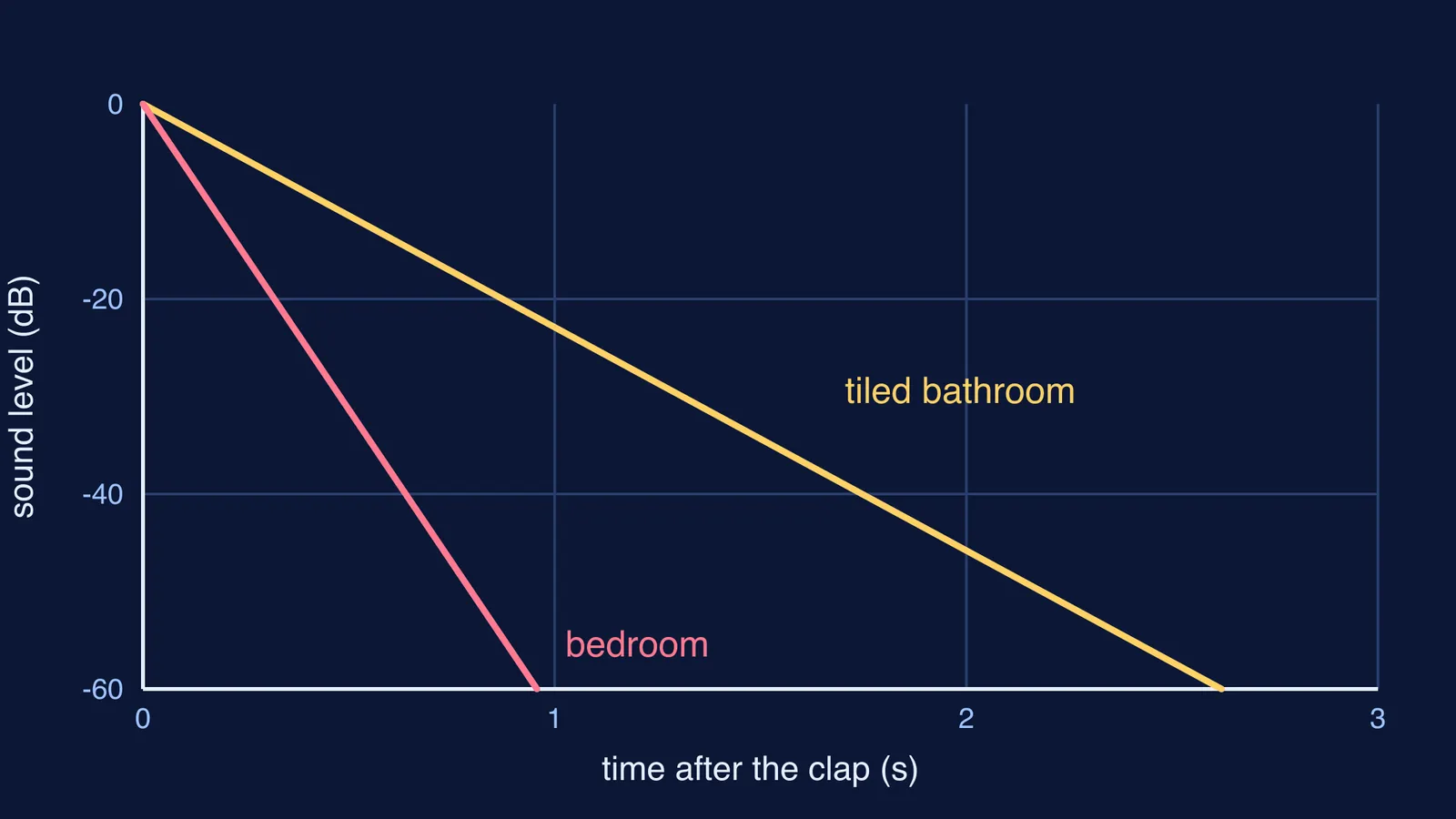
Reverberation time is the time it takes a sound to fade to 60 decibels below its starting level (HyperPhysics). The Sabine formula estimates it as RT = 0.161V ÷ A, where V is the room's volume in cubic metres and A is the total absorption, each surface's area multiplied by its absorption coefficient (HyperPhysics).
Here is a worked example using the 1000 Hz values above, plus HyperPhysics' 0.05 for ordinary plaster.
Bathroom, 2 m × 1.5 m × 2.7 m: V = 8.1 m³. Walls, floor and ceiling add up to 24.9 m², all hard (0.02), so A = 24.9 × 0.02 ≈ 0.50. RT ≈ 0.161 × 8.1 ÷ 0.50 ≈ 2.6 s.
Bedroom, 3.5 m × 3 m × 2.7 m: V ≈ 28.4 m³. Plaster walls and ceiling (45.6 m² at 0.05) give 2.28, a 6 m² rug (0.4) gives 2.4, and 4.5 m² of bare floor (0.02) gives 0.09, so A ≈ 4.77. RT ≈ 0.161 × 28.4 ÷ 4.77 ≈ 0.96 s.
The bedroom is more than three times bigger, yet its sound dies away in well under half the time. The rug alone supplies about half the absorption.
How can you compare rooms at home with a clap test?
You need a phone with a voice recorder app that shows the waveform, and a quiet house.
Stand in the middle of the room and record one sharp clap, then stay silent.
Do the same in the bathroom, your bedroom, the kitchen and a stairwell if you have one.
Look at each waveform. The tall spike is the clap; the tail after it is reverberation. Use the app's timeline to note when the tail flattens.
For each room, note the tail length and the hard and soft surfaces you see.
Hang two thick towels in the bathroom, clap again, and compare.
The longest tail should come from the most tiled, emptiest room and the shortest from the room with the most fabric. Our post on why empty rooms echo explains why moving furniture out makes a flat ring.
Why do curtains and carpets make a room sound dead?
Soft materials have much higher absorption coefficients than tile, so less sound comes back: in the SFU absorption table, velour drapes hung 4 inches from a wall absorb 0.52 of the sound at 1,024 Hz. That raises A in the Sabine formula and shortens the ring. The Class 9 answer is the same: reverberation in a big hall is reduced by covering walls and ceilings with absorbent materials such as curtains (NCERT-based Class 9 Sound notes).
The story of how this formula was found is in our profile of Wallace Sabine and reverberation time. For the full chapter, see our Class 9 sound guide.
If standing waves are hard to picture from a formula, the Fermi Simulation Lab has interactive simulations for ideas that are easier to see than to read.
Tonight, take your phone into the bathroom, clap once, and look at the tail.