On this page
On a dark night, a thin line of light flashes across the sky and is gone. That shooting star is not a star. It is a speck of rock or dust meeting Earth's air at enormous speed, and all that kinetic energy has to go somewhere. Much of it ends up as heat.
What is a shooting star, exactly?
A meteoroid is a solid natural object roughly 30 micrometres to 1 metre across, moving in or coming from interplanetary space; the International Astronomical Union set this definition in 2017 (Matlovič and Tóth, introduction to meteor astronomy). The streak of light it makes in the air is the meteor. Anything that survives to the ground is a meteorite.
Many visible meteors come from particles between a grain of sand and a small pebble in size, according to the American Meteor Society.
Why do shooting stars burn up in the atmosphere?
Because they arrive so fast. Meteoroids typically enter Earth's atmosphere at about 11 to 72 km/s (American Meteor Society). Radar measurements put the average between 25 and 30 km/s, according to a review by Elizabeth Silber and colleagues (Silber et al., 2018).
From the meteoroid's point of view, air molecules come at it at its own speed and slam into its front face, handing over energy as heat. When the surface reaches about 2000 K, roughly the boiling point of the material, it starts to evaporate, a process called ablation (Matlovič and Tóth).
The same authors say most meteor light comes from evaporated meteoroid atoms, glowing in an envelope of hot, ionised air and rock vapour. Nothing is burning in the chemical sense, the way wood burns in oxygen. Most visible meteor activity happens about 80 to 120 km above the ground (American Meteor Society).
Is it friction or compressed air?
It is often described as friction, but the real picture depends on size and height (Silber et al., 2018):
Very high up, where the air is thin: molecules strike one at a time. These high-energy collisions knock atoms off the surface, a process called sputtering, and heat the meteoroid directly.
Bigger meteoroids, about 4 mm and up, lower down: air piles up in front faster than it can flow aside, forming a shock wave, a thin layer of squeezed, very hot gas.
Squeezing a gas quickly raises its temperature. Our post on finding temperature after adiabatic compression shows the formula. The same physics heats a returning capsule, as in why spacecraft heat up on reentry.
How much energy does a one-gram meteoroid carry?
Take a 1 g pebble at 30 km/s, close to the radar average.
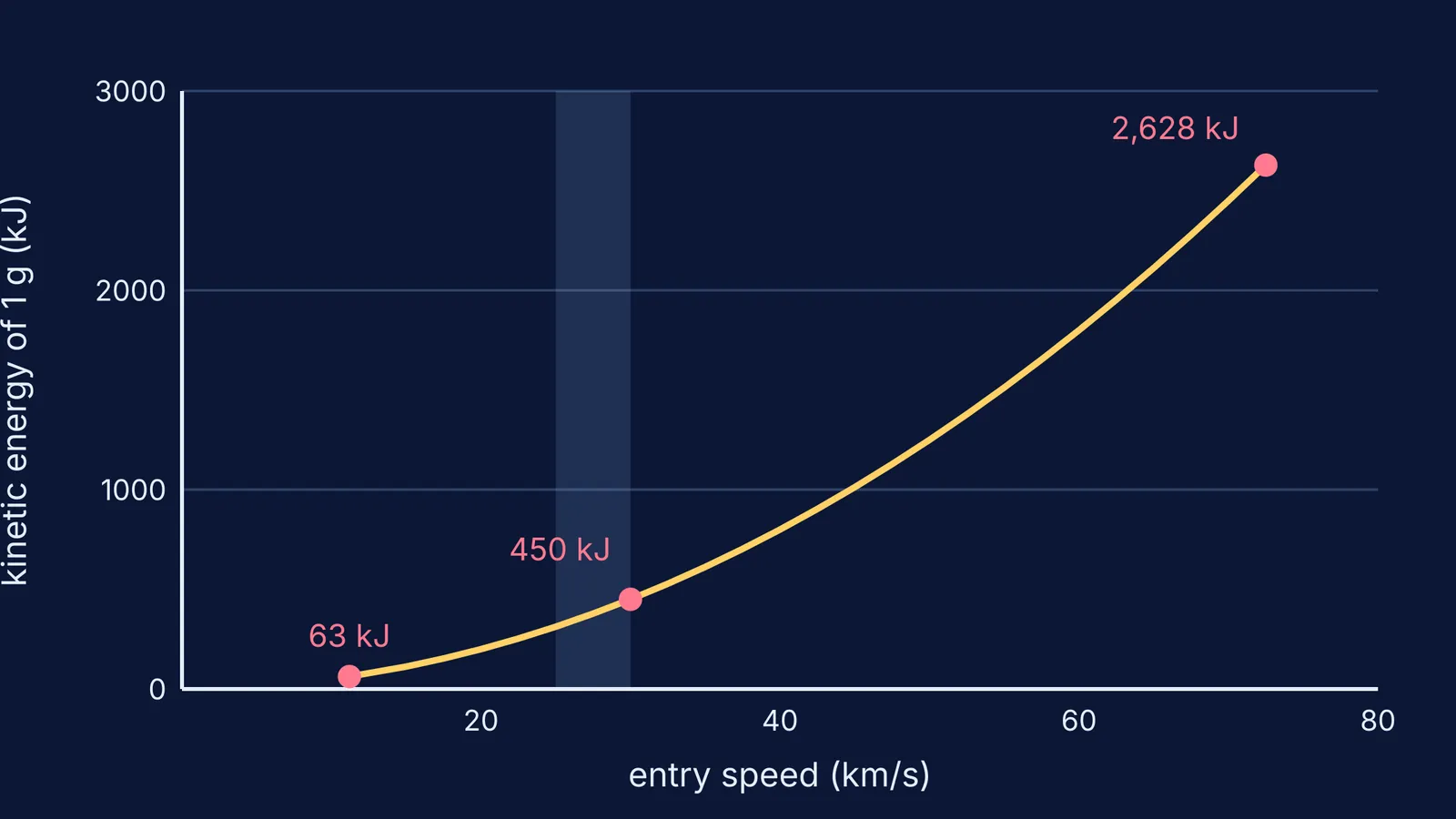
Kinetic energy: KE = ½mv² = ½ × 0.001 kg × (30,000 m/s)² = 450,000 J, or 450 kJ. If ½mv² feels like magic, see how F × s becomes ½mv².
Compare it with an explosive. By convention, one gram of TNT releases 4,184 J (TNT equivalent). So 450,000 ÷ 4,184 means the pebble carries the energy of about 108 g of TNT, just from its motion.
Now change the speed. KE grows with v², so the same gram carries about 63 kJ at 11.2 km/s and about 2,628 kJ at 72.5 km/s, the two ends of the entry-speed range in the Silber review. That is 6.5 times the speed and about 42 times the energy. The chart at the top of this post plots this curve.
Zoom in to one molecule. A nitrogen molecule is 28 u, with 1 u = 1.6605 × 10⁻²⁷ kg (NIST), so 4.65 × 10⁻²⁶ kg. At 30 km/s it carries about 2.1 × 10⁻¹⁷ J. A molecule at room temperature (about 300 K) has (3/2)kT ≈ 6.2 × 10⁻²¹ J, with k = 1.380649 × 10⁻²³ J/K (NIST). Each incoming molecule hits with more than 3,000 times that energy.
Silber and colleagues note that the energy needed to vaporise a meteoroid completely is several orders of magnitude smaller than the kinetic energy that collisions with air deliver (Silber et al., 2018). An ablating meteoroid receives far more energy than it needs to boil away.
If you struggle to picture energy flowing from moving air into a hot surface, the Fermi Simulation Lab has interactive simulations for ideas that are easier to see than to read. To practise ½mv² problems like the one above, the Fermi Problem Library has worked problems with a step-by-step solver that explains the reasoning.
Why do some meteors reach the ground?
Size, speed and strength all matter. Particles 0.1 to 10 cm across ablate between about 70 and 100 km up, while metre-sized bodies go much deeper before they give up most of their energy (Silber et al., 2018). The Chelyabinsk meteor of 2013 blew apart 23 km above the ground, and meteorites that survive are typically between pebble and fist size (NASA). Their outer layer melts on the way down, forming a fusion crust.
Next time you see a streak, try a rough estimate: guess a mass, pick a speed between 11 and 72 km/s, and work out ½mv².