

On this page
Why is atmospheric reentry so hot?
When an orbiter returns from low Earth orbit, it travels at approximately 7.8 kilometres per second (roughly 28,000 kilometres per hour, as documented in NASA's International Space Station flight profile). To reach the ground safely, that speed must drop to zero. As students preparing for exams like JEE learn from Émilie du Châtelet's kinetic energy relation, kinetic energy scales with the square of velocity: KE = ½mv².
For a single kilogram of returning spacecraft:
Orbital velocity: v = 7,800 m/s
Kinetic energy per kilogram: KE/m = ½ × (7,800)² ≈ 30.4 MJ/kg
By comparison, detonating one kilogram of TNT releases roughly 4.2 megajoules, and vaporizing one kilogram of liquid water requires 2.26 megajoules. Each kilogram of an orbiting spacecraft carries more than 7 times the energy of TNT. The work-energy theorem states that atmospheric drag must perform -30.4 megajoules of mechanical work per kilogram to stop the vehicle. That work turns kinetic energy into thermal energy. You can see how mechanical work and energy exchange across reference frames in the Fermi Simulation Lab.
Is reentry heating caused by friction or compression?
The most common misconception in aerospace physics is that spacecraft heat up because of friction—the rubbing of air against the vehicle's hull. In reality, surface friction contributes only a small fraction of the heat. The primary driver is rapid gas compression.
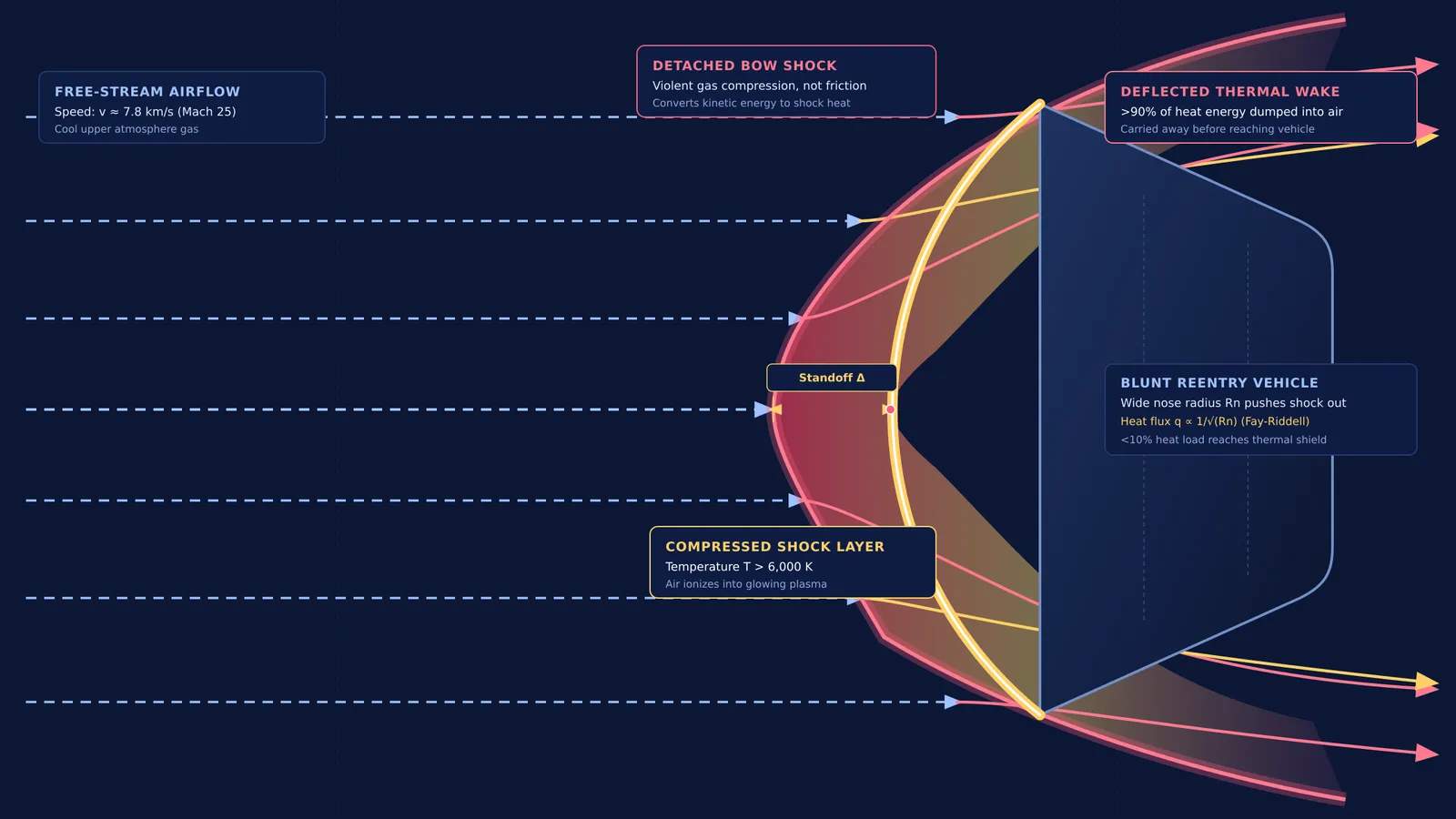
In the upper atmosphere, sound waves travel at roughly 300 metres per second. A returning spacecraft travels at Mach 25, more than twenty times faster. Because the craft outruns the pressure waves that would warn air molecules ahead, the air cannot flow smoothly around it. As detailed in NASA SP-252, the vehicle violently compresses the oncoming gas like a piston, forming a detached bow shock wave.
Across this shock wave, the gas undergoes extreme adiabatic compression. In thermodynamics, as seen in heat capacity and thermodynamic work equations, compressing a gas without heat loss raises its internal energy: ΔU = -W. The work done on the air drives its static temperature above 6,000 kelvins—hotter than the surface of the Sun. This intense heating breaks oxygen and nitrogen molecules into separate atoms and ionizes them into a glowing plasma sheath that temporarily blocks radio communications.
Why are spacecraft shaped like blunt capsules instead of needles?
Intuition might suggest shaping a spacecraft like a needle to slice cleanly through air. In the early 1950s, engineers assumed slender shapes were necessary until H. Julian Allen and A. J. Eggers, Jr. re-examined the problem at NACA.
In NACA Report 1381, Allen and Eggers showed that a pointed nose attaches the shock wave directly to the vehicle's skin. In an attached shock, the thin boundary layer—the fluid interface explored in Ludwig Prandtl's pioneering work on fluid boundary layers—conducts an unbearable fraction of the shock's heat into the hull, melting the structure.
Allen and Eggers discovered that a blunt, rounded nose forces the shock wave to detach, sitting ahead of the vehicle by a standoff distance Δ. This bow shock dumps more than 90% of the converted thermal energy into the surrounding air, which flows around the vehicle and dissipates into the wake.
In 1958, J. A. Fay and F. R. Riddell quantified this mechanism in their paper on stagnation point heat transfer in dissociated air. The Fay-Riddell equation proved that convective heat flux q is inversely proportional to the square root of the nose radius: q ∝ 1/√(R_n). A wider, blunter nose spreads the stagnation zone and lowers peak heating. Students exploring multi-step thermodynamics problems can practice breaking down energy fluxes in the Fermi Problem Library.
How do heat shields survive the shock layer?
Even with a detached bow shock dumping most energy into the wake, the remaining heat would melt standard aerospace alloys. Spacecraft survive using two thermal protection systems:
Ablative shields: Used on capsules such as Apollo, Orion, and SpaceX Dragon, ablative shields employ porous resins that absorb heat through chemical decomposition. As the material chars, it turns into gas and blows outward into the boundary layer, blocking incoming heat and carrying energy away.
Radiative and insulating tiles: Used on the Space Shuttle and experimental spaceplanes, these materials have ultra-low thermal conductivity and high emissivity. The European Space Agency's Intermediate eXperimental Vehicle (IXV) demonstrated this during its 7.5-kilometre-per-second reentry, using Carbon-Silicon Carbide ceramic panels to withstand 1,700 °C while keeping interior electronics safe.


