

On this page
A solar panel in space gets more sunlight than one on your roof in Delhi, because there is no air or cloud in the way. So why do satellites, from the International Space Station to India's GSAT communication satellites, also carry batteries? The answer is the orbit itself: the satellite keeps passing behind Earth, into its shadow.
Why do satellites need batteries if they have solar panels?
Sunlight near Earth carries about 1361 watts per square metre, according to NASA's Earth fact sheet. That is plenty, but only while the panels can see the Sun.
NASA's overview of the ISS electrical power system lists the arrays as "Intermittent power (90 minute orbit, 30 minute eclipse)" and says the batteries "Supply power during eclipse periods." A NASA technical report on the station's lithium-ion batteries describes the cycle in one line: the solar arrays charge batteries during insolation (sunlight) for discharge during eclipse.
That cycle repeats often. In 24 hours the station makes 16 orbits and passes through 16 sunrises and 16 sunsets, according to NASA's space station facts page. Without a battery, the lights, computers and life support would cut out 16 times a day.
How long is a satellite in Earth's shadow?
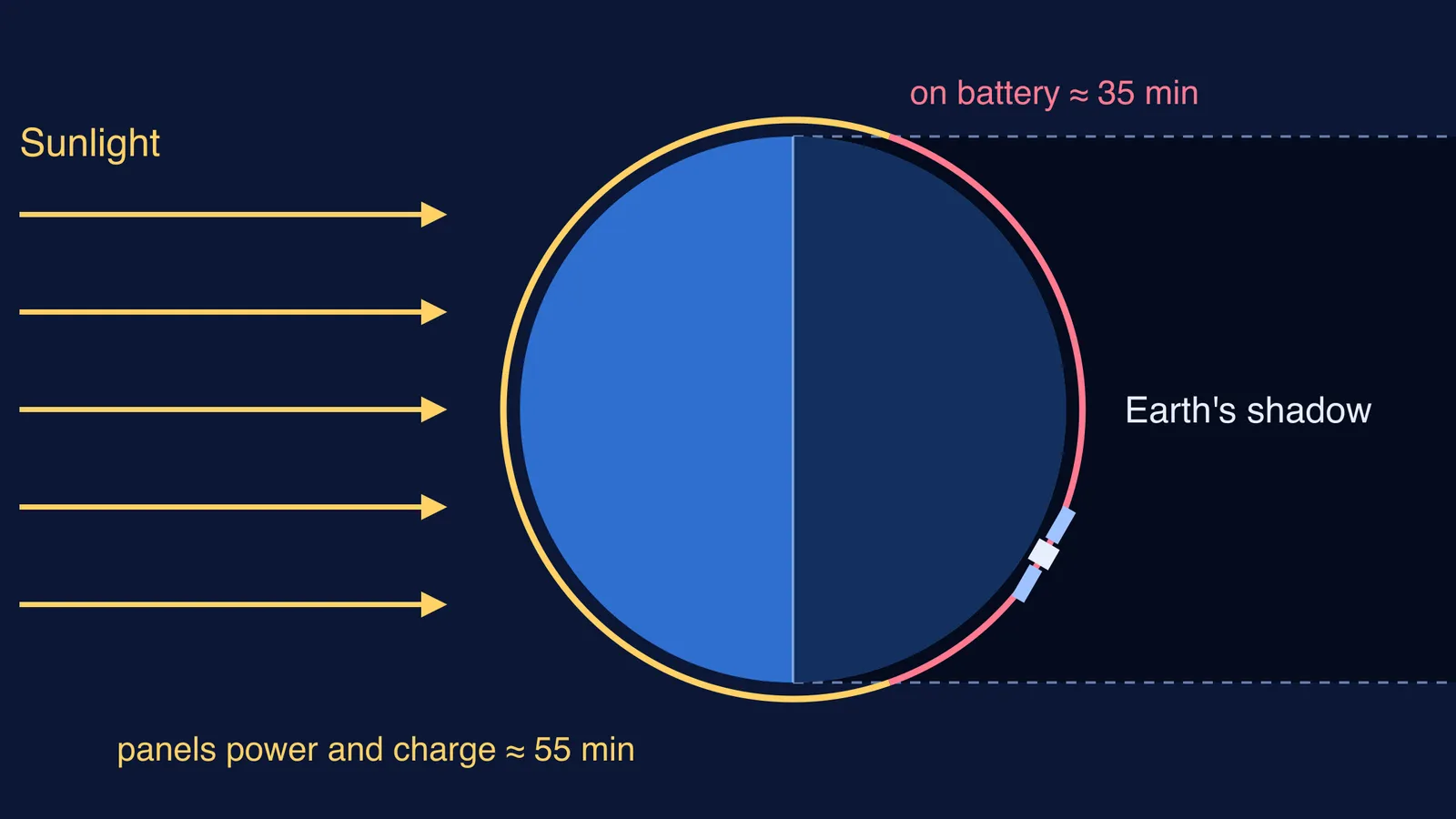
You can work this out with Class 11 trigonometry. Treat Earth's shadow as a cylinder as wide as Earth, and take the simplest case: a circular orbit whose plane contains the Sun. The satellite is in shadow on the night side whenever it is closer to the shadow's axis than Earth's radius R. If the orbit radius is r, the shadowed arc spans 2 × arcsin(R/r) out of 360 degrees.
Earth's mean radius is 6371 km (NASA), and NASA's ISS power overview gives the station's altitude as about 240 miles, roughly 386 km.
Low orbit (ISS): r = 6371 + 386 = 6757 km, so R/r = 0.943 and arcsin(0.943) is about 70.6 degrees.
Shadowed fraction: 141 / 360, about 39 percent. Of a 90-minute orbit, that is about 35 minutes in darkness, close to NASA's stated 30 minutes (the real orbit is usually tilted relative to the Sun, which shortens the eclipse).
Geostationary orbit: the altitude is 35 786 km and one orbit takes 23 hours 56 minutes (ESA), so r = 42 157 km and R/r = 0.151. The shadowed arc is about 17.4 degrees, or about 69 minutes a day.
That last number matches what operators see. CelesTrak's explainer on geostationary orbit says these satellites can spend as much as 70 minutes of every day in shadow, but only in eclipse seasons around the equinoxes, from late February to mid-April and from early September to mid-October. The rest of the year, Earth's tilt means the shadow passes above or below them. Even so, they need a battery for that hour: ISRO's GSAT-10 page lists two 128 Ah lithium-ion batteries alongside its solar array.
How big does a satellite battery need to be?
Here is a worked example for an imaginary small satellite in a 90-minute low orbit, using the shadow time from the section above.
Load: the satellite needs 100 W all the time.
Energy for the shadow: 100 W × 35/60 h = 58 Wh.
Battery size: engineers avoid draining a battery fully. The ISS's original nickel-hydrogen batteries were designed for a maximum 35% depth of discharge in normal operation, according to the NASA battery report. At that limit, 58 Wh needs a battery of about 167 Wh.
Panel power: in the remaining 55 minutes of sunlight the panels must run the 100 W load and put back 58 Wh, which takes 58 / (55/60) = 64 W more. That is at least 164 W, before charging losses.
Panel area: if the cells convert 30% of sunlight (an assumption for this example), 164 W / (0.30 × 1361 W/m²) is about 0.4 m².
Notice what the battery does to the design: the panels are sized for about 1.6 times the actual load, only because of the shadow.
What does this teach you about orbits and energy?
This one question links three chapters you study separately. Orbits decide how long the dark stretch lasts. The photoelectric effect explains how light frees electrons in a solar cell; our post on why brighter light doesn't give faster photoelectrons covers that step. Cell chemistry explains what the battery stores, as in why AA batteries are 1.5 volts. Matching supply and demand is the same problem behind why your lights dim when the AC starts.
The shadow geometry is easier to see than to read. The Fermi Simulation Lab has interactive simulations for ideas like this, and if a step in the calculation trips you up, the Fermi Problem Library has a step-by-step solver that explains the reasoning rather than printing an answer.


