

On this page
At night on a highway, a sign far ahead looks lit from inside while the trees beside it stay dark. The sign has no bulb. It is sending your own headlight beam back to you, using Class 10 and Class 12 optics.
What is a retroreflector?
A retroreflector is a surface that sends light back towards where it came from, over a wide range of angles. An ordinary mirror sends slanting light off at the same slant on the other side, away from you. A matt white wall scatters light everywhere, so little of it reaches your eyes. Our post on regular and diffuse reflection explains both.
Your eyes sit close to your headlights, so light returned to the headlights also reaches you. That is why a sign looks bright to the driver and dull to someone on the pavement. Reflective paint usually contains tiny glass beads, and signs and tape can use thin plastic with microscopic corner reflectors (corner reflector, Wikipedia).
How do glass beads send light back to the driver?
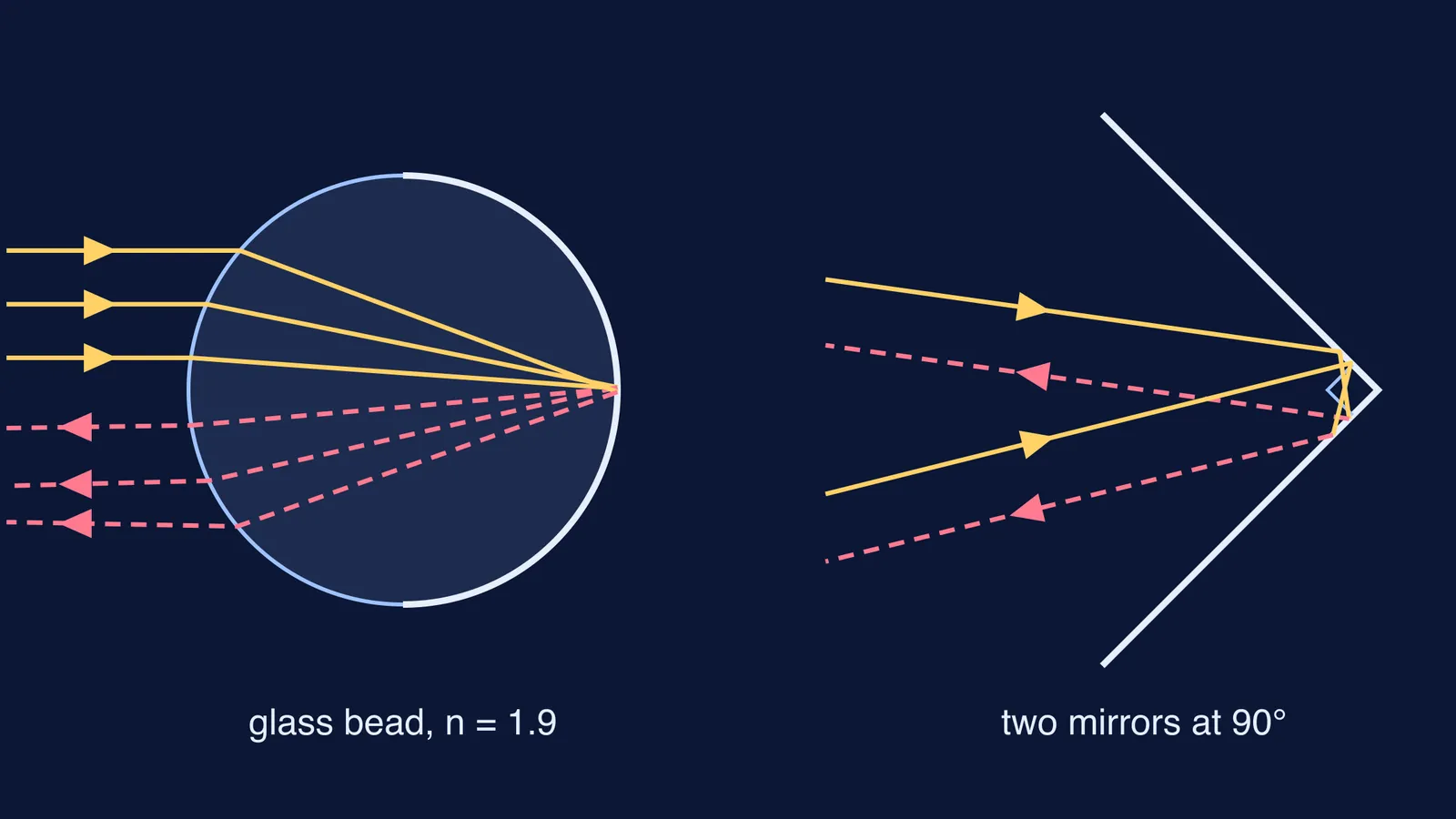
Each bead is a tiny lens with a reflective layer behind it. Light enters, bends towards the axis, focuses at the back, bounces off the reflective layer and leaves travelling back the way it came.
This only works if the focus lands on the back surface, and that depends on the glass. A US patent on glass microspheres for road markers and signs says that as the refractive index rises from about 1.5, the focus moves closer to the rear surface, reaching it at a refractive index of approximately 1.9 (US patent 5,576,097).
Worked example: what refractive index does a bead need?
You can check that number with one Class 12 formula for refraction at a spherical surface: n2/v − n1/u = (n2 − n1)/R. Use the sign convention from our post on refraction through a glass sphere.
Headlight rays arrive almost parallel, so u = −∞ and the n1/u term vanishes.
Light goes from air (n1 = 1) into glass (n2 = n) at a front surface of radius +R, so v = nR/(n − 1).
The back of the bead is 2R from the front. Setting v = 2R gives n/(n − 1) = 2, so n = 2.
Ordinary glass, n = 1.5, gives v = 3R: the focus falls a whole radius behind the bead, and the returning light spreads out.
Our answer of 2 uses the near-axis (paraxial) approximation. Rays entering nearer the edge focus slightly short, so real beads work best a little below 2, which fits the patent's figure of about 1.9. For the diagram at the top of this post, we traced rays through an n = 1.9 bead with Snell's law: rays entering between 15% and 65% of the radius from the axis came back within about 1.5° of their arrival direction.
How do corner prisms and cat's eyes work?
The second design uses three flat mirrors meeting at right angles, like the inside corner of a box. Each reflection flips one component of the ray's direction, so a ray travelling along [a, b, c] leaves along [−a, −b, −c], exactly reversed (corner reflector, Wikipedia). Car and bicycle tail lights are moulded with arrays of these small corners, according to the same source.
In two dimensions, two plane mirrors at angle θ turn a ray through 360° − 2θ, which is 180° when θ = 90°; our post on deviation by plane mirrors works through it.
The same idea sits on the Moon. Apollo 11 astronauts left a panel of 100 corner-cube prisms, each 3.8 cm across, and Apollo 15 left 300, so laser light fired from Earth comes straight back (UCSD lunar retroreflector page).
The road studs called cat's eyes come from Percy Shaw of Halifax, England, who patented them as Catseyes in 1934. His stud had a rubber cushion that closed over the glass like an eyelid when a tyre ran over it, keeping it clean (Calderdale Museums).
Real cats' eyes shine for a related reason. The tapetum lucidum, a layer just behind the retina, works as a retroreflector, which is why the pupil seems to glow in a torch beam (tapetum lucidum, Wikipedia).
How can you test this at home?
You need a torch and a bicycle reflector, or the reflective strip on a school bag.
Stand a few metres away and hold the torch right beside your eye. The reflector looks bright.
Keep looking from the same spot but move the torch out to arm's length. The reflector goes dull, because the light is going back to the torch, not to you.
Tilt the reflector a little. A mirror would throw the beam aside; the reflector keeps sending it back.
For ideas easier to see than read, the Fermi Simulation Lab has interactive simulations, and the Fermi Concept Library gives every physics concept its own lesson.
Next time a sign lights up in the dark, you will know the light was yours all along.


