

On this page
Ask anyone to draw a raindrop and you will get the same shape: round at the bottom, pointed at the top. Falling rain almost never looks like that. Real drops are spheres when they are small and flattened buns when they are big. The reason is a tug of war between two forces you meet in Class 11 physics: surface tension and air resistance.
Are raindrops really tear-shaped?
No. NASA's Global Precipitation Measurement team says raindrops are shaped like the top of a hamburger bun, round on the top and flat on the bottom. The US Geological Survey makes the same point on its page Are raindrops shaped like teardrops?: small drops are spheres and larger ones look more like a bun.
The pointed shape probably comes from a drop hanging from a tap or leaf tip, stretched by its own weight. Once it falls freely, nothing holds its top, so the tip disappears.
Why are small raindrops round?
Surface tension. Water molecules attract each other more strongly than they attract air, as NASA's raindrop explainer puts it, so the surface behaves like a stretched skin that pulls inwards. A sphere has the smallest surface area for a given volume, so a drop left to itself becomes a sphere.
Smaller drops hold that shape more firmly. The extra pressure inside a drop is 2T/r, where T is surface tension and r is the radius, so halving the radius doubles the pressure keeping the drop round. Our post on excess pressure in a drop and a soap bubble works through that formula.
In a 1970 wind-tunnel study, H. R. Pruppacher and K. V. Beard found that drops with an equivalent radius below 140 micrometres showed no deformation from a sphere they could detect, while drops from 140 to 500 micrometres were only slightly squashed.
Why do big raindrops flatten like a bun?
Air resistance. USGS describes a tug of war between surface tension and the pressure of air pushing up against the bottom of the drop. Bigger drops fall faster, so the air pushes harder on their underside. The bottom flattens and can even dip inwards. NASA notes it can look like a kidney bean.
There is a size limit. According to NASA, drops that grow larger than 4.5 millimetres become distorted into a parachute shape and then break up into smaller drops. USGS describes the same thing: the dip grows almost explosively into a bag with a ring of water around it, which then bursts.
For the maths of falling drops, see terminal velocity when small drops merge into one and the work done by air resistance on a falling raindrop.
How flat is a raindrop? A worked example
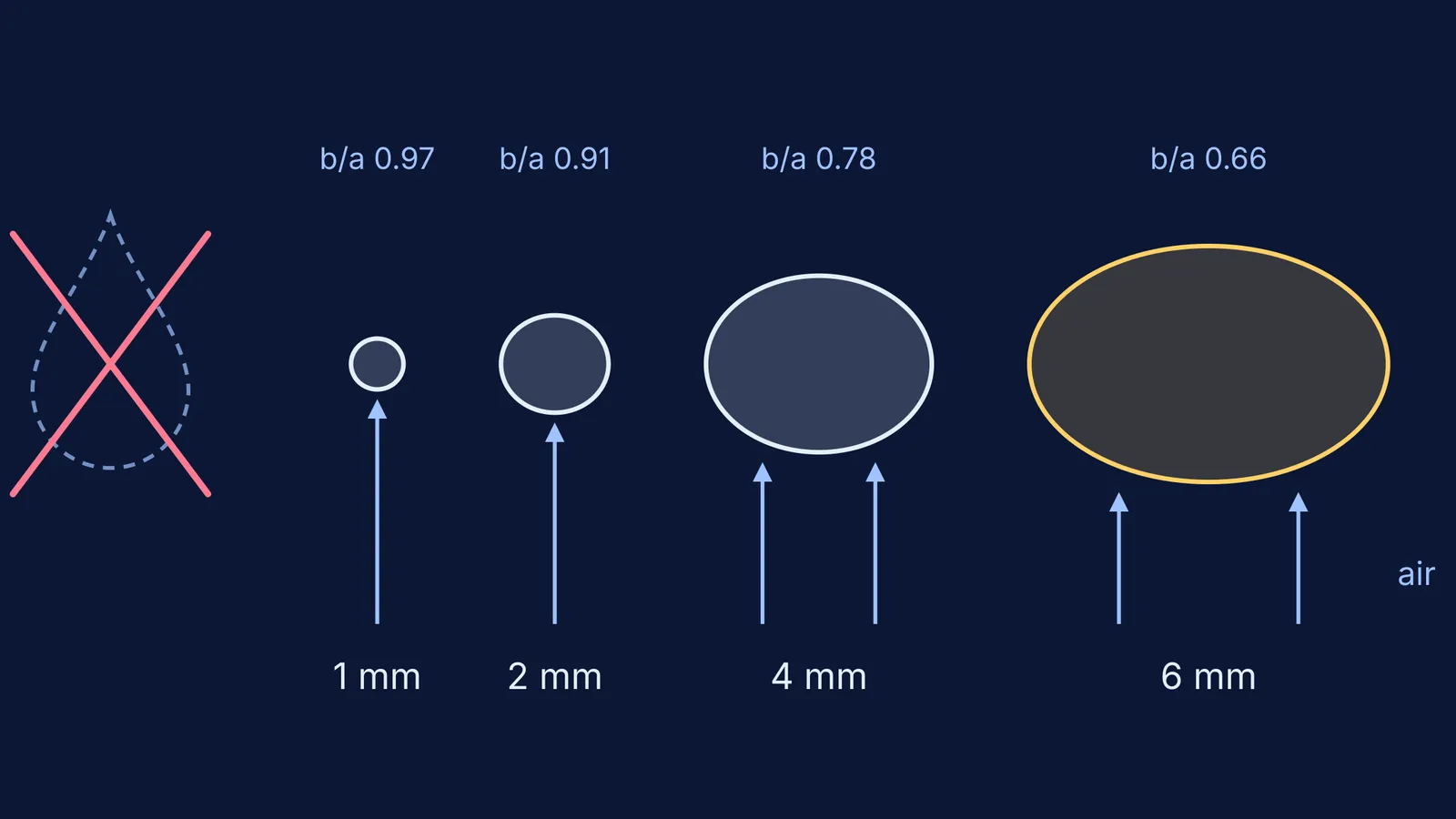
Meteorologists describe a drop's flatness by its axis ratio, b/a: height divided by width. A sphere has b/a = 1. A widely used fit to wind-tunnel data, credited to Pruppacher and Beard (1970) in a radar paper by Chandrasekar, Gorgucci and Bringi, is b/a = 1.03 − 0.062D, where D is the drop's diameter in millimetres, valid for drops from 1 to 9 mm.
Put in some numbers:
D = 1 mm: b/a = 1.03 − 0.062 = 0.97. Almost a sphere.
D = 2 mm: b/a = 1.03 − 0.124 = 0.91.
D = 4 mm: b/a = 1.03 − 0.248 = 0.78. The drop is about 22% shorter than it is wide.
D = 6 mm: b/a = 1.03 − 0.372 = 0.66. Only two-thirds as tall as it is wide.
Now compare surface tension. A drop of radius 0.5 mm has six times the excess pressure (2T/r) of a drop of radius 3 mm, because 3 ÷ 0.5 = 6. As drops grow, the inward pull that keeps them round weakens while the air pushing on them strengthens. The fit treats the drop as a squashed ellipse, so it smooths over the flat bottom you see on real large drops.
A tug of war like this is easier to see than to read, which is what the Fermi Simulation Lab and its interactive simulations are for.
How do you explain raindrop shape in an exam or viva?
This four-step answer covers it:
Name the forces: surface tension pulls the drop into a sphere, and air pressure pushes up on its underside.
Small drops: surface tension wins, because excess pressure 2T/r is large when r is small.
Large drops: they fall faster, air pressure wins, and the bottom flattens into a bun.
Very large drops: the flat base caves into a bag, which bursts into smaller drops.
Two slips to avoid:
Saying gravity stretches a falling drop into a tear. It is the air below that does the shaping.
Mixing up radius and diameter. USGS quotes radius and NASA quotes size, so check which one a question means.
If surface tension itself feels shaky, the Fermi Concept Library gives each concept in physics its own lesson and shows where it sits in the map.


