

On this page
A falling raindrop feels its weight pulling down and air resistance (drag) pushing up. At steady speed the two are equal, and that one fact tells you exactly how much work drag does.
What work does air resistance do on a falling raindrop?
At terminal speed, air resistance does negative work equal in size to the work done by gravity: over a fall of height h, drag does −mgh. OpenStax University Physics describes terminal velocity as the state where the drag force equals the weight, mg = F_D, so the velocity stays constant. Drag points against the motion, so its work is negative; gravity's work is +mgh.
Gravity's work is also the drop's loss of potential energy. In OpenStax's section on potential energy, the change in gravitational potential energy is the negative of the work done by gravity, ΔU = −W. So you can say it in one line: at terminal speed, drag does negative work equal to the drop in potential energy.
Why doesn't the kinetic energy change at terminal speed?
The work-energy theorem states that the net work done on a particle equals the change in its kinetic energy (OpenStax, section 7.3). At terminal speed the net work is mgh + (−mgh) = 0, so ΔK = 0. The speed, and with it the kinetic energy, stays fixed.
The same idea in energy language: OpenStax section 8.3 says the change in mechanical energy (K + U) equals the work done by non-conservative forces such as drag. With K constant and U falling by mgh, the mechanical energy falls by exactly the work drag does. That energy leaves the drop and goes into the surrounding air.
How much energy does drag take from a real raindrop?
Large raindrops about a quarter of an inch (roughly 6 mm) across fall at about 10 m/s, according to the Weather Guys at the University of Wisconsin–Madison. NASA's Global Precipitation Measurement mission also puts the maximum, for the largest drops, at about 10 m/s. Treat the drop as a sphere of radius 3 mm (real large drops are flattened, but this is close enough), with water's density of about 1 g/cm³ from the USGS Water Science School and g = 9.8 m/s² as OpenStax uses.
Volume: V = (4/3)πr³ = (4/3)π(3 × 10⁻³ m)³ = 1.13 × 10⁻⁷ m³.
Mass: m = ρV = 1000 kg/m³ × 1.13 × 10⁻⁷ m³ = 1.13 × 10⁻⁴ kg, about 0.11 g.
Weight: mg = 1.11 × 10⁻³ N. At terminal speed the drag force is the same size, pointing up.
Kinetic energy at 10 m/s: K = ½mv² = ½ × 1.13 × 10⁻⁴ × 10² = 5.7 × 10⁻³ J.
Last 1 km of the fall at terminal speed: gravity does +mgh = 1.11 × 10⁻³ N × 1000 m = +1.11 J, drag does −1.11 J, net work is zero, so K is still 5.7 × 10⁻³ J at the ground.
Over that kilometre, drag removes about 200 times the drop's own kinetic energy, yet the speed never changes. Drag takes energy at a rate of F × v = 1.11 × 10⁻³ N × 10 m/s ≈ 0.011 W, exactly the rate at which gravity supplies it.
What happens before the drop reaches terminal speed?
Drag grows with speed: OpenStax section 6.4 gives F_D = ½CρAv², so at low speed it is much smaller than the weight. Before terminal speed, gravity does more positive work than drag does negative work, and the kinetic energy rises.
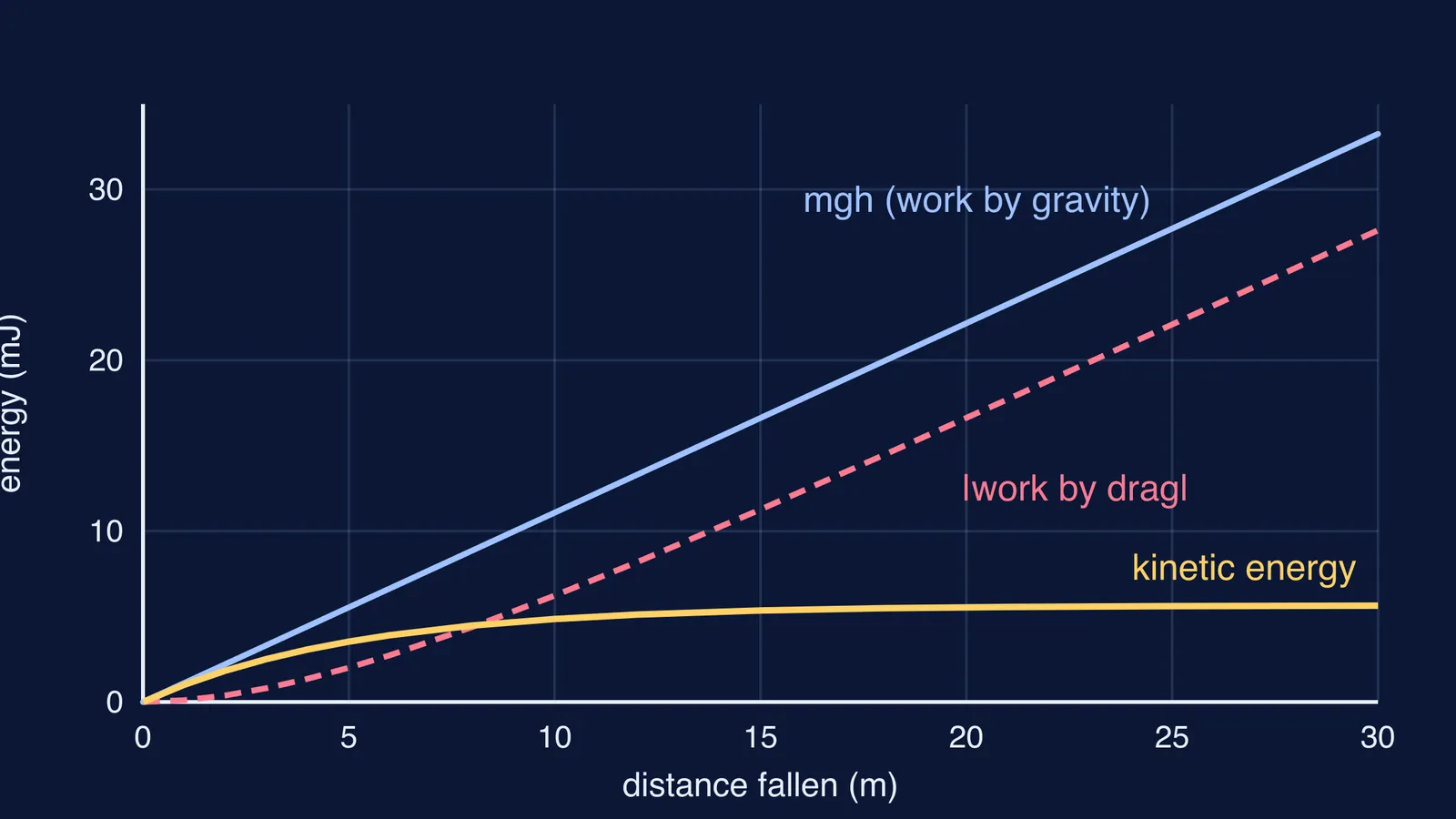
The diagram at the top shows this for our drop starting from rest, using that v² drag law with a 10 m/s terminal speed. In this model the kinetic energy reaches 95% of its final value within about 15 m. After that, the drag curve runs parallel to the gravity line: every extra metre of gravity's work is matched by drag.
How do you answer this in an exam?
For any body at terminal or constant speed:
Check the speed. If the question says terminal velocity or uniform speed, ΔK = 0.
Write gravity's work: W_g = +mgh, where h is the height fallen.
Apply the work-energy theorem: W_g + W_drag = ΔK = 0, so W_drag = −mgh.
Watch the sign. Drag opposes the motion, so its work is negative, and the loss of mechanical energy is mgh.
If the body is still speeding up, use W_drag = ΔK − mgh with the real starting and final speeds.
The most common slip is writing W_drag = 0 because the velocity is constant. Constant velocity means zero net work, not zero work by each force.
If you keep making this kind of sign or method mistake, the Fermi Problem Library has worked problems with a step-by-step solver that explains the reasoning rather than printing an answer. If the gap is the idea itself, the Fermi Concept Library gives each concept in physics its own lesson and its place in the map.
Next time it rains, remember that a large drop already at terminal speed a kilometre up lands with the same kinetic energy it had there.


