

On this page
When fluid mechanics problems ask what happens when mist or raindrops coalesce, students often assume that terminal velocity scales directly with mass or volume. If several identical droplets combine into a single larger drop, intuition might suggest a speed increase matching the combined volume. In reality, steady falling speed depends on the exact balance between downward gravitational pull and upward viscous drag.
Why is terminal velocity proportional to the square of the radius?
According to the NCERT Class 11 Physics textbook, when a spherical droplet falls through a viscous fluid such as air, it experiences three vertical forces. The downward driving force is its gravitational weight, W = mg = (4/3)πr³ρg, where r is droplet radius, ρ is liquid density, and g is gravitational acceleration. Acting upward is the buoyant force from displaced air, F_b = (4/3)πr³σg, where σ represents air density. Opposing downward motion is viscous drag.
In his classic 1851 investigation published in the Transactions of the Cambridge Philosophical Society, George Gabriel Stokes showed that a sphere moving through fluid at low velocity experiences a viscous drag force F_v = 6πηrv, where η is dynamic viscosity and v is instantaneous speed. As the falling drop speeds up, viscous drag increases until net vertical acceleration vanishes. This dynamic equilibrium defines terminal velocity:
W = F_b + F_v
(4/3)πr³ρg = (4/3)πr³σg + 6πηrv
Rearranging for terminal velocity v yields:
v = [2r²(ρ - σ)g] / (9η)
Because gravitational weight and buoyancy both scale with droplet volume (r³) while viscous drag scales linearly with droplet radius (r), dividing net weight by drag leaves terminal speed proportional to radius squared (v ∝ r²). This quadratic relationship governs how falling speed changes when droplets change size, a principle fundamental to surface tension and viscosity across capillary and falling-drop phenomena.
How does the droplet radius scale when n drops coalesce?
When n identical small droplets merge into a single larger drop, the principle of mass conservation—central to fluid statics in the NCERT Class 11 Physics textbook—dictates that the total volume of liquid remains constant. If each individual small droplet has radius r and volume (4/3)πr³, the total liquid volume before coalescence is n × (4/3)πr³. When they unite into one spherical drop of radius R, its volume is (4/3)πR³.
Equating the two volumes gives:
(4/3)πR³ = n × (4/3)πr³
R³ = n r³
R = n¹/³ r
The new radius equals the initial radius multiplied by the cube root of the droplet count:
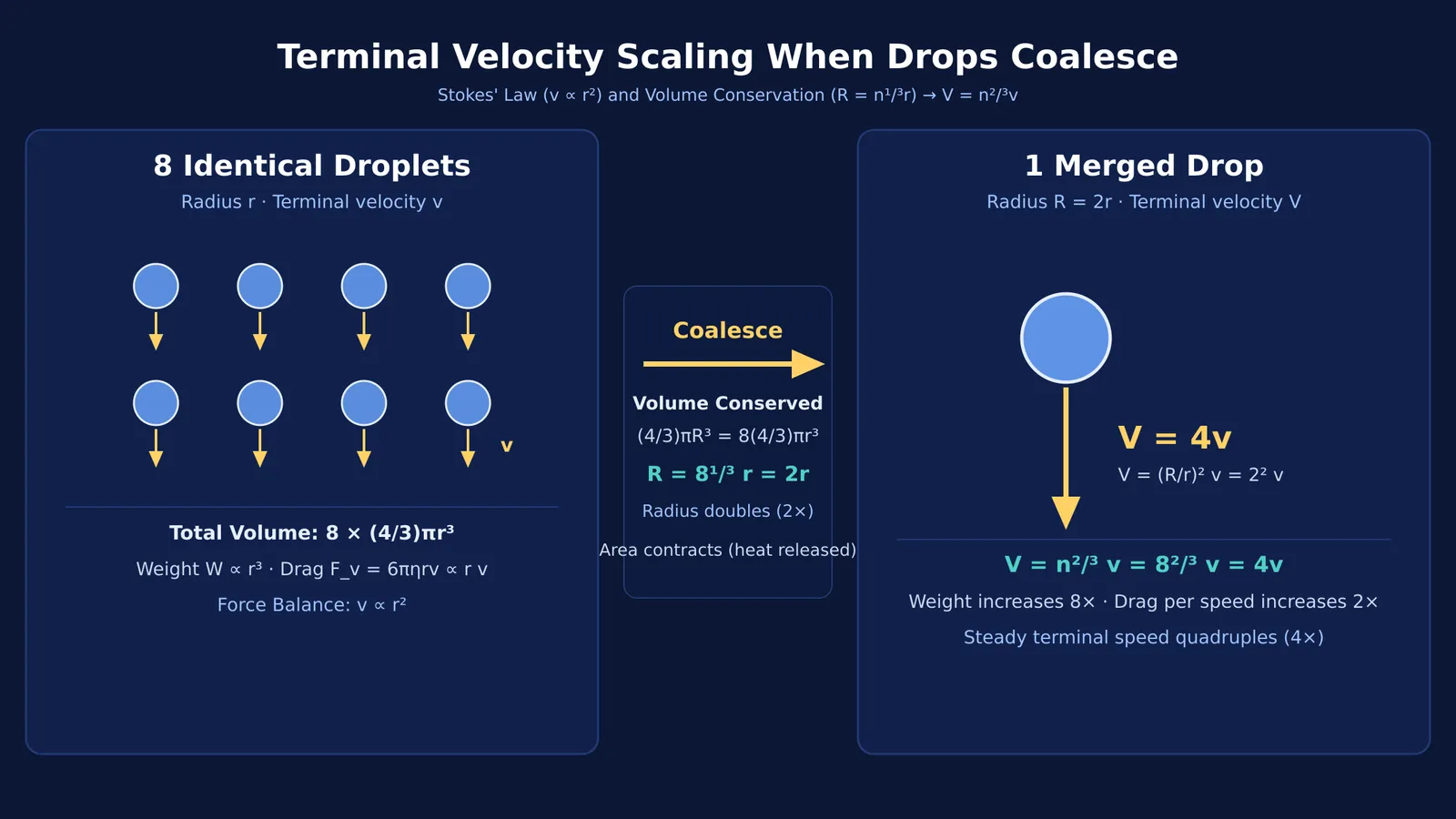
For n = 8, R = 8¹/³ r = 2r (radius doubles).
For n = 27, R = 27¹/³ r = 3r (radius triples).
For n = 64, R = 64¹/³ r = 4r (radius quadruples).
What is the terminal velocity when n small drops merge into one?
Because Stokes' hydrodynamic formulation in the Transactions of the Cambridge Philosophical Society establishes that terminal velocity is proportional to radius squared, comparing radii gives the terminal speed V of the merged drop directly:
V / v = (R / r)² = (n¹/³ r / r)² = n²/³
V = n²/³ v
This scaling law reveals the physical balance: combining n droplets increases total downward weight n times, but the larger drop's frontal radius only grows by n¹/³ times. Because drag per unit speed increases by n¹/³ while driving force increases by n, the drop must move n / n¹/³ = n²/³ times faster to restore force balance. Accounting for buoyant force and drag correctly is essential for avoiding common fluid mechanics and buoyancy mistakes.
How does this apply to standard exam numericals?
Problems involving coalescing droplets appear regularly in engineering entrance papers conducted by the National Testing Agency. Consider a standard question from JEE Main 2023: eight identical water droplets fall through still air, each reaching a terminal velocity of 10 cm/s. If the eight droplets merge into a single drop, what is the terminal velocity of the new drop?
You can solve this systematically in three steps:
Identify the droplet count: n = 8, with individual speed v = 10 cm/s.
Determine the merged radius ratio: R = 8¹/³ r = 2r.
Compute the velocity ratio: V = n²/³ v = 8²/³ × 10 cm/s = (2²) × 10 cm/s = 4 × 10 cm/s = 40 cm/s.
The terminal velocity quadruples to 40 cm/s. The same mechanical relationship proved vital in Robert A. Millikan's 1913 oil-drop experiment published in the Physical Review, where measuring the terminal velocity of microscopic falling drops enabled the first precise measurement of the elementary electric charge.
When practicing multi-step fluid mechanics problems, the Fermi Problem Library provides worked problems with a step-by-step solver that explains the reasoning rather than printing an answer.
What happens to the released surface energy?
Under thermal and surface phenomena detailed in the NCERT Class 11 Physics textbook, when small droplets coalesce into a single drop, total surface area decreases. Because liquid molecules at an interface possess excess potential energy from surface tension, reducing surface area releases surface energy as heat. Initial surface area for n droplets is n × 4πr², whereas the merged drop has surface area 4πR² = 4π n²/³ r². The surface area contracts by ΔA = 4πr² (n - n²/³), releasing surface energy:
ΔU = 4πTr² (n - n²/³)
Assuming no heat escapes, this energy warms the drop by Δθ = [3T(1 - n⁻¹/³)] / [r ρ s], where T is surface tension, ρ is density, and s is specific heat capacity. To see how acceleration decays toward terminal speed during this transition, read our guide on integrating variable acceleration as a function of velocity.
For a structured overview of fluid mechanics and Stokes' law alongside related topics, the Fermi Concept Library covers every concept in physics, chemistry, biology, mathematics and computing, each with its own lesson and its place in the map.


