

On this page
Drop beans or palak into boiling water and for a minute they look greener than ever. Leave them for twenty minutes and they come out a dull khaki. That change is one clean chemical swap, and once you understand it you can control it.
What makes a green vegetable green in the first place?
The colour comes from chlorophyll; our post on why leaves look green and what chlorophyll does with light covers the light side.
Chlorophyll a has the formula C55H72MgN4O5, according to the ChEBI chemical database of the European Bioinformatics Institute. Its core is a large flat ring built from four nitrogen-containing units, and a single magnesium ion sits in the middle, held by the four nitrogen atoms. That magnesium is the weak point. How chemists first showed it was there is the story of Richard Willstätter and the magnesium at the heart of chlorophyll.
Why do green vegetables turn olive when overcooked?
A 2008 study of green peas by Erge, Karadeniz, Koca and Soyer in the journal GIDA summarises the sequence from earlier research:
Heating releases acids held in the plant's cells, and new acids form.
In that acid, the magnesium in the chlorophyll ring is replaced by two hydrogen ions.
The product, pheophytin, is olive brown instead of green.
As an equation: chlorophyll (with Mg) + 2 H+ gives pheophytin + Mg2+.
Food chemists Aparicio-Ruiz, Riedl and Schwartz write that the most common colour changes of cooked, frozen or stored vegetables come from chlorophylls turning into pheophytins, which are "responsible for yellow-brown olive color". Keep heating and pheophytin loses another group to become pyropheophytin, also a dull olive brown, according to a summary of a 2018 Journal of Chromatography A study by its co-author Jordi Eras.
How fast does chlorophyll break down when greens are heated?
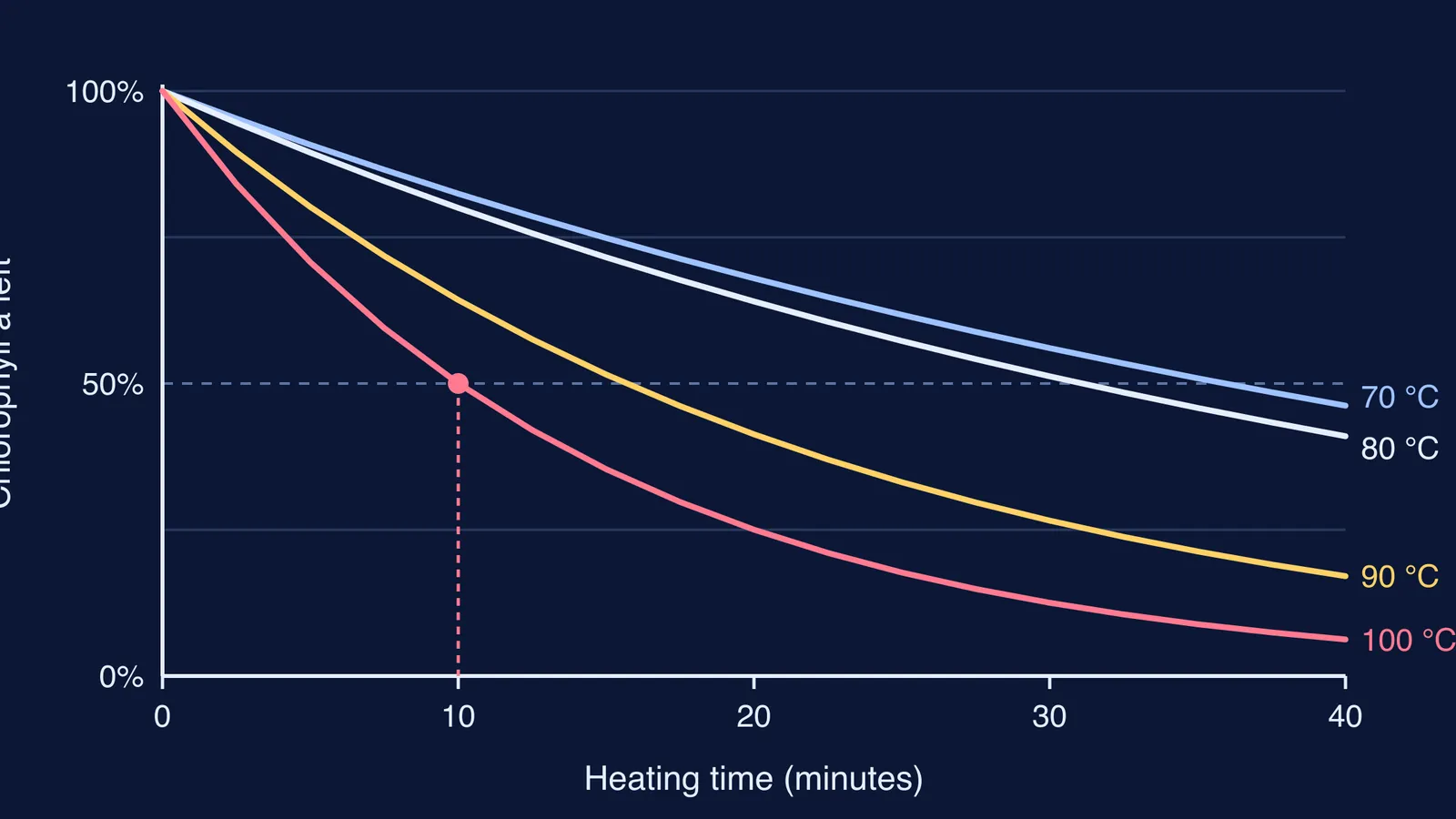
Erge and colleagues heated peas at 70, 80 and 90 °C in a water bath and at 100 °C in an oil bath, and measured both chlorophylls by HPLC. Both followed first-order kinetics, the same maths as radioactive decay. Chlorophyll a had a half-life of 35.91 minutes at 70 °C and 10.00 minutes at 100 °C. Chlorophyll a broke down 12 to 18 times faster than chlorophyll b, and since a is blue-green and b is yellow-green, the peas drifted towards yellow as they cooked.
How much chlorophyll is left after 5, 10 or 20 minutes?
For first-order decay, C = C0 × e^(−kt). The pea study's rate constant for chlorophyll a at 100 °C is k = 0.0693 per minute. Plug in:
After 2 minutes: e^(−0.139) ≈ 0.87, so about 87% remains.
After 5 minutes: about 71%.
After 10 minutes: 50%, one half-life.
After 20 minutes: 25%.
Each extra 10 minutes halves whatever chlorophyll a is left. These are lab numbers for peas, not spinach in your kadhai: treat them as a shape, not a timer. If the curve itself is hard to picture, the Fermi Simulation Lab has interactive simulations for ideas that are easier to see than to read.
How do you keep green vegetables bright green?
The University of Illinois Extension guide to cooking vegetables gives practical rules that match the chemistry:
Cook briefly, to crisp-tender. Less time at high temperature means less pheophytin.
Cook green vegetables uncovered; the guide recommends a lid for yellow, orange and red vegetables but not for green ones.
Add lemon juice, tomatoes or vinegar late. The guide notes that acids destroy chlorophyll and toughen vegetables, and suggests adding a small amount at the start and the rest once the vegetables are tender.
Skip the baking soda trick. Bases turn chlorophyll into brighter green chlorophyllin, but they also soften vegetables and make them likely to turn mushy.
Steam when you can; the guide calls steaming the preferred method because it cooks quickly.
For palak paneer, blanch the spinach briefly, plunge it into cold water and add the tomato afterwards. Cooler greens lose chlorophyll more slowly, and the pea researchers likewise cooled their samples under tap water as soon as each heating period ended.
Which chemistry and biology topics does this connect to?
One pot of greens touches three chapters:
Coordination chemistry: a metal ion held at the centre of a ring. Aparicio-Ruiz and colleagues note that putting zinc or copper into the ring produces a "regreening effect": these complexes are more resistant to acid and heat than the natural magnesium ones, and the bright green of table olives comes mostly from copper in the ring.
Acids and pH: hydrogen ions displacing a metal ion. Compare it with how anthocyanins change flower colour with pH.
Kinetics: first-order decay, half-life and the Arrhenius equation. The pea study found an activation energy of 47.78 kJ/mol for chlorophyll a (Erge et al., 2008).
If one of these feels shaky, the Fermi Concept Library gives every concept in chemistry and biology its own lesson.
Next time the sabzi comes out khaki, you can name the molecule that did it.


