

On this page
When you look at a garden, you are seeing a canvas painted by organic chemistry. The bright hues of petals and fruits are not just for show; they attract pollinators and protect the plant from environmental stress. Three main families of biological pigments do the heavy lifting: carotenoids, betalains, and anthocyanins.
Carotenoids are fat-soluble pigments responsible for warm colours. They create the bright yellows and oranges of sunflowers and marigolds, and they act as accessory pigments to help the plant harvest light during photosynthesis (Wikipedia).
Betalains produce deep red and yellow colours, but they are chemically distinct from other pigments because they are synthesised from the amino acid tyrosine. There is a fascinating exclusivity rule in botany: anthocyanins and betalains have never been found in the same plant. Betalains are restricted to a single order of plants, which includes beets, cacti, and bougainvillea.
Anthocyanins are the most versatile of the three. They are water-soluble flavonoid pigments stored in the cell vacuole, and they alone are responsible for the vast majority of pink, purple, blue, and black flowers. Roughly 2% of all hydrocarbons fixed by a plant during photosynthesis are converted into flavonoids like anthocyanins (Wikipedia).
Why do flowers have different colours?
A flower's final colour depends on the specific pigment molecules it produces, but that is only half the story. If you extract anthocyanins from a red rose and a blue cornflower, you often find the exact same base molecule. The difference in colour comes from the environment inside the plant's cells.
Anthocyanins are sensitive to metal ions. For instance, magnesium or iron can bind to the pigment to deepen its hue. However, the most dramatic shifts happen because anthocyanins are natural halochromes, which are substances that change colour when the acidity of their environment changes.
If you are struggling to picture how a single molecule can exist in so many states, the Fermi Concept Library maps out the molecular structures of common acid-base reactions, helping you see exactly where the protons attach and detach.
How does pH affect anthocyanin colour?
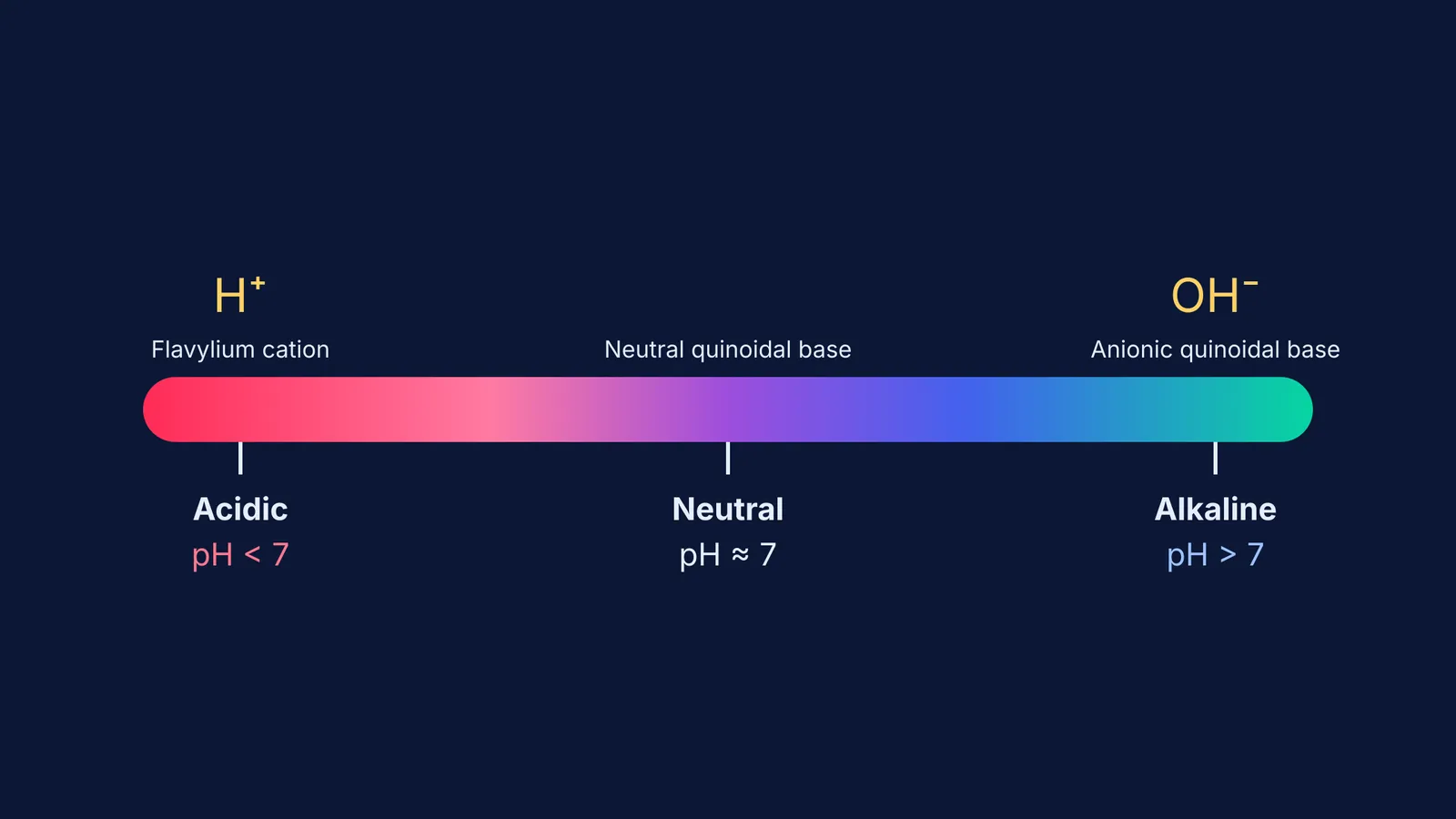
Anthocyanin molecules change their physical shape in response to the concentration of hydrogen ions (H⁺) in the cell vacuole. This structural shift changes the wavelengths of light the molecule absorbs and reflects.
In acidic conditions (where the pH is less than 7), the molecule gains a hydrogen ion to form a flavylium cation. This structure strongly reflects red and pink light. If you are calculating the pH of highly dilute HCl, you already know that even tiny amounts of acid change a solution's balance; in a flower petal, this acidity locks the pigment into its red form.
In a neutral environment, the molecule loses a proton to become a neutral quinoidal base, which typically appears purple or violet. While neutral pH is not always 7 (it changes with temperature), the neutral state of the pigment generally sits squarely in the purple band.
In alkaline conditions (where the pH is greater than 7), the molecule loses yet another proton. It becomes an anionic quinoidal base, shifting the reflected light into the blue and green spectrum.
What is the red cabbage indicator?
Because of their broad, predictable colour shifts, anthocyanins make excellent pH indicators. Red cabbage is one of the richest natural sources available. Fresh red cabbage contains approximately 150 mg of anthocyanins per 100 g (Wikipedia), making it potent enough to dye water a deep violet just by boiling the leaves.
Chemists and students use red cabbage extract to test household liquids. It provides a visual scale that is often clearer than synthetic indicator paper.
Make your own red cabbage pH scale
You can map out the full anthocyanin colour spectrum in your kitchen in a short time.
Extract the pigment: Chop a small section of a red cabbage into pieces. Pour boiling water over the cabbage and let it steep for a few minutes until the water turns dark purple. Strain out the leaves.
Set up the test: Pour a small amount of the purple liquid into five clear glasses.
Test strong acid: Add a spoonful of white vinegar or lemon juice to the first glass. The sudden drop in pH will force the anthocyanins into their flavylium cation form, turning the liquid bright red.
Test weak acid: Add a splash of carbonated water to the second glass. It will shift to a lighter pink or violet.
Keep the neutral control: Leave the third glass as it is. It remains purple.
Test weak alkali: Dissolve baking soda in water and add it to the fourth glass. The liquid will turn a striking blue.
Test strong alkali: Add a few drops of household bleach or ammonia to the fifth glass. The high pH changes the structure to a chalcone, turning the solution green.
By observing these shifts, you are watching the exact same chemical mechanism that a plant uses to signal pollinators and paint its petals.


