

On this page
When you have a cold, "good morning" comes out closer to "good bordig". The blocked sound does not come from your vocal folds; it comes from the space the buzz travels through. That is a story about resonance.
Why does your voice sound different when you have a cold?
A cold inflames the blood vessels in the lining of your nose, so the tissue swells and the passages narrow. MedlinePlus describes a stuffy nose this way and lists the common cold, flu and sinus infections among its causes.
Less open space in the nose means less sound resonates there. Hyponasality is "reduced nasal resonance or energy associated with nasal sounds, typically due to a blockage or an obstruction in the nasopharynx or nasal cavity", according to the American Speech-Language-Hearing Association (ASHA). ASHA lists swelling from the common cold or allergic rhinitis among its causes.
What does resonance have to do with your voice?
Your vocal folds make a raw buzz, and the spaces above them shape it. ASHA defines resonance as "the modification of sound from the vocal folds", set by the size and shape of the vocal tract, including the throat, mouth and nasal cavities (ASHA). Each cavity boosts some frequencies and weakens others.
Most vowels and vowel-like consonants in English are made with the passage to the nose closed or nearly closed, ASHA notes. For m, n and ng, the soft palate (velum) lowers and air escapes through the nose while the lips or tongue block the mouth (Wikipedia: nasal consonant). The nose then acts as a side branch of the vocal tract.
That side branch leaves a fingerprint in the sound. In a 1962 paper in The Journal of the Acoustical Society of America, Osamu Fujimura described nasal sounds by their formants (frequencies that are boosted) and antiformants (frequencies that are cancelled), and showed that the position of the antiformant tells one nasal consonant from another (Fujimura, 1962).
Why do "m" and "n" sound like "b" and "d"?
M and b use the same lip movement; the main difference is whether the nose is open. In more severe hyponasality, /m/, /n/ and /ŋ/ lose their nasal quality and sound like /b/, /d/ and /g/, says ASHA. So "my nose" drifts towards "by dose".
ASHA notes that hyponasality is heard as reduced nasal resonance on vowels and other voiced sounds too, not only on nasal consonants.
Volume is not the whole story, though. A study in The Journal of Laryngology and Otology tested 21 adults before and after a decongestant nasal spray. Nasal cavity volume and nasalance scores (a nasometer measure of nasality) both rose significantly, but the two changes did not correlate, so the authors suggested other factors are involved too (Birkent and colleagues, 2009).
Try it: a two-minute pinch test
Say "mama" normally, then pinch your nostrils shut and say it again. Listen for it drifting towards "baba".
Hum "mmm" with your lips closed, then pinch your nose. The hum chokes off, because the nose was the sound's only way out.
Say "papa" both ways. It barely changes, because p is an oral sound.
Record "nine new names" both ways on your phone and play them back. The pinched version is close to your cold voice.
How does a blockage change the notes a tube favours?
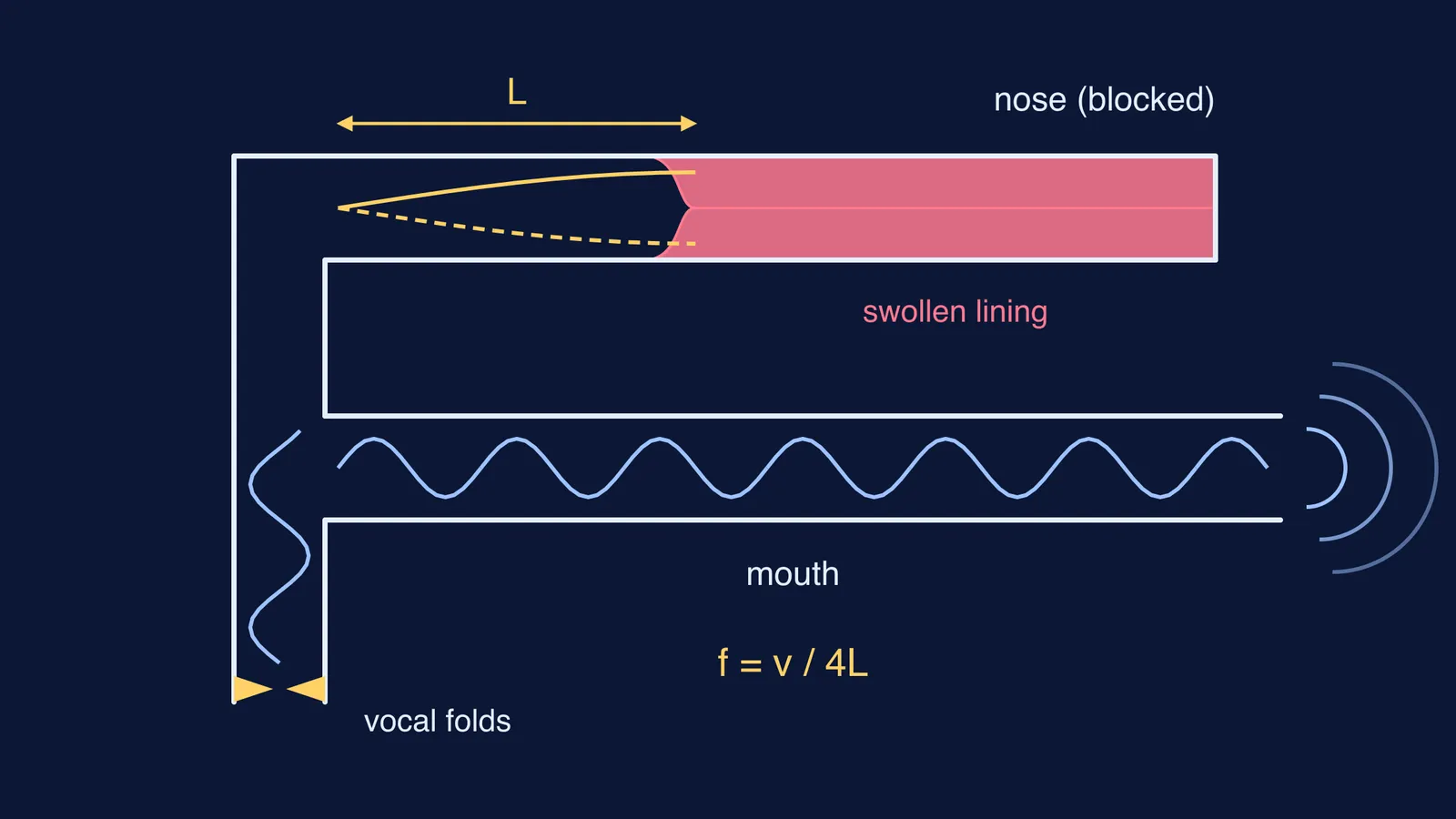
Physics textbooks model air spaces as pipes. For a tube closed at one end, the fundamental frequency is f = v/4L, and only odd harmonics resonate (HyperPhysics). Sound travels at about 344 m/s in air at 20 °C (HyperPhysics).
A worked example with a toy tube (illustrative lengths, not a real nose):
Open length 10 cm, closed at the far end: f = 344 ÷ (4 × 0.10) = 860 Hz. The next resonance is 3 × 860 = 2,580 Hz.
Swelling closes it after 6 cm: f = 344 ÷ (4 × 0.06) ≈ 1,430 Hz. The next resonance is about 4,300 Hz.
A real nose is a branching cavity, not a pipe, but the principle holds: change the shape of an air space and you change which frequencies it favours. It is the same idea behind why shorter wind chime rods ring higher notes. For another case of sound building up at particular frequencies, see why a microphone squeals near a speaker.
If standing waves in pipes still feel abstract, the Fermi Simulation Lab has interactive simulations for ideas that are easier to see than to read. To revise resonance from the basics, each concept in the Fermi Concept Library has its own lesson.
When is a blocked voice more than a cold?
MedlinePlus notes that congestion from a cold or flu typically goes away by itself within a week (MedlinePlus). ASHA lists other causes of hyponasality, including enlarged adenoids, a deviated septum and polyps. If a blocked-sounding voice stays after the cold has gone, or a child always sounds blocked, ask a doctor or an ENT specialist.
Curious about the timing of colds? Read why we catch more colds in winter.


