

On this page
At a school assembly, someone walks towards the stage with a mic and the PA lets out a piercing squeal. The microphone is not broken. It is caught in a loop, built from physics you already study: sound waves, amplification and feedback.
Why does a microphone squeal when it is near the speaker?
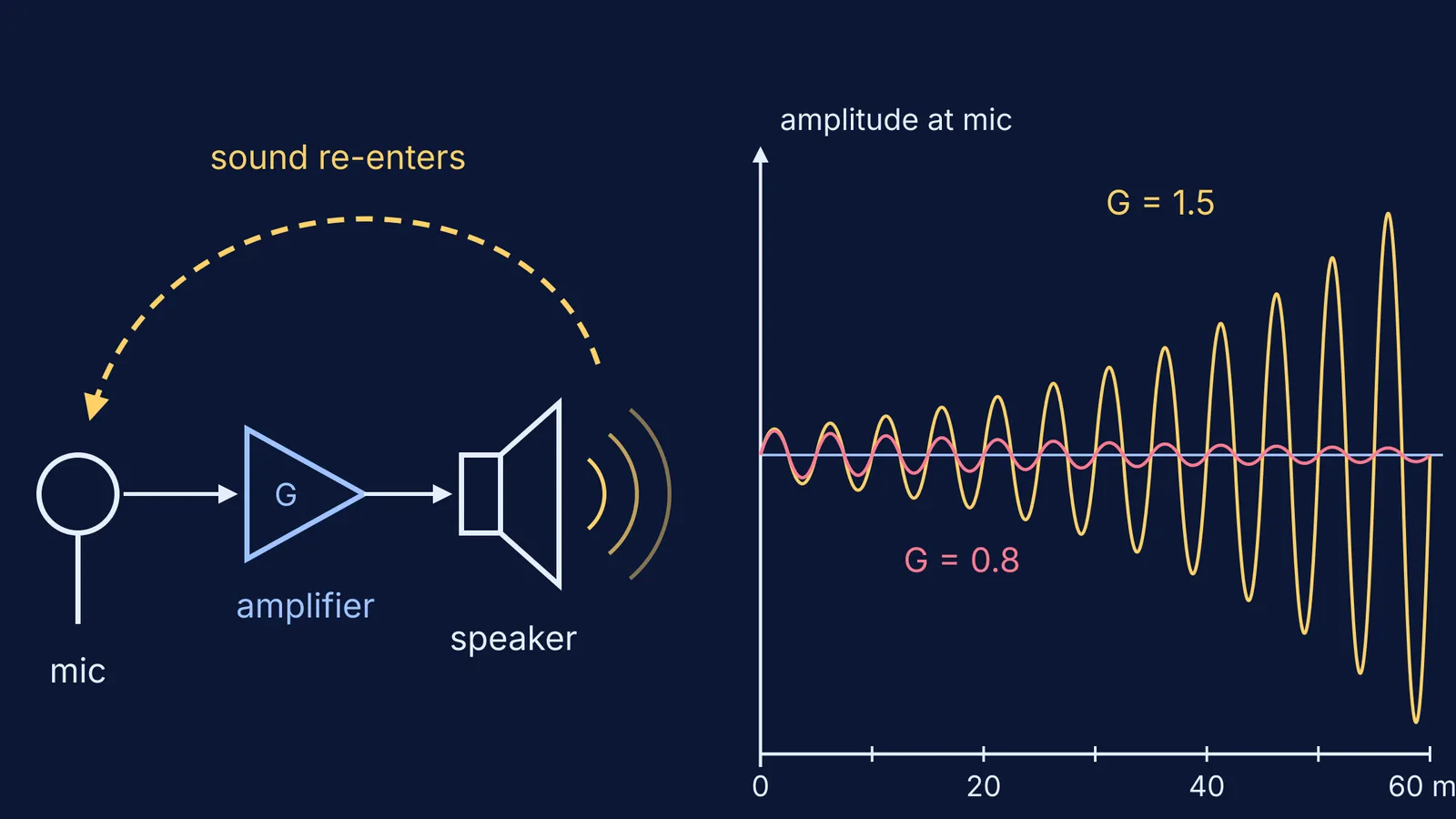
Audio feedback is a positive feedback loop that forms when there is an acoustic path from a loudspeaker back to the microphone feeding it (Audio feedback, Wikipedia). The chain goes like this:
The microphone picks up a small sound: a voice, a tap or background hiss.
The amplifier makes it louder.
The speaker plays it into the room.
Part of that sound reaches the microphone again, and the cycle repeats.
In Sound On Sound, Paul White writes that sound leaking from the PA back into a microphone "will circulate around the system, growing louder all the time".
What is loop gain, and when does the howl start?
Loop gain is how many times louder a sound is after one full trip round the loop: mic, amplifier, speaker, air and back. An acoustic feedback guide on sound-au.com says that when the loop gain, "the total gain of the entire system including the room", exceeds unity, feedback will occur.
Below 1, each trip makes the sound quieter and it dies away. Above 1, each trip makes it louder. Writing in FRONT of HOUSE, Phil Graham gives the example of a loop gain of 1.5: the returning signal is 1.5 times the original after one trip and 2.25 times after two.
How fast does a microphone squeal grow?
Say the speaker is 3.44 m from the microphone. Sound travels at about 344 m/s in air at 20 °C (HyperPhysics, speed of sound), so counting only the trip through the air, one lap takes 3.44 ÷ 344 = 0.01 s, or 10 ms.
Loop gain 0.8: after 10 laps (0.1 s) the sound is 0.8 to the power 10, about 0.11 of where it started. A tap on the mic fades out.
Loop gain 1.0: the sound neither grows nor dies. It hangs, ringing.
Loop gain 1.5: after 10 laps it is 1.5 to the power 10, about 58 times louder. After 20 laps, a fifth of a second, it is about 3,300 times louder.
It stops rising only when the amplifier or speaker reaches its limit.
Why is the squeal always one particular pitch?
Gain above 1 is not enough. The returning sound must also arrive in step with the sound already at the microphone. The sound-au.com guide explains that the system is stable at frequencies where the feedback is out of phase, but prone to oscillation where the signals are in phase and the gain is high enough.
With a 10 ms lap, a wave comes back in step if a whole number of cycles fit into 10 ms: 100 Hz, 200 Hz, 300 Hz and so on. Whichever of those the microphone, speaker and room boost most wins. According to the same guide, the howl usually lands on the room's strongest resonance peak, "which explains why the frequency is very steady and repeatable". Move the microphone and you change the delay, so a different frequency may take over.
Flip the sign and the same loop idea makes amplifiers steady instead: see how Harold Black's negative feedback amplifier works.
How do you stop a microphone from squealing?
Every fix brings the loop gain back below 1. Tips are from Paul White's Sound On Sound guide unless linked otherwise.
Hold the microphone close to your mouth. A quieter voice needs more gain, and more gain means more risk.
Cardioid mics pick up least from behind, so aim the back of the mic at the speaker, never the front.
Keep the main speakers in front of the microphones, not behind them.
Do not cup the head of the microphone with your hand.
Step back from the speaker. With no reflections, sound intensity from a point source follows the inverse square law (HyperPhysics), so double the distance gives a quarter of the intensity. In most untreated rooms, though, that law stops applying only a metre or two from the speaker (sound-au.com), so the benefit shrinks.
If it squeals anyway, turn the volume down. Engineers set up by raising each mic's gain until feedback just starts, then backing off, and also use equalisers and automatic feedback suppressors (Audio feedback, Wikipedia).
How does this connect to your physics syllabus?
This one squeal ties together the speed of sound, reflection, the inverse square law, phase and resonance. Our posts on why an echo needs about 17 metres and uses of multiple reflection of sound build on the same ideas.
Waves adding in step or out of step are easier to see than to read about, and the Fermi Simulation Lab has interactive simulations for ideas like these. If phase or resonance is still fuzzy, the Fermi Concept Library gives each concept its own lesson.
Next time an assembly mic squeals, spot the loop and pick the fix that breaks it.


