On this page
In the 1920s, a long-distance telephone call passed through many amplifiers in a row, and each one drifted a little as its batteries and vacuum tubes changed. Bell System engineer Harold Black's answer, sketched on a ferry in 1927, was to make the amplifier correct itself by feeding part of its output back, upside down, into its own input.
##What did Harold Black sketch on the ferry in 1927?
Black earned an electrical engineering degree at Worcester Polytechnic Institute in 1921 and joined Western Electric's engineering department, which became Bell Telephone Laboratories in 1925, according to the IEEE History Center's Engineering and Technology History Wiki. The same biography dates the invention to 2 August 1927. He sketched the circuit and its equations on a page of The New York Times while crossing the Hudson River by ferry to work, according to his Wikipedia biography.
Black told the story himself in IEEE Spectrum: Inventing the negative feedback amplifier: Six years of persistent search helped the author conceive the idea 'in a flash' aboard the old Lackawanna Ferry (December 1977).
In a 1977 interview with Michael Wolff for the IEEE History Center oral history, Black put it in one sentence: "It came to me that if I fed the output back to the input in reverse phase and kept the device from singing I would have exactly what I wanted and I could write this equation." Singing meant the amplifier broke into oscillation on its own.
What is a negative feedback amplifier?
A negative feedback amplifier is a high-gain amplifier in which a fraction of the output is returned to the input in opposite phase, so that the amplifier works against its own errors.
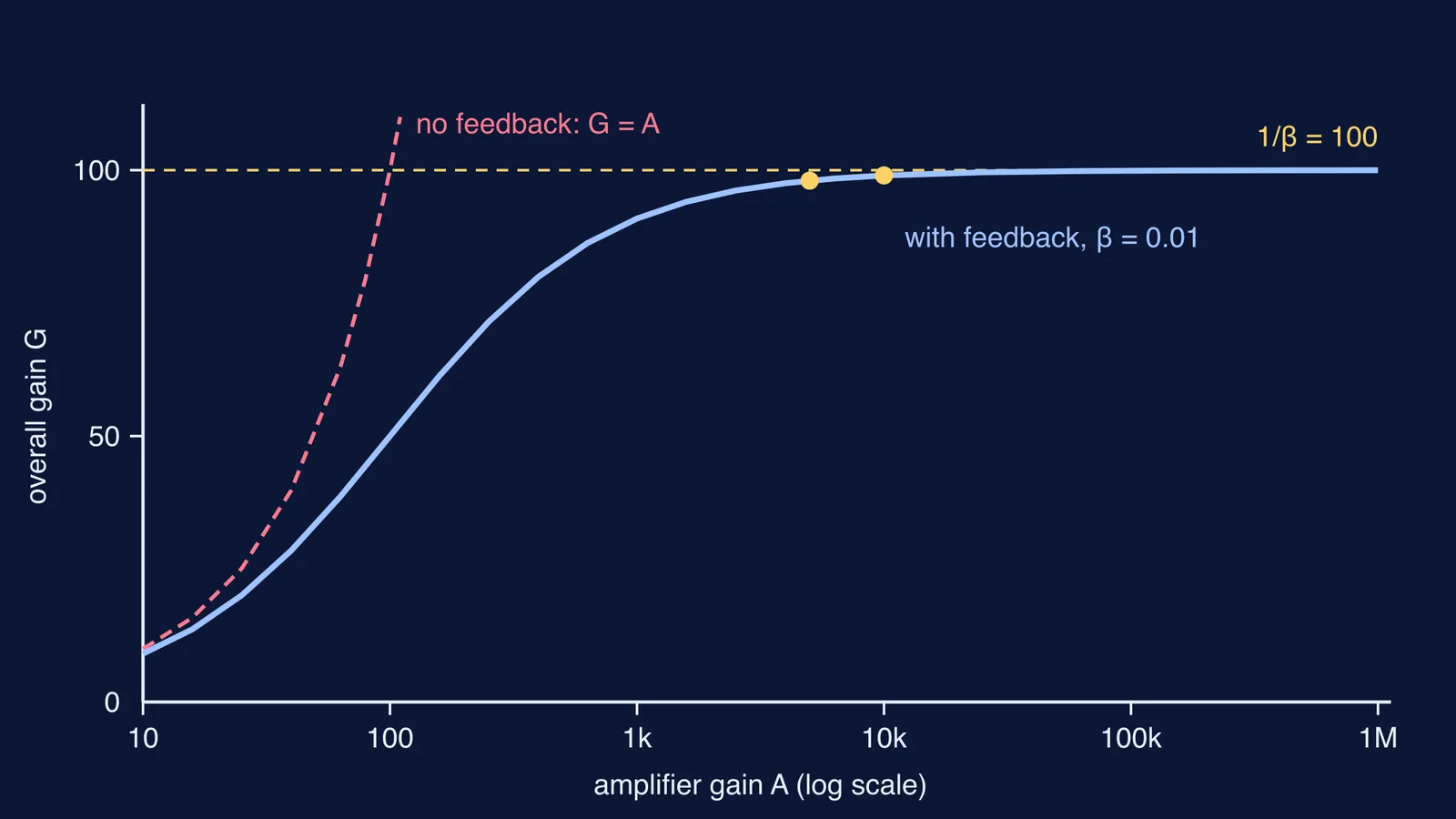
Call the amplifier's own gain A and the fraction fed back β. The overall gain then becomes G = A / (1 + Aβ). When Aβ is much larger than 1, G is very nearly 1/β.
Black's own paper, Stabilized Feedback Amplifiers in the Bell System Technical Journal (January 1934), states the key result plainly: under this condition "the amplification is independent of μ but does depend upon β." (Black wrote the amplifier's gain as μ and put the minus sign inside μβ, so his denominator reads 1 − μβ.) The feedback network can be built from resistors, which barely drift, so the whole amplifier inherits their steadiness.
How does negative feedback trade gain for stability?
Take an amplifier with A = 10,000 and a feedback network with β = 0.01.
Loop gain: Aβ = 10,000 × 0.01 = 100.
Overall gain: G = 10,000 / (1 + 100) = 99.0, close to 1/β = 100.
Now the tube ages and A halves to 5,000. Loop gain becomes 50, and G = 5,000 / 51 = 98.0.
Without feedback, the gain fell by 50%. With feedback, it fell by about 1%.
The price: you threw away a factor of 101 in gain, on purpose.
The same factor, 1 + Aβ, divides the noise and distortion the amplifier adds, as Black spells out on page 5 of his 1934 paper.
What did Black's 1934 paper actually show?
In Stabilized Feedback Amplifiers, Black described building an amplifier with gain about 40 decibels higher than needed, a 10,000-fold excess on an energy basis, then throwing the excess away through feedback.
Gain varied less than 0.01 dB when the plate voltage changed from 240 to 260 volts; a conventional amplifier of comparable size would have shifted by about 0.7 dB.
Unwanted modulation products sat 75 dB below the signal at full load, against only 35 dB without feedback: a 40 dB reduction.
In a field trial at Morristown, New Jersey, seventy of these amplifiers were operated in tandem.
His patent, US 2,102,671 Wave translation system, was granted on 21 December 1937.
Why can feedback make an amplifier oscillate?
Real amplifiers shift the phase of signals differently at different frequencies, so at some frequency the fed-back signal can arrive in step and the loop feeds itself. Black's paper warns that unless the phase relations are controlled well beyond the useful band, "singing will occur."
Harry Nyquist, who also worked on telephone transmission in the Bell System, gave engineers a test for this in Regeneration Theory (Bell System Technical Journal, January 1932). Read more on Hendrik Bode's frequency-response plot, Norbert Wiener's cybernetics and the body's own thyroid hormone negative feedback loop.
How do you solve a feedback problem step by step?
The same four steps work for an amplifier, a thermostat or a hormone loop:
Name the forward gain A: what the system does with no correction.
Name β: what fraction of the output is measured and sent back.
Work out Aβ. If it is much larger than 1, the answer is close to 1/β.
Check the sign. Opposing feedback steadies; feedback that adds in step can oscillate.
If a loop is easier to see than to read, the Fermi Simulation Lab has interactive simulations for ideas like this. To revise the gain, phase and oscillation ideas underneath, each has its own lesson in the Fermi Concept Library.