On this page
Sound spreads out from its source in all directions, so it fades quickly. Every use of multiple reflection is a way to stop that spread: hard surfaces bounce the sound again and again and send it where you want it. Name the surface doing the bouncing and where the sound ends up, and you can answer any question on this topic.
What is multiple reflection of sound?
Sound reflects from a hard surface the way light reflects from a mirror: the angle of incidence equals the angle of reflection, both measured from the normal. Multiple reflection means the sound bounces many times, off the walls of a tube, a cone or a curved surface, before it reaches the listener.
Uncontrolled bouncing gives you echoes and the muddy ring explained in why empty rooms echo. The uses below are the controlled version.
What are the uses of multiple reflection of sound?
Learn each use as a pair: a device and the surface that reflects.
Megaphones and horns. The walls of the cone reflect sound that would have spread sideways, so more of it travels forward. A megaphone serves to direct the sound waves in the direction the horn is pointing. More in how a megaphone makes your voice louder.
The stethoscope. Sound from the heart or lungs is guided along a narrow tube to the doctor's ears, bouncing off its inside instead of escaping into the room. In the autumn of 1816, the French physician René Laennec rolled a sheet of paper into a tube, placed one end on a patient's chest and found he could easily hear her lung sounds, according to a history of Laennec in the Anatolian Journal of Cardiology. Read the full story of René Laennec and the first stethoscope.
Curved ceilings and walls. A concave ceiling works like a curved mirror for sound: it catches sound heading upwards and reflects it down to the audience, so the back rows can hear. A curved wall works too: Lord Rayleigh explained the whispering gallery of St Paul's Cathedral in London this way: sound waves cling to the concave wall and travel round it, losing much less strength than sound spreading out in all directions. In 1922 C.V. Raman, then Palit Professor of Physics at Calcutta University, and G.A. Sutherland published a study of the whispering-gallery effect in the Proceedings of the Royal Society that took a closer look at this explanation.
Sounding boards. A sounding board sits above or behind a speaker. Many older churches fixed one above the pulpit to reflect and therefore amplify the speaker's voice, according to Simon Fraser University's Handbook for Acoustic Ecology. In a hall, a curved board behind the stage sends backward-going sound out to the seats.
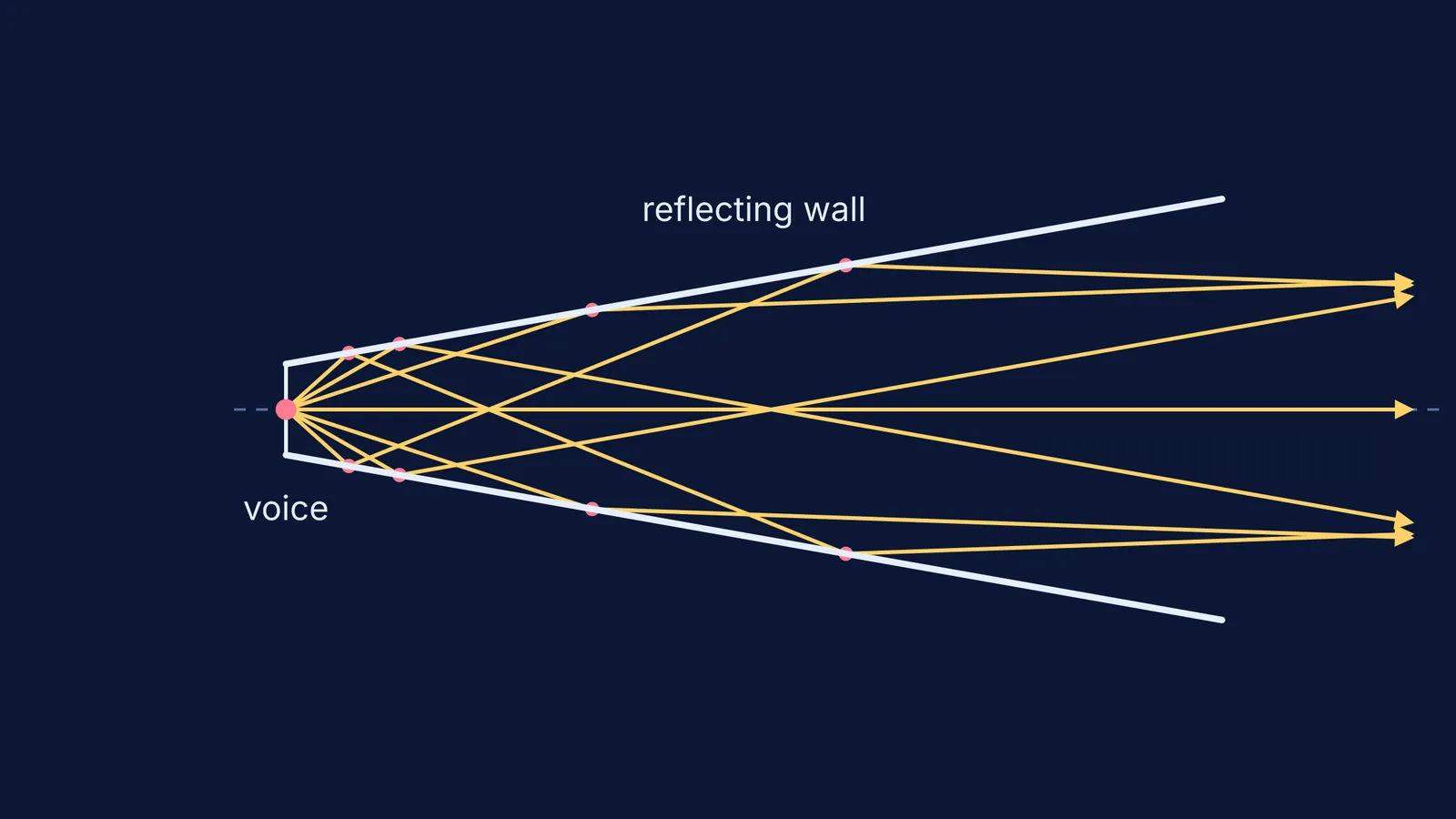
How does a megaphone fold sound forward, step by step?
The diagram at the top traces rays in a cone with walls tilted 10° from the axis.
The rule: if a wall is tilted at angle a above the axis and a ray travels at angle t above the axis (t bigger than a), the ray makes an angle (t − a) with the wall and, by the law of reflection, leaves at (t − a) on the other side. Its new direction is a − (t − a) = 2a − t. For the lower wall, tilted at −a, it is −2a − t.
With a = 10°:
A ray at 18° hits the upper wall and leaves at 20° − 18° = 2°.
A ray at 30° leaves at 20° − 30° = −10°, parallel to the lower wall, so it never hits it.
A ray at 42° becomes 20° − 42° = −22°. That is steeper than the lower wall, so it bounces again: −20° − (−22°) = +2°.
Rays that left your mouth spread over 84° come out within 20°. The 42° ray, bouncing twice, shows why it is called multiple reflection.
If a step here felt shaky, the Fermi Concept Library has a lesson on every concept in physics, from the laws of reflection to wave behaviour.
How do you write the answer in an exam?
For a three-mark question, give each use in three parts: device, reflecting surface, where the sound goes.
Megaphone: the cone's walls reflect the sound forward repeatedly, so it does not spread out and carries further in one direction.
Stethoscope: the heartbeat's sound is reflected many times inside the tube and reaches the doctor's ears.
Curved ceiling or sounding board: the concave surface reflects sound towards the audience so it spreads evenly across the hall.
If you understand the idea but lose marks on angle numericals, practise in the Fermi Problem Library, where a step-by-step solver explains the reasoning rather than printing an answer.
Tonight, roll a sheet of A4 paper into a tight tube and hold it between your ear and a ticking clock. You will hear the same effect Laennec used in 1816.