

On this page
At the back of a school assembly, the teacher's voice fades into noise. Hand that teacher a paper cone and the same voice carries, with no battery and no amplifier. The cone adds no energy; it changes how your voice's energy leaves and where it goes.
Where does your voice go without a megaphone?
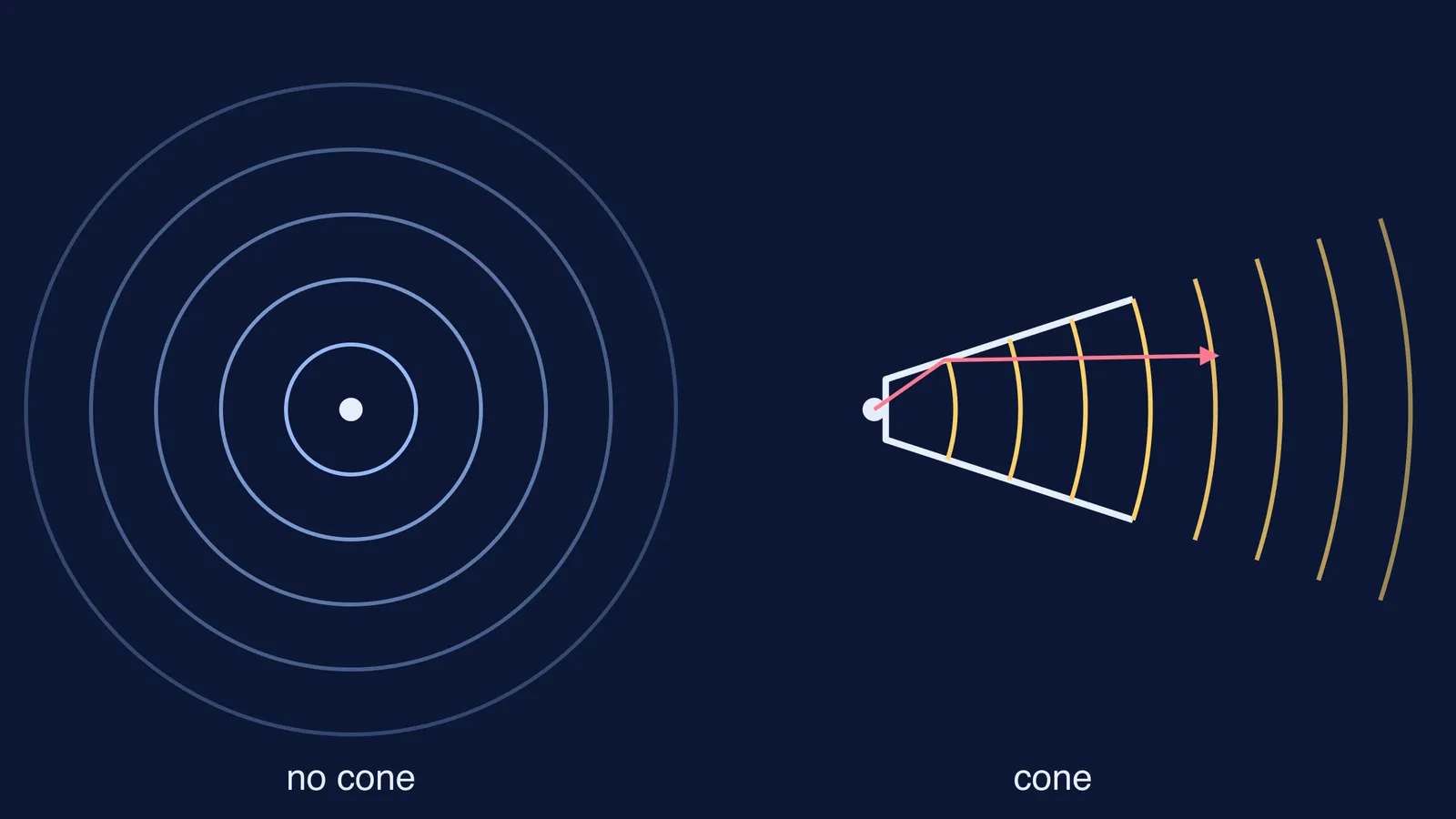
When you speak in open air, the sound leaves your mouth and spreads out in nearly every direction. The energy you produce each second gets shared over a larger and larger surface as it travels.
Sound intensity is the sound power per unit area, measured in watts per square metre, as HyperPhysics explains.
For a source that spreads equally in all directions, the intensity at any radius is the source strength divided by the area of the sphere at that radius, which is the inverse square law. The area of a sphere is 4πr², so double the distance and the same power covers four times the area.
In decibels, doubling the distance from a point source drops the level by about 6 dB, and ten times the distance drops it by 20 dB, according to HyperPhysics on inverse square calculations. We work through that 6 dB step in our post on how sound level drops when you double the distance.
How does a megaphone make your voice louder?
1. It stops sound escaping sideways and backwards. Sound that would have gone off to the sides hits the inside wall of the cone and reflects. Because the wall slopes outwards, a ray that hits it is turned closer to the forward direction, as the pink ray in the diagram above shows. CBSE Class 9 study notes list the megaphone, with the stethoscope, the ear trumpet and the hearing aid, as devices based on the multiple reflection of sound. To check that sound obeys the same reflection laws as light, see our guide to verifying the laws of reflection of sound in the lab.
2. It helps your voice push on the air. Your vocal tract is small and the open air is large, and energy passes poorly between such a mismatched pair. A megaphone increases volume by matching the acoustic impedance of the vocal cords to the air, so more sound power is radiated, and directs the waves where the horn points, as the Wikipedia article on megaphones summarises. Researchers at UNSW Sydney describe the bell of a French horn in a similar way: an impedance-matching device that acts a little like the horn on an old gramophone or an ear trumpet (Chen, Smith and Wolfe, 2014).
The trade-off is fair. Listeners in front hear more; people behind you hear less.
How much louder can a cone make you?
Use the inverse square idea from the first section. Suppose your voice puts out a fixed power P.
With no cone, P spreads over a full sphere of area 4πr².
Now imagine an ideal cone that squeezes all of P into half of that sphere (area 2πr²). The intensity in front doubles.
A doubling of intensity is 10 × log₁₀(2), or about 3 dB, using the decibel formula on HyperPhysics. Our post on why two equal sound sources add 3 dB uses the same step.
Squeeze P into a quarter of the sphere and intensity is four times larger: about 6 dB.
From the first section, about 6 dB is what you lose by doubling your distance. So in this ideal case, a friend twice as far away in front hears you about as loudly as a friend at the original distance with no cone.
Real megaphones are not this tidy. Low-pitched sound tends to spread out of the mouth of a small cone, while high-pitched sound is beamed better. The megaphone's frequency response is also greater at higher frequencies, which somewhat distorts the sound of the voice (Wikipedia: Megaphone). Electric megaphones also add an amplifier, so they put in energy as well as directing it.
Try it at home: a 15-minute cone test
You need chart paper, tape, a friend and a phone with any free sound-level meter app.
Roll the chart paper into a cone with a mouth-sized hole at the narrow end. Tape it.
Stand your friend about 10 steps away in an open space. Say "aaah" at a steady, comfortable volume for three seconds. Your friend notes the reading.
Repeat through the cone, pointed at your friend.
Repeat through the cone pointed away, so your friend is behind it.
Before you start, write your prediction for each case. Afterwards, compare: front should beat no cone, and behind should be the quietest.
Phone meters are rough, so look for the pattern, not exact numbers. Keep the volume gentle.
If the picture of energy spreading over a sphere still feels abstract, the Fermi Simulation Lab has interactive simulations for ideas that are easier to see than to read. Change the setup and watch what happens.


