

On this page
On a clear January evening anywhere in India, Orion is easy to find: three bright stars in a short line, a reddish star above and a bluish-white one below. Look for it in June and it is gone. The stars have not moved. We have.
This is one of the clearest everyday signs that Earth goes around the Sun, the idea your textbook calls the revolution of the Earth.
Why does Orion appear only in winter evenings?
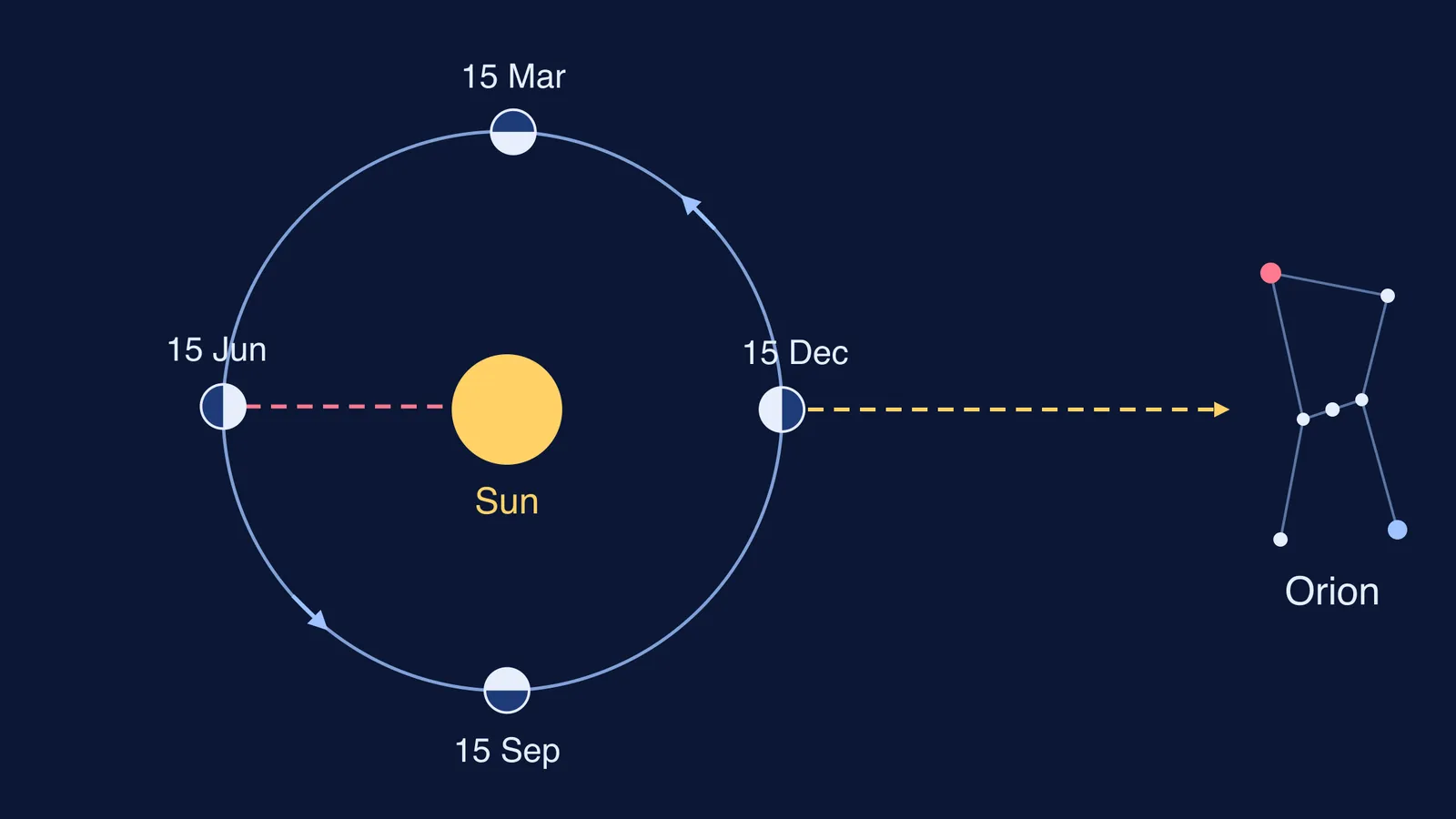
At night you are on the side of Earth facing away from the Sun, so you only see stars in that direction. As Earth travels around its orbit, that night side points at a slowly changing part of space.
In December and January, Earth sits between the Sun and Orion, so your night side faces Orion and the Hunter is up for much of the night. Six months later Earth is on the far side of its orbit, and, as EarthSky puts it, Earth's motion in orbit brings the Sun between us and Orion at the same time each year. Orion is then up during the day, drowned out by sunlight.
The Wikipedia entry on Orion) gives the numbers: Orion's belt is best placed at about 9 pm in January, and from May to July Orion is in the daytime sky and invisible at most latitudes. The Armagh Observatory and Planetarium describes it rising in the east in December evenings and staying visible right through until March.
Why do stars rise four minutes earlier every night?
Earth spins once relative to the Sun in 24 hours, but once relative to the distant stars in a little less. NASA Glenn Research Center gives this sidereal day as 23 hours 56 minutes 4.2 seconds, about 3 minutes 56 seconds shorter than the solar day.
The gap comes from the orbit. NASA's page uses Earth's orbital motion of 0.9856 degrees per day against the fixed stars. Each day Earth must turn about one extra degree to bring the Sun back to the same place, and that takes about four minutes.
BBC Sky at Night Magazine sums up the result: constellations shift westward by one degree each night and rise in the east four minutes earlier. Four minutes a night adds up to about two hours a month. We explain the two kinds of day step by step in why a sidereal day is 4 minutes shorter than a solar day.
When can you see Orion from India, month by month?
Orion straddles the celestial equator, so it is visible from latitudes between about 80 degrees north and 68 degrees south, according to its Wikipedia entry). All of India is well inside that band. Here is a worked example using two facts from above: the belt is highest at about 9 pm by the end of January, and the stars run about two hours earlier each month.
Mid-December: the belt is highest at about midnight. Orion rises around dusk, and evening viewing begins.
Mid-January: highest at about 10 pm. The best month for evening viewing.
Mid-February: highest at about 8 pm, soon after dark.
Mid-March: highest at about 6 pm, around sunset, so at dusk Orion is already sliding into the west.
Mid-April: highest at about 4 pm. At dusk it is well down in the west and sets a few hours after dark.
Mid-May: highest around 2 pm, setting soon after the Sun and lost in the twilight glare until it returns in the pre-dawn sky later in the year.
This is why the evening season runs from about December to March. The times are approximate: India runs on one clock, so the same star crosses the sky earlier by the clock in Kolkata than in Mumbai.
How can you test this yourself?
A weekly check makes the orbit something you see, not memorise.
Pick one spot and one time, say 8 pm, every Sunday from January to March.
Note where Orion's belt is: height above the horizon in fists held at arm's length, and its direction.
Each week the belt should sit about 7 degrees further west at the same clock time, one degree for each night, the westward shift BBC Sky at Night Magazine describes.
In March, write down the date Orion first looks low in the west at your chosen time.
City lights wash out fainter stars, so a darker rooftop helps; our post on why city skies show so few stars explains why. For a star that never changes position through the year, compare with why the pole star does not move.
If the orbit still feels hard to picture from a flat diagram, the Fermi Simulation Lab has interactive simulations for ideas that are easier to see than to read. To fit the revolution of the Earth alongside rotation and the seasons, the Fermi Concept Library gives each concept its own lesson and its place in the map.
This January, find the belt at 9 pm, then check it again in February at the same time.


