

On this page
You oil your hair on a Sunday morning and by afternoon it catches the light in one bright band. What changed is the surface the light meets, a school physics idea: regular versus diffuse reflection.
What does the surface of a hair look like?
A hair is covered by a cuticle made of thin, flat cells that overlap like roof shingles, according to a 2003 study of light scattering from single hairs by Stephen Marschner of Cornell University and colleagues (ACM Transactions on Graphics). Citing earlier measurements, the same paper notes that the scale surfaces tilt toward the root end by approximately 3 degrees, and it uses an index of refraction of about 1.55 for hair.
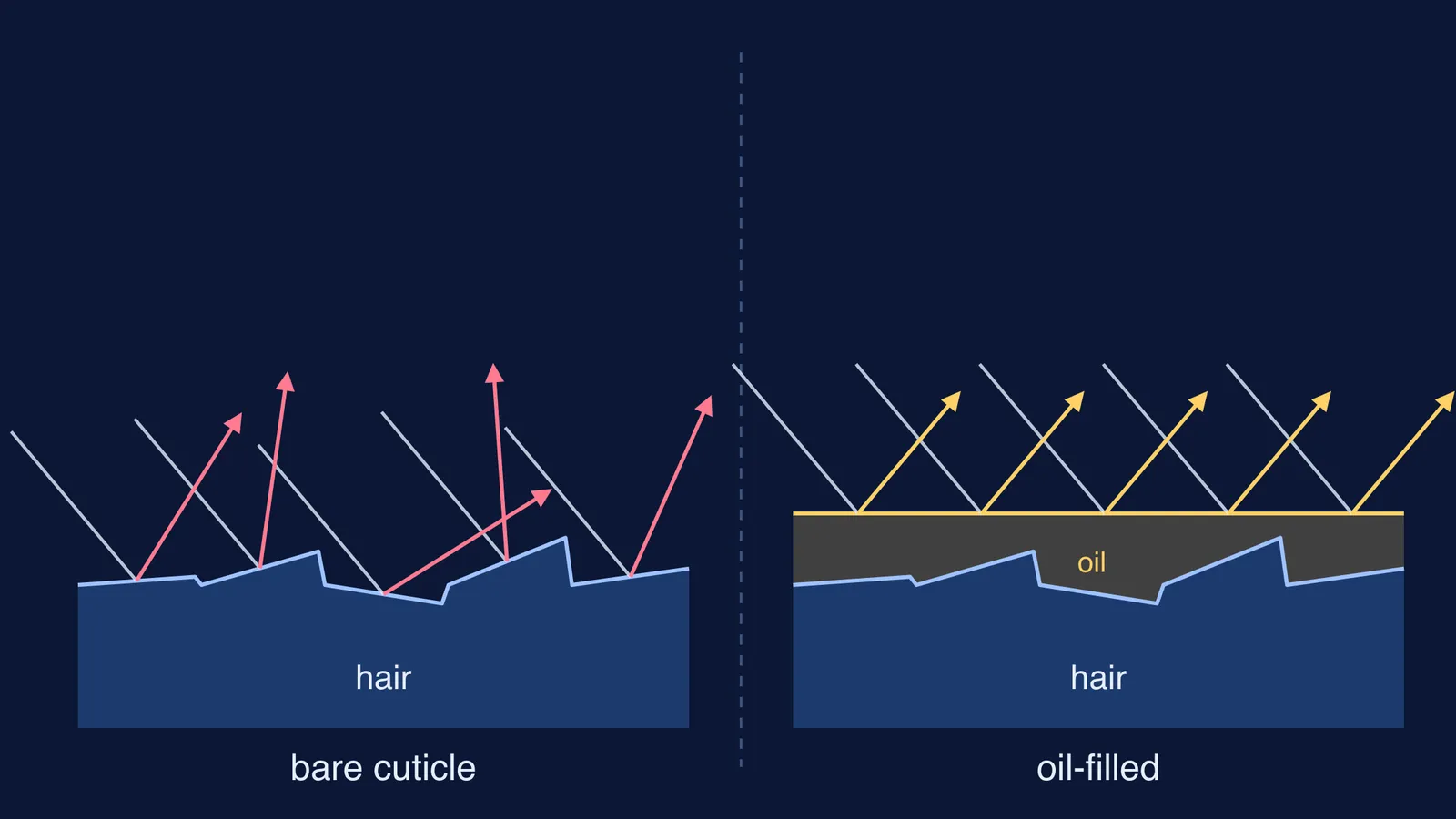
Flat scales act like small mirrors pointing almost the same way. Lifted or chipped scales point in many directions, so light leaving them spreads out.
Franz-Josef Wortmann and colleagues measured laser light reflected from single hairs and defined a gloss index as the ratio of specularly to diffusely reflected light (International Journal of Cosmetic Science, 2004). More mirror-like light and less scattered light means hair that looks shinier.
Why does hair look shiny after oiling?
In regular reflection, a smooth surface sends parallel rays out parallel, so you see a bright highlight from one direction. In diffuse reflection, a rough surface sends rays off in many directions, so it looks evenly dull from everywhere. Our explainer on regular and diffuse reflection and why the laws still hold walks through this with ray diagrams.
Oil changes the surface in two ways:
It fills the gaps between scale edges, so light reaching those edges meets oil and hair, not air and hair.
Its top surface is a liquid film that settles smooth over the bumps. That film becomes the new mirror.
How much does oil change the reflection?
For light hitting a boundary straight on, the fraction reflected is R = ((n1 − n2) / (n1 + n2))², from the Fresnel equations. For ordinary glass in air this gives about 4%, the same source notes.
Use hair at n = 1.55 (the Marschner value above) and coconut oil, whose refractive index at 40 °C is 1.448 to 1.450 under the Codex standard for named vegetable oils. Take 1.449.
Air to bare hair: R = (0.55 / 2.55)² ≈ 0.047, so about 4.7% of the light is reflected at each scale surface and edge.
Air to oil: R = (0.449 / 2.449)² ≈ 0.034, so about 3.4% is reflected at the oil's top surface.
Oil to hair: R = (0.101 / 2.999)² ≈ 0.0011, so only about 0.11% is reflected where oil meets the scales.
Once oil covers the scales, the boundary at the jagged edges reflects about 40 times less light than bare hair in air (4.7 ÷ 0.11). Most reflected light now comes from the oil's smooth top, which sends it one way. The share reflected at the top surface is similar (3.4% against 4.7% for bare hair); the big change is where that light goes. More of it ends up in one bright highlight, which your eye reads as shine.
Mustard oil (1.461 to 1.469) is even closer to hair in the same Codex table. This is a simplified model: real hair is a curved cylinder, light arrives at many angles, and a thick, uneven layer of oil can itself scatter light.
Why is the shine white even on black hair?
The bright band is light that bounced off the surface without entering the hair, so it keeps the colour of the lamp. Marschner's team found that this surface highlight is white, while a second highlight, made by light that passes through the hair and reflects off its far side, is coloured (ACM Transactions on Graphics). Earlier studies they cite found that this second highlight is not present in black hair.
Try it at home: a 10-minute reflection check
Tape two clean strands of hair from a comb side by side on dark paper.
Rub a tiny drop of coconut oil along one strand and wipe off the excess.
Shine a phone torch at about 45° from one side; look from the other.
Predict which strand will be brighter, then move your head slowly. The oiled strand should flash bright over a narrow range of angles; the dry one should look dimmer but stay visible from more angles.
Then compare the two sides of kitchen foil, explained in why aluminium foil is shiny on one side and dull on the other. Scattering also explains why milk looks white.
If it is hard to picture rays leaving a rough surface in many directions, the Fermi Simulation Lab has interactive simulations for ideas that are easier to see than to read. For refractive index on its own, the Fermi Concept Library gives each physics concept its own lesson.
Next time your hair is oiled, find the bright band and predict where it will move when you turn your head.


