

On this page
When a storm breaks on the walk home, the instinct is to run under the nearest tree. It is one of the most dangerous places to stand.
Lightning killed around 2,558 people in India in 2023, 39.7% of all deaths from forces of nature, according to NCRB data reported by Down To Earth.
Why does lightning strike trees and other tall objects?
As a charged leader comes down from the cloud, streamers rise from the ground to meet it, and where they connect decides where the bolt lands (US National Weather Service). Tall, pointed objects tend to send up streamers early, because charge crowds onto sharp points and the electric field there is strongest, the same idea behind the sharp tip of a lightning conductor.
"Height, pointy shape, and isolation are the dominant factors controlling where a lightning bolt will strike," according to the National Weather Service's lightning myths page. A lone tree in an open field scores high on all three.
Why is it dangerous to stand under a tree during lightning?
Compared with a metal rod, a tree is a poor conductor, so some of the current racing to the ground can take an easier path, including one through you. The National Weather Service describes how this happens (NWS: how lightning strikes people):
Side flash: part of the current jumps from the struck object to a person within a foot or two, often someone sheltering under a tree from rain or hail.
Ground current: much of the energy spreads outward along the ground; the NWS says this causes the most lightning deaths and injuries because it covers a much larger area.
Direct strike: you become part of the main channel, the deadliest but less common case; on open ground you may be the tallest point.
The NWS states that being underneath a tree is the second leading cause of lightning casualties (NWS lightning myths). The India Meteorological Department gives the same rule in its thunderstorm and lightning do's and don'ts: do not take shelter under trees, particularly isolated trees. For how current harms people, see why the body's electrical resistance matters for safety.
What is step voltage, and why do your feet matter?
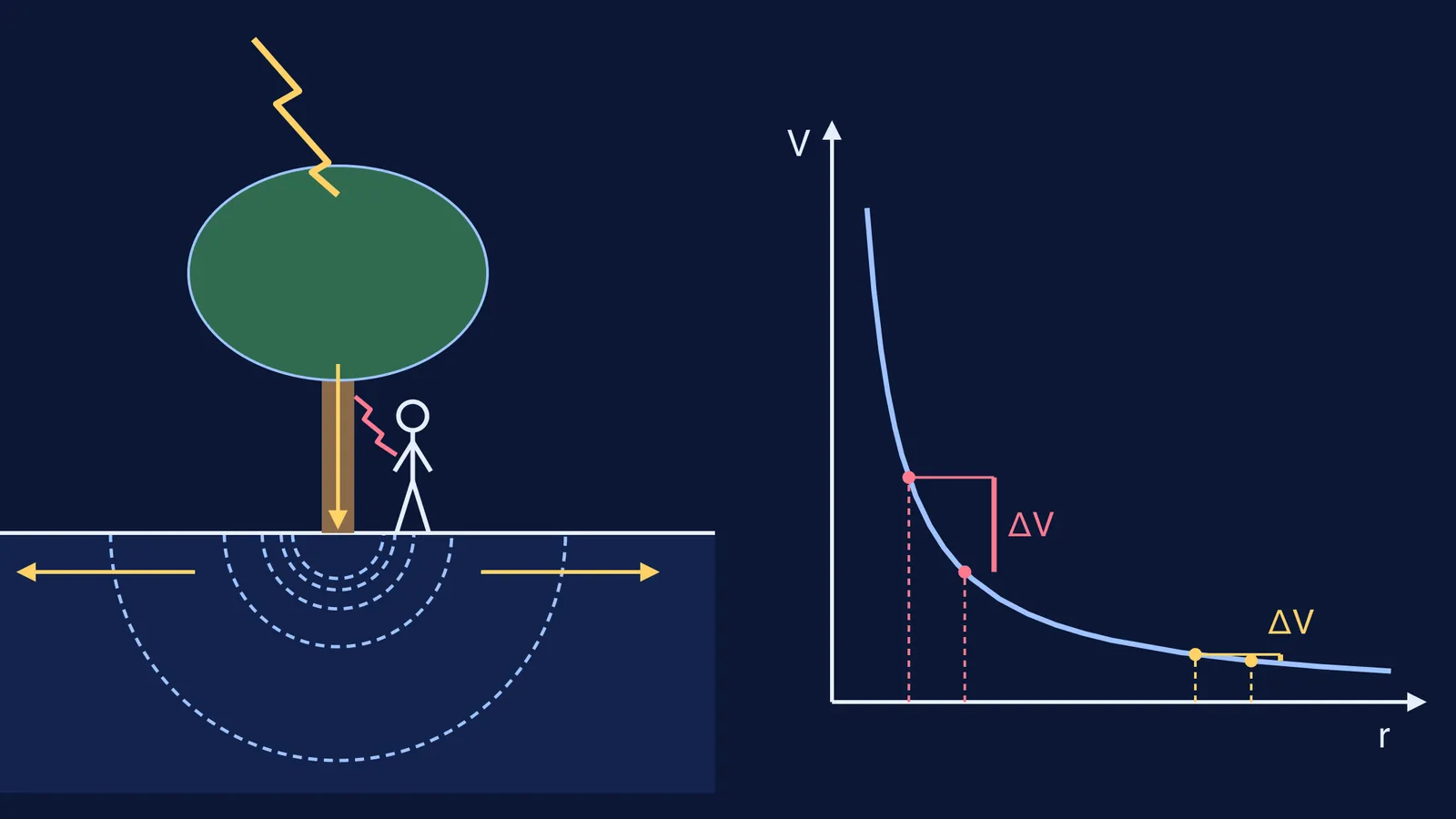
Current spreading into the ground makes the ground's potential fall with distance from the strike. Your feet stand at different potentials, and that difference, the step voltage, drives current up one leg and down the other. The NWS notes that the greater the distance between contact points, the greater the potential for death or serious injury (NWS).
Here is a worked example using the simplest model: a current I enters the ground at one point and spreads evenly in hemispheres through soil of resistivity ρ. At distance r the current density is J = I/(2πr²), the field is E = ρJ, and the potential is V(r) = ρI/(2πr), the same 1/r shape as a point charge.
We pick round numbers as assumptions, not measurements: I = 10,000 A and ρ = 100 Ω m, so ρI/2π is about 159,000 V m.
Standing 1 m from the trunk with a 0.5 m stride: ΔV = 159,000 × (1/1 − 1/1.5), about 53,000 V.
Standing 20 m away with the same stride: ΔV = 159,000 × (1/20 − 1/20.5), about 194 V.
At 20 m with feet together: ΔV is close to zero.
In this model, moving from 1 m to 20 m cuts the step voltage by roughly 270 times. Real soil is uneven and strikes vary, so take the shape, not the numbers: the danger is concentrated near the strike, where the diagram's equipotential rings crowd together. Ideas like this are easier to see than to read, which is what the interactive simulations in the Fermi Simulation Lab are for.
Where should you go instead during a thunderstorm?
This checklist follows the IMD do's and don'ts:
When thunder roars, go indoors: a pukka house or building, or a hard-top vehicle with the windows rolled up. Here is why you are safe inside a car during lightning.
Use the 30/30 rule: go indoors after you see lightning, and stay in for 30 minutes after the last thunder.
Move away from ponds and wet paddy fields, come down from hills, and get off bicycles and motorcycles.
In a group, spread out so one strike cannot injure everyone.
Rubber-soled shoes and car tyres do not protect you.
If there is no shelter at all, IMD advises the lightning crouch: feet together, head down, ears covered. The NWS cautions that crouching doesn't make you any safer outdoors, so use it only as a last resort while you move towards shelter.
If the 1/r potential felt shaky, the Fermi Concept Library has a lesson for every physics concept. Next time the sky darkens, head for a building, not a tree.


