

On this page
On a foggy January morning in Delhi, you step out for the school bus and soon need a tissue. You don't have a cold. Your nose is doing its job, with some school physics inside it.
Why does your nose run in cold weather?
Two things happen at once. Biology: your nose conditions air for your lungs, and cold, dry air makes it release extra fluid. Physics: warm, wet breath leaving your lungs passes over a nasal lining the cold air has just chilled, and some water vapour condenses into liquid. Both drip out of the front of your nose.
Doctors call a runny nose rhinorrhoea, and when cold air sets it off, cold-induced rhinitis. In a 2001 questionnaire study of 144 skiers in Italy, 48.6% had cold-induced rhinitis, and a runny nose was the distinctive symptom, reported by 96% of them.
How does your nose warm and moisten the air you breathe?
Researchers who placed tiny temperature probes in the noses of 50 volunteers found that inhaled air reached about 34°C in the nasopharynx, the space behind the nose (Keck and colleagues, Laryngoscope, 2000). Along the way it picks up water from the moist lining, so your lungs receive warm, damp air.
The extra fluid on a cold day is a nerve reflex, not just a leak. In a 1993 experiment, volunteers breathed cold, dry air into one nostril only, and both sides of the nose produced more secretion. Numbing the lining with lidocaine cut the response on both sides, and atropine, which blocks the nerve signal to the glands, cut it on the side where it was applied: nerves, not just the cold itself, turn the tap on.
Where does the condensation come from?
Warming and wetting cold air takes heat and water from the lining of your airways, so the lining cools. When you breathe out, air at body temperature and full of water vapour passes over that cooler lining, and some vapour condenses back onto it. A 2021 modelling study in Frontiers in Physiology found that about 33% of the water taken from the airway lining while breathing in is returned to it this way while breathing out.
The same rule explains why you can see your breath in winter: cool air holds less water vapour than warm air, so the extra comes out as liquid.
Worked example: how much water does your nose add?
The US National Weather Service gives the saturation vapour pressure as es = 6.11 × 10^(7.5T / (237.3 + T)) hPa, with T in °C. The ideal gas law converts it to grams of water per cubic metre.
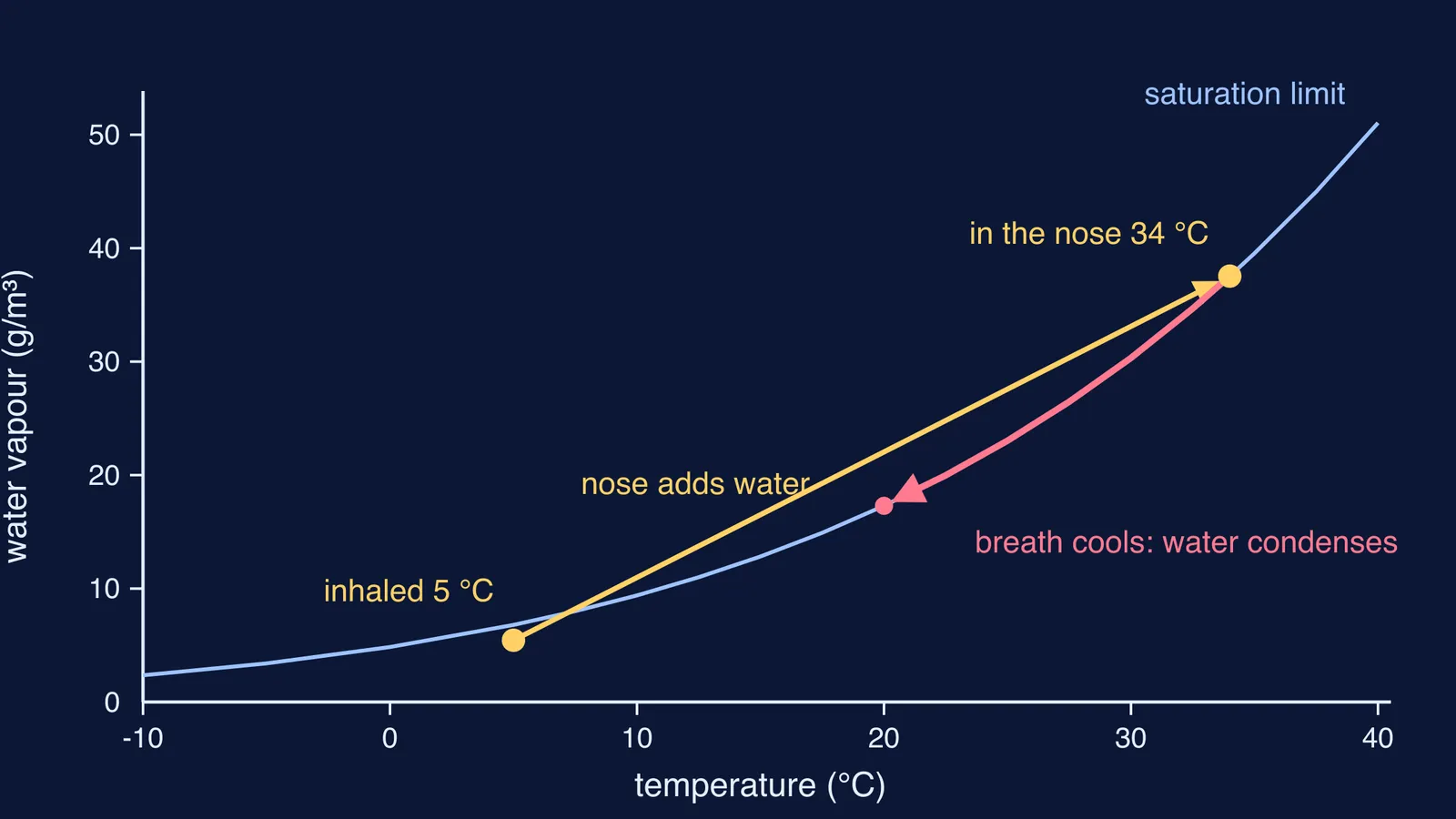
A winter morning at 5°C and 80% relative humidity: es is about 8.7 hPa, so saturated air would hold about 6.8 g/m³, and 80% of that is about 5.4 g/m³. (If "80% relative humidity" feels fuzzy, read what relative humidity really means.)
Air at the back of your nose at 34°C, taken as saturated: es is about 53.2 hPa, or about 37.5 g/m³.
The difference: your nose adds about 32 g of water to every cubic metre you breathe in, which is 32 mg per litre.
Now a humid 30°C day at 70%: that air already carries about 21.2 g/m³, so your nose adds only about 16 g/m³. The cold morning asks your nose for roughly twice the water.
On the way out, suppose that same saturated 34°C air cools to 20°C near the front of your nose (an illustrative figure). Saturated air at 20°C holds only about 17.3 g/m³, so up to about 20 g/m³ could condense.
The diagram above plots this path. Curves like this are easier to see than to read, and the Fermi Simulation Lab has interactive simulations for that kind of idea.
How do you write this as a 'give reason' answer?
If a question asks why the nose runs in winter, three linked points cover it:
The nose warms and humidifies inhaled air before it reaches the lungs.
Cold, dry air triggers a nerve reflex that increases nasal secretion.
Warm, moist exhaled air condenses on the cooled nasal lining, and the extra liquid drips out.
To see step 3 at home, breathe gently on a steel tumbler straight from the fridge and on one at room temperature. The room-temperature one may mist for a moment, but the cold one fogs far more and stays fogged longer, because its surface is much further below the dew point of your breath.
If the respiratory system chapter has gaps, the Fermi Concept Library has a lesson for every concept in biology, physics and chemistry, each with its place in the map.
When is a runny nose more than the cold?
A clear drip that starts outdoors and settles indoors fits the picture above. Winter also brings infections; read why colds spread more in winter. A runny nose that comes with fever, thick or coloured mucus or face pain, or that lasts for days indoors too, points to something other than cold air, and that is a question for a doctor.
Next time you reach for a tissue at the bus stop, you will know two subjects are at work: biology and physics.


