On this page
Everything with mass pulls on everything else. So why doesn't your friend on the next bench drag you over? The pull is real, just far too small to notice.
How strong is the gravitational pull between two people?
Newton's law of gravitation gives the force between two masses: F = G m₁ m₂ / r². The constant G is 6.674 30 × 10⁻¹¹ m³ kg⁻¹ s⁻², according to the NIST CODATA 2022 value. (m³ kg⁻¹ s⁻² is the same unit as N m²/kg².) The force only becomes large when at least one mass is enormous.
Take two people of 60 kg each, standing 1 m apart, and treat each one as a point mass:
Multiply the masses: 60 × 60 = 3,600 kg².
Multiply by G: 6.674 × 10⁻¹¹ × 3,600 = 2.40 × 10⁻⁷.
Divide by r² = 1 m²: F ≈ 2.4 × 10⁻⁷ N, or about 0.24 micronewtons.
That is the whole pull between two adults standing close together. Your skin has no chance of noticing it.
Why does Earth's gravity feel so strong, then?
Because Earth's mass is huge. The NASA Earth fact sheet gives Earth's mass as 5.9722 × 10²⁴ kg and its mean radius as 6,371 km. Put those into the same formula for a 60 kg person and you get about 589 N. Using the standard acceleration of gravity, 9.806 65 m/s², weight = mg gives 588 N. The two answers agree.
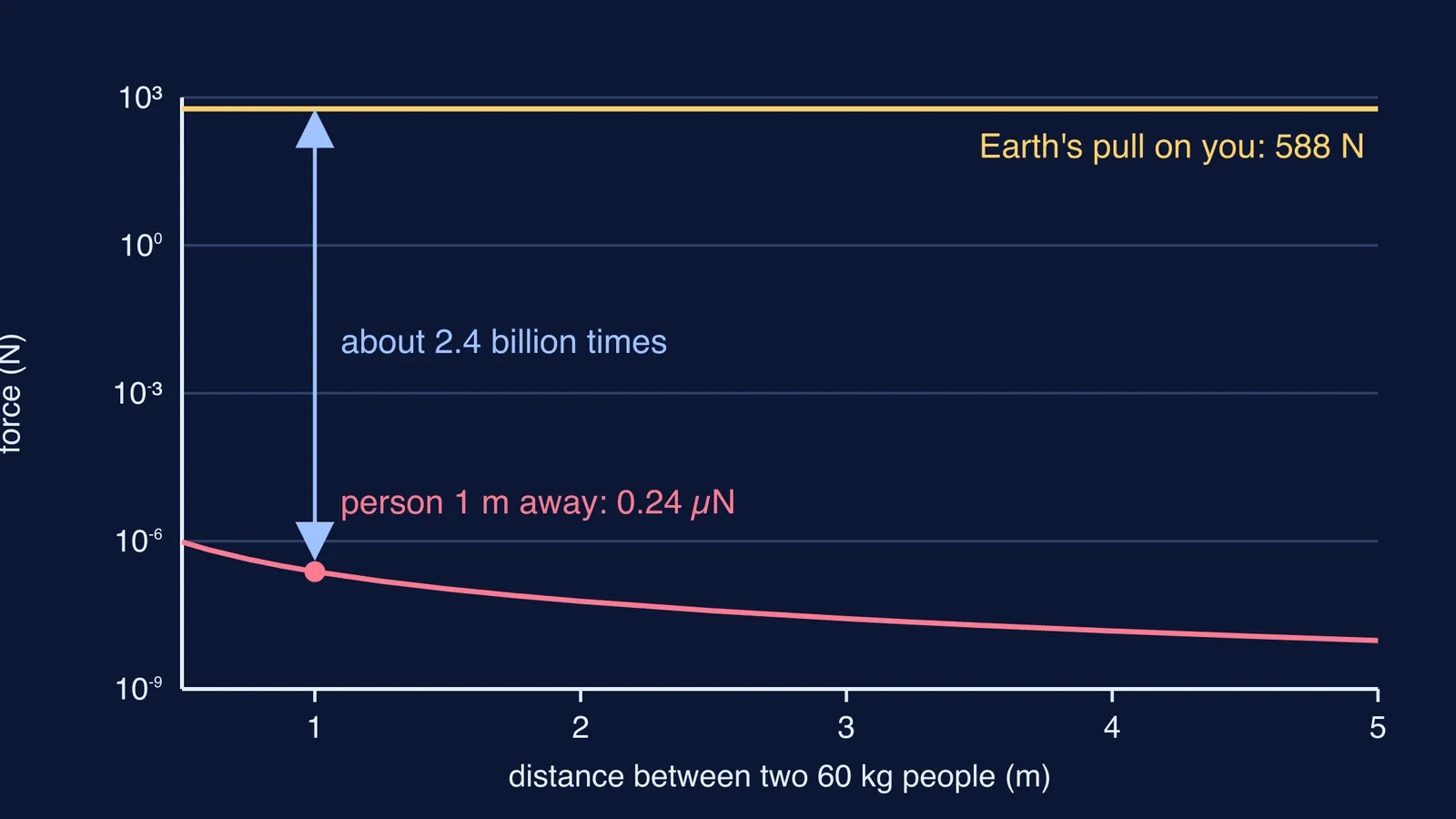
So Earth's pull on you is about 588 N, and your friend's pull at 1 m is about 0.00000024 N. Divide one by the other and Earth wins by a factor of roughly 2.4 billion. The hero diagram above plots this gap: even as two people get closer, their mutual pull stays around nine powers of ten below their weight.
There is a second reason you never notice it: friction and the push of the floor hold you in place, and they easily cancel a sideways tug of a fraction of a micronewton. If you want the small letter and the capital letter kept straight, our post on the difference between g and G walks through both.
What would happen if nothing else was pushing on you?
Imagine the same two people floating at rest 1 m apart in deep space, with no air, floor or other forces. Use the same NIST value of G as before.
Each person's acceleration is a = Gm / r² = 6.674 × 10⁻¹¹ × 60 ≈ 4.0 × 10⁻⁹ m/s².
They move towards each other, so the gap closes at twice that: about 8.0 × 10⁻⁹ m/s².
After one minute, the gap shrinks by ½ × 8.0 × 10⁻⁹ × 60² ≈ 1.4 × 10⁻⁵ m, about 14 micrometres.
After one hour, it shrinks by ½ × 8.0 × 10⁻⁹ × 3,600² ≈ 0.05 m, roughly 5 cm.
So the pull does act, and given time it would bring you together. On Earth, a breath of air swamps it. (We treated the force as constant; it grows slightly as the gap closes.)
Has anyone actually measured the pull between ordinary objects?
Yes. In 1798 Henry Cavendish published Experiments to determine the density of the earth in the Philosophical Transactions of the Royal Society (background on the Cavendish experiment). He used an apparatus designed by John Michell: a wooden arm 6 feet long, hung by a wire 40 inches long, with a small lead ball at each end and the whole thing shut in a wooden case to keep out draughts. The paper describes the aim as "rendering sensible the attraction of small quantities of matter". Our post on how the Cavendish experiment measured G covers how the twist turns into a number.
Gravity is also tiny next to the electric force. Compare the two for an electron and a proton in Coulomb force versus gravity.
How do you estimate the pull of any nearby object?
Use this four-step check:
Write F = G m₁ m₂ / r² with every quantity in SI units: kg and metres.
Round G (NIST CODATA 2022) to 6.7 × 10⁻¹¹ and work in powers of ten first. Get the exponent right, then fix the leading digits.
Compare with a force you know, such as your weight (mass × 9.8 N) or the weight of a small object.
Ask what else acts on the object: friction, air, a normal force. If those are millions of times bigger, the gravitational pull won't show.
Try it on a 1,000 kg car whose centre is 3 m from you (a 60 kg person): 6.7 × 10⁻¹¹ × 1,000 × 60 / 9 ≈ 4.5 × 10⁻⁷ N. That is still under a micronewton.
If powers of ten keep tripping you up, the Fermi Problem Library has worked problems with a step-by-step solver that explains the reasoning rather than printing an answer. If you'd rather see an idea than read about it, the Fermi Simulation Lab has interactive simulations for ideas that are easier to see than to read.