

On this page
In many homes, the trick for a shining mirror is a crumpled sheet of yesterday's paper. The habit has real reasons behind it, each a chapter from your science textbook: capillary action, loose fibres and friction. It also has limits.
Why do people clean windows with newspaper?
A good glass wiper has to do three jobs. It has to lift the dirty water off the surface, leave nothing of itself behind, and rub hard enough to loosen grime without scratching. Cleaning guides describe newsprint as made largely from ground-up wood pulp, with densely packed fibres that are unlikely to separate into lint, and a slightly abrasive texture that helps lift dirt (House Digest). Each of those claims maps onto one idea in physics or chemistry.
How does paper soak up water from glass?
Capillary action is a liquid flowing into a narrow space without the help of outside forces such as gravity (Wikipedia: Capillary action). Water molecules stick to the cellulose in paper (adhesion) and to each other (cohesion), so water is pulled into the tiny gaps between fibres.
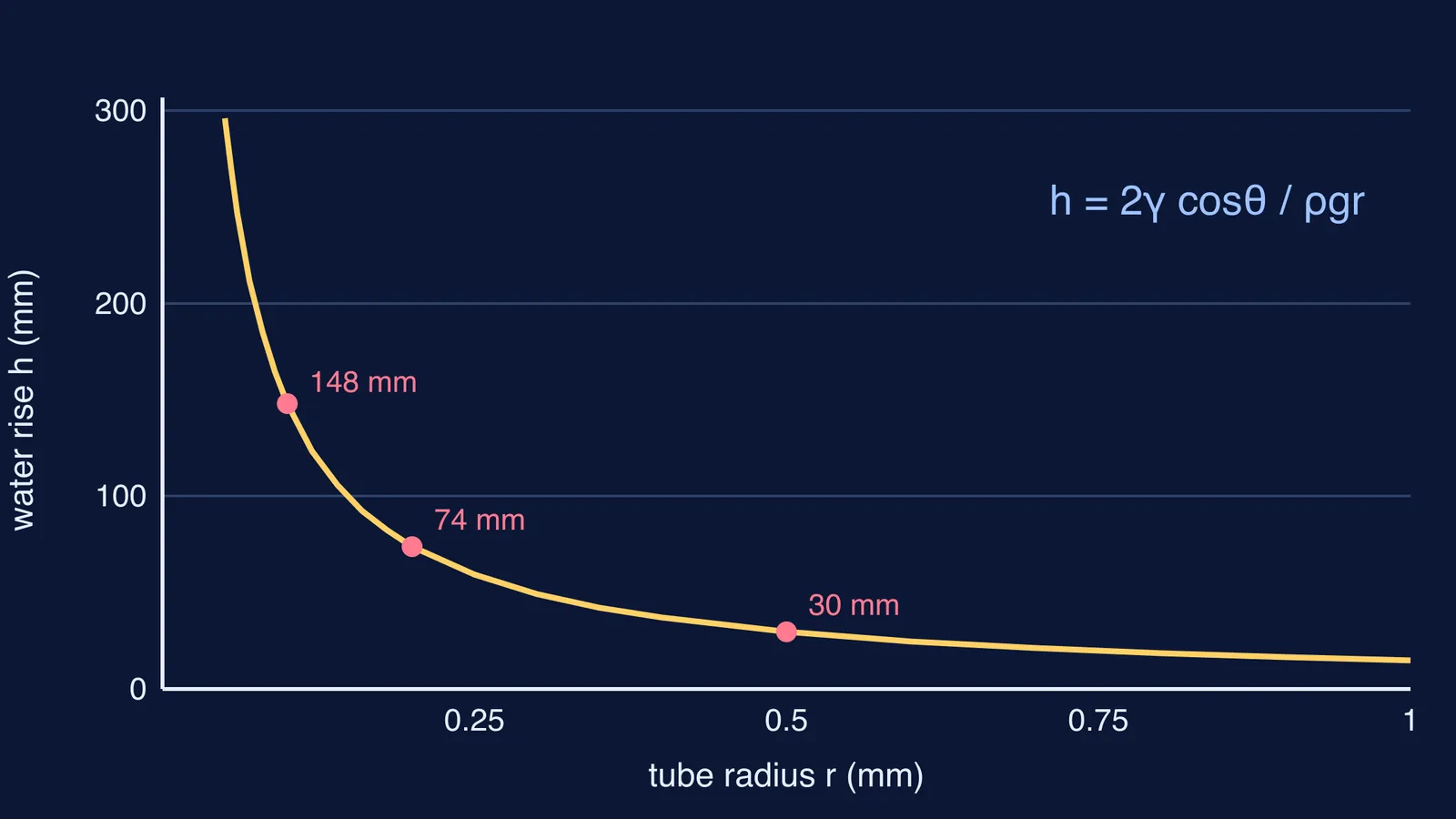
The narrower the gap, the stronger the pull. Jurin's law gives the height water climbs in a tube as h = 2γcosθ/ρgr, where r is the tube's radius (Wikipedia: Capillary action). For water in a glass tube of radius 0.2 mm, that works out to a rise of about 7 cm, and because r sits in the denominator, halving the radius doubles the height. Paper towels absorb liquid the same way, drawing it from a surface into the towel by capillary action, and the fine gaps between newsprint fibres do the same job on a wet pane. You can see the same idea in why gulab jamun soaks up syrup and in this capillary rise test with thin and wide tubes.
Real paper is messier than a neat tube. A 2020 study in the Journal of Fluid Mechanics by Sooyoung Chang and Wonjung Kim found that the swelling of the cellulose fibre network, together with the hollow insides of the fibres, strongly affects how fast water moves into paper. That helps explain why the classic Washburn equation predicts the speed poorly (Chang and Kim, 2020).
Why does lifting the water matter? Water hardness is the amount of dissolved calcium and magnesium in water, and hard water leaves spots or film on glasses as it dries (USGS Water Science School). A wiper that soaks the water up carries those minerals away.
Why doesn't newspaper leave lint like a cloth?
Lint is a visible build-up of textile fibres, and it comes from materials such as cotton, linen and wool, which contain many very short fibres that can work loose from the weave (Wikipedia: Lint)). An old cotton vest or towel can drop those fibres onto wet glass, where they dry as specks and haze.
In newsprint the fibres are pressed into a sheet rather than spun into thread, and, as the cleaning guide above notes, they are unlikely to separate into lint the way rags or paper towels do.
How does newspaper scrub off grime?
No surface is truly smooth. Friction comes from tiny bumps called asperities, and the real area of contact between two surfaces is a very small fraction of the area you see (Wikipedia: Friction). When you press and rub, the bumps on the paper catch on dried grime and fingerprint oil and drag them off. As the load increases, the number and area of contacts grows, which is why a firm rub tends to work better than a light wipe. More in our guide to ways to increase and decrease friction.
Is newspaper still a good idea for your windows?
Sometimes, but not always. Once the paper gets wet, the ink can leave dark stains on panes and wooden frames, and many modern windows carry low-emissivity, glare-reduction or other coatings that newsprint can scratch (House Digest).
Microfibre is the usual alternative. It is a synthetic fibre finer than one denier, under ten micrometres across, and its split fibres trap dirt and absorb liquid (Wikipedia: Microfiber). Microfibre cloths are used on scratch-prone surfaces such as screens, glass and lenses.
Which wiper works best? A quick test at home
You need a mirror, a spray bottle of water with a drop of dish soap, and three wipers: newspaper, an old cotton cloth, and a microfibre cloth or paper towel.
Mark three equal patches and smudge each the same way, say a fingerprint and a little hair oil.
Predict which wiper leaves the clearest patch, and write why, using capillary action, lint and friction.
Spray each patch twice and wipe with a different wiper, same number of circles.
Once dry, look at each patch at a low angle against a torch, noting streaks, fibres and grey ink marks.
If your prediction was wrong, work out which job (soaking, shedding nothing, scrubbing) the winner did better. To see ideas like these move as you change the numbers, try the interactive simulations in the Fermi Simulation Lab. If adhesion or surface tension feels hazy, each has its own lesson in the Fermi Concept Library.


