

On this page
Dip a narrow glass tube into water and the water climbs up inside it, above the level outside. Dip a wider tube and it climbs less. How much less? Guess the heights first, then check them.
Why does water rise higher in a thinner tube?
The curved water surface inside the tube (the meniscus) has lower pressure just under it than the air above, and the water column rises until its weight balances that pressure difference. The NCERT Class 11 Physics chapter on mechanical properties of fluids (section 9.6.5) derives the result as h = 2S cos θ / (ρga).
Here h is the capillary rise, S the surface tension, θ the contact angle between water and glass, ρ the density of water, g the acceleration due to gravity and a the tube's radius. The same NCERT section notes that the rise "is larger, for a smaller a".
Because a sits in the denominator, height is inversely proportional to radius: halve the radius and the rise doubles. This rule is called Jurin's law, after James Jurin, whose 1718 paper in the Philosophical Transactions of the Royal Society investigated the ascent of water in capillary tubes. Our post on how James Jurin linked capillary rise to tube radius tells that story.
How high will water climb in each tube?
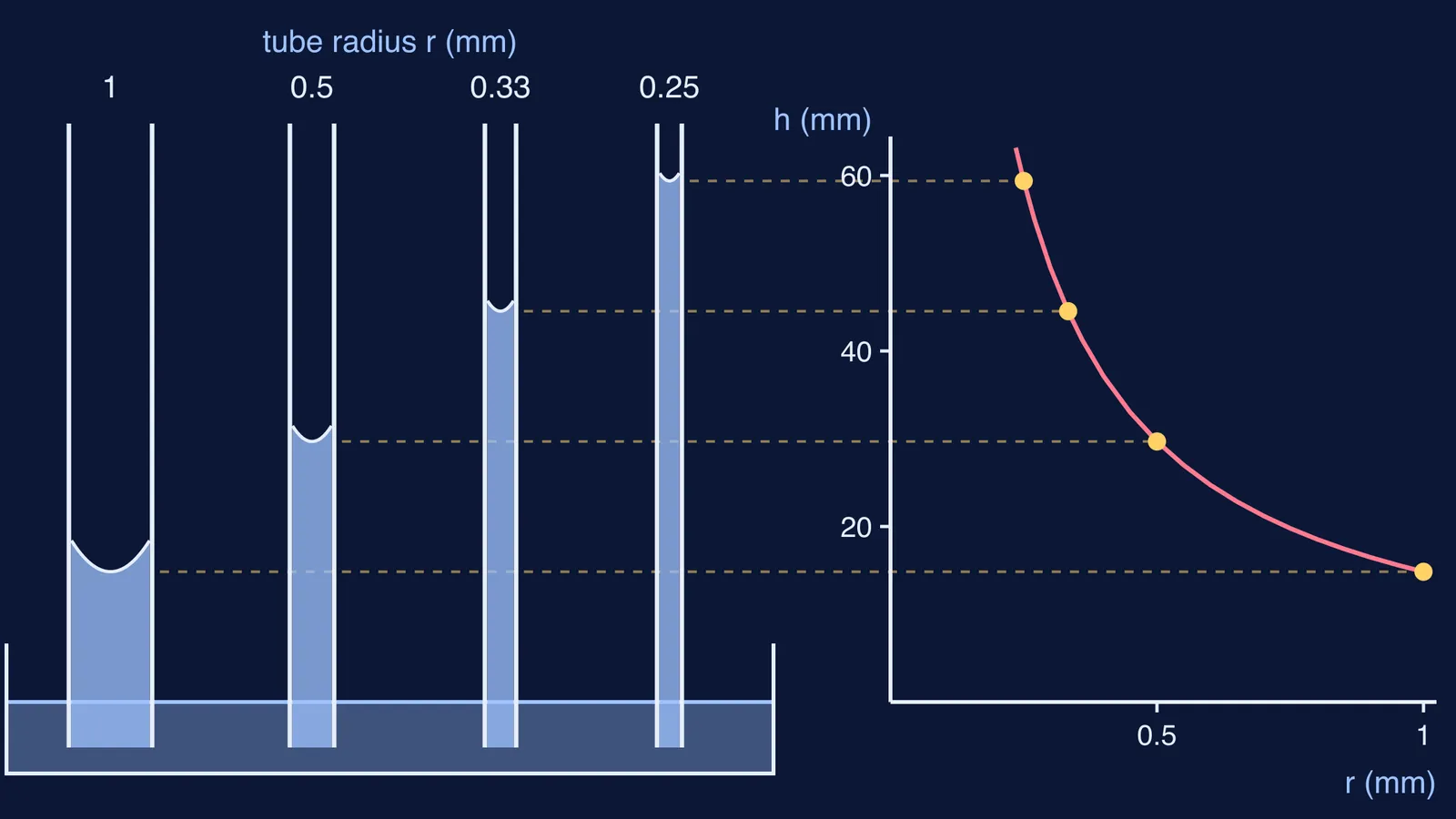
Predict before you calculate. Take four clean glass tubes with radii 1 mm, 0.5 mm, 1/3 mm (about 0.33 mm) and 0.25 mm. Before reading on, write down your guess for each height. Is the thinnest tube's water twice as high as the widest, or four times?
Now the worked numbers. The IAPWS release on the surface tension of water gives 72.74 mN/m at 20 °C, which is 0.07274 N/m. Use ρ = 1000 kg/m³ and g = 9.8 m/s², the values NCERT uses, and take cos θ = 1 for clean glass, as NCERT's own example does.
Then 2S / (ρg) = 2 × 0.07274 / (1000 × 9.8) = 1.48 × 10⁻⁵ m², which is 14.8 mm². Divide by the radius:
r = 1 mm: h ≈ 14.8 mm
r = 0.5 mm: h ≈ 29.7 mm
r = 1/3 mm (about 0.33 mm): h ≈ 44.5 mm
r = 0.25 mm: h ≈ 59.4 mm
NCERT's worked example gets 2.98 cm for a radius of 0.05 cm using S = 0.073 N/m, which matches the 0.5 mm row above.
What does the test show when you shrink the radius?
Going from 1 mm to 0.25 mm divides the radius by 4, so the rise is multiplied by 4, from about 15 mm to about 59 mm. That matches the Jurin's law figure for water in glass, h ≈ 1.48 × 10⁻⁵ m²/r. The steps are not even: the first halving adds about 15 mm, while the move from 0.33 mm to 0.25 mm, a much smaller change in radius, adds another 15 mm. That is what a 1/r curve looks like, and it is the shape in the diagram above.
The same logic explains why a very fine tube, such as a 0.1 mm radius, would pull water up about 148 mm by this formula. It is also why a cotton wick, full of tiny gaps, lifts liquid well; our post on why a diya wick draws up oil works through that case.
When does the capillary rise formula stop working?
Wide tubes. The simple law holds only when the tube's radius is smaller than the liquid's capillary length, as the summary of Jurin's law notes. For water, the capillary length, the square root of S/(ρg), works out to about 2.7 mm with the values above, so a 2 mm radius is already near that limit.
Mercury. NCERT points out that mercury's meniscus is convex, so cos θ is negative and the liquid sits lower in the tube than outside.
Dirty glass or added soap. Both change the contact angle or the surface tension, so measured heights drift from the clean-glass prediction.
A 10-minute predict-and-test routine
Write the formula and circle the one quantity you will change (the radius).
Predict the heights for at least three radii, and say in words what should happen to h × r.
Run the test: real capillary tubes, a simulation, or the formula in a spreadsheet.
Compare. If a prediction was off, find which step went wrong: units (mm against m), radius against diameter, or the factor of 2.
Change one more thing, such as a liquid with lower surface tension, and predict again before you test.
If you are doing this in the school lab, our guide on how to find surface tension by capillary rise runs the formula backwards, from a measured height to S.
When a prediction keeps going wrong and you cannot see why, Fermi's AI tutor notices where you are stuck and decides whether to explain, ask or show. For other ideas that are easier to see than to read, the Fermi Simulation Lab has interactive simulations to use with the same predict-then-test habit.


