

On this page
In 1718 an English physician named James Jurin showed the Royal Society a set of glass-tube experiments and an explanation of why water climbs a narrow tube and what decides how high it goes. His result is now called Jurin's law, the basis of the capillary formula in school physics and JEE.
Who discovered that capillary rise depends on tube radius?
Jurin, with an earlier name beside him. The history on Wikipedia's page on Jurin's law says Giovanni Alfonso Borelli's experiments in 1670 had already found that the rise was inversely proportional to the radius of the tube, and that Jurin confirmed this in 1718, after which the law was named in his honour. The 1911 Encyclopaedia Britannica article on capillary action credits Francis Hauksbee (spelled Hawksbee there) with the first accurate observations of capillary action in tubes and glass plates, in a 1709 book and later papers.
Jurin's paper, "An account of some experiments shown before the Royal Society; with an enquiry into the cause of the ascent and suspension of water in capillary tubes", appeared in Philosophical Transactions volume 30, pages 739-747, dated 30 April 1718 in the Crossref record of the paper. The Dictionary of National Biography records that he studied at Trinity College, Cambridge, took his MD in 1716 and was secretary of the Royal Society from 1721 to 1727.
What did Jurin's 1718 experiment actually show?
In the paper's opening lines, shown as the abstract in the Crossref metadata, Jurin writes that a friend had proposed a perpetual motion machine based on an observation by the late Mr Hawksbee, and that he could not at first see why it should not succeed.
His key result, as the 1911 Britannica summarises this paper and a 1719 follow-up, is that the height at which the liquid is suspended depends on the section of the tube at the surface of the liquid, and is independent of the form of the lower part. Only the bore at the water's top surface counts.
He also named a cause, in words the Britannica quotes: "the attraction of the periphery or section of the surface of the tube to which the upper surface of the water is contiguous and coheres." In plain words, the pull comes from the ring of glass touching the top edge of the water.
How does h = 2T cos θ / rρg follow from Jurin's idea?
According to the 1911 Britannica, Thomas Young founded capillary theory on the principle of surface tension in an essay published in 1805. Put the two ideas together:
The water surface meets the glass along a circle of length 2πr.
Surface tension T pulls along that circle at the contact angle θ, so the upward force is 2πr T cos θ.
The raised column of water weighs πr²hρg.
At equilibrium the two balance: 2πr T cos θ = πr²hρg.
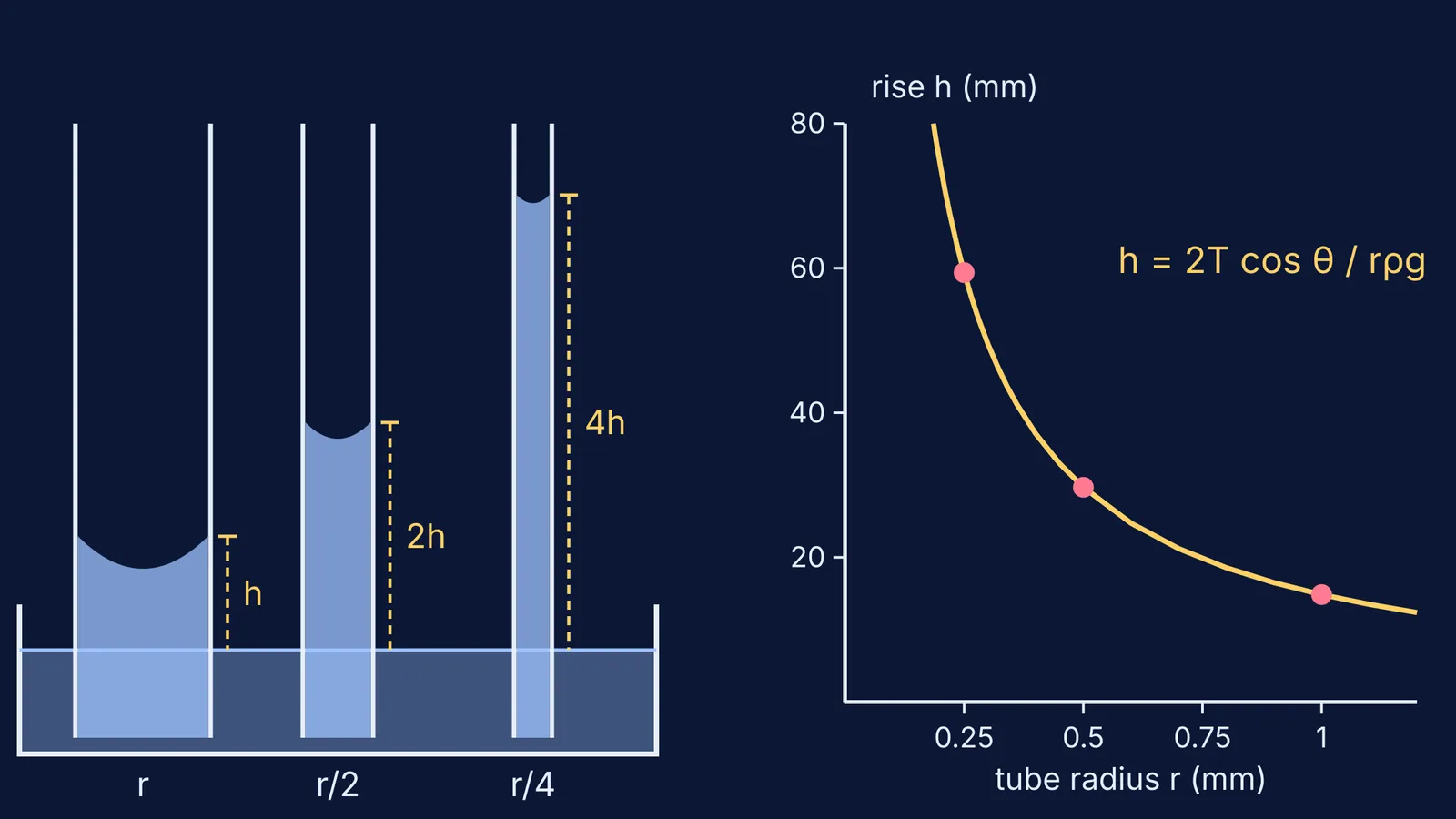
Divide both sides by πr²ρg: h = 2T cos θ / rρg.
The pull grows with the perimeter (r) but the weight grows with the cross-section (r²), so thinner tubes win. The same physics explains why a diya wick draws up oil.
If forces along a curved liquid surface are hard to picture, the Fermi Simulation Lab has interactive simulations for ideas that are easier to see than to read.
How high does water rise in a thin glass tube?
For a worked example, the IAPWS release on the surface tension of water gives 72.74 mN/m for water at 20 °C. Assume clean glass (θ ≈ 0, so cos θ ≈ 1), ρ ≈ 1000 kg/m³ and g = 9.8 m/s².
Then 2T/ρg = 2 × 0.07274 / (1000 × 9.8) ≈ 1.48 × 10⁻⁵ m², which is about 14.8 mm². So the rise in millimetres is roughly 14.8 divided by the radius in millimetres:
r = 1 mm gives h ≈ 14.8 mm
r = 0.5 mm gives h ≈ 29.7 mm
r = 0.25 mm gives h ≈ 59.4 mm
r = 0.1 mm gives h ≈ 148 mm, nearly 15 cm
Each time the radius halves, the height doubles: for a given liquid, tube and temperature, h × r stays fixed.
Exam checklist: five checks before you use Jurin's law
Radius or diameter? Halve the diameter before you substitute.
Units: T in N/m (1 mN/m = 0.001 N/m) and r in metres.
Contact angle: if θ is more than 90°, cos θ is negative, so h is negative and the liquid sits below the outside level.
Temperature: the same IAPWS table lists 71.98 mN/m at 25 °C and 58.92 mN/m at 100 °C, so water rises less in a tube of hot water.
Geometry: a tube shorter than h does not overflow (here is why water never overflows a capillary tube that is too short), and two flat plates need the formula for capillary rise between parallel plates.
When a capillary numerical keeps coming out wrong and you cannot see why, the Fermi Problem Library has worked problems with a step-by-step solver that explains the reasoning rather than printing an answer.


