

On this page
It is a classic trap question in Class 11 fluids: a capillary tube sticks out of the water by less than the height water would normally climb. Does the water gush out of the top like a fountain? It does not, and once you see why, the question becomes a free mark.
Does water overflow from a capillary tube that is too short?
No. The water rises to the top of the tube and stops there, with its surface spread across the rim.
Capillary rise in a tube of radius r is h = 2T cos θ/(ρgr), where T is surface tension, θ is the contact angle and ρ is the liquid's density (OpenStax College Physics 2e, section 11.8). The same OpenStax section lists the surface tension of water at 20 °C as 0.0728 N/m and the water–glass contact angle as 0°.
The formula tells you how high water climbs in a long enough tube, not what happens in a short one. For that, look at the meniscus.
Why does hR stay constant?
In a narrow round tube the meniscus is part of a sphere, and its radius is R = r/cos θ (Young–Laplace equation, Wikipedia). The pressure jump across this curved surface is 2T/R, so just below it the water is at lower pressure than the air above. That deficit holds the column up, so ρgh = 2T/R, which rearranges to hR = 2T/(ρg).
Look at the right-hand side: surface tension, density and g. None of them depends on the tube. With T = 0.0728 N/m it comes to about 1.5 × 10⁻⁵ m². The same Wikipedia page writes the rise in terms of tube radius: for water in glass, h ≈ 1.4 × 10⁻⁵ m² divided by the radius (it assumes a 20° contact angle), so a tube of 1 mm radius lifts water about 14 mm and one of 0.1 mm radius about 14 cm.
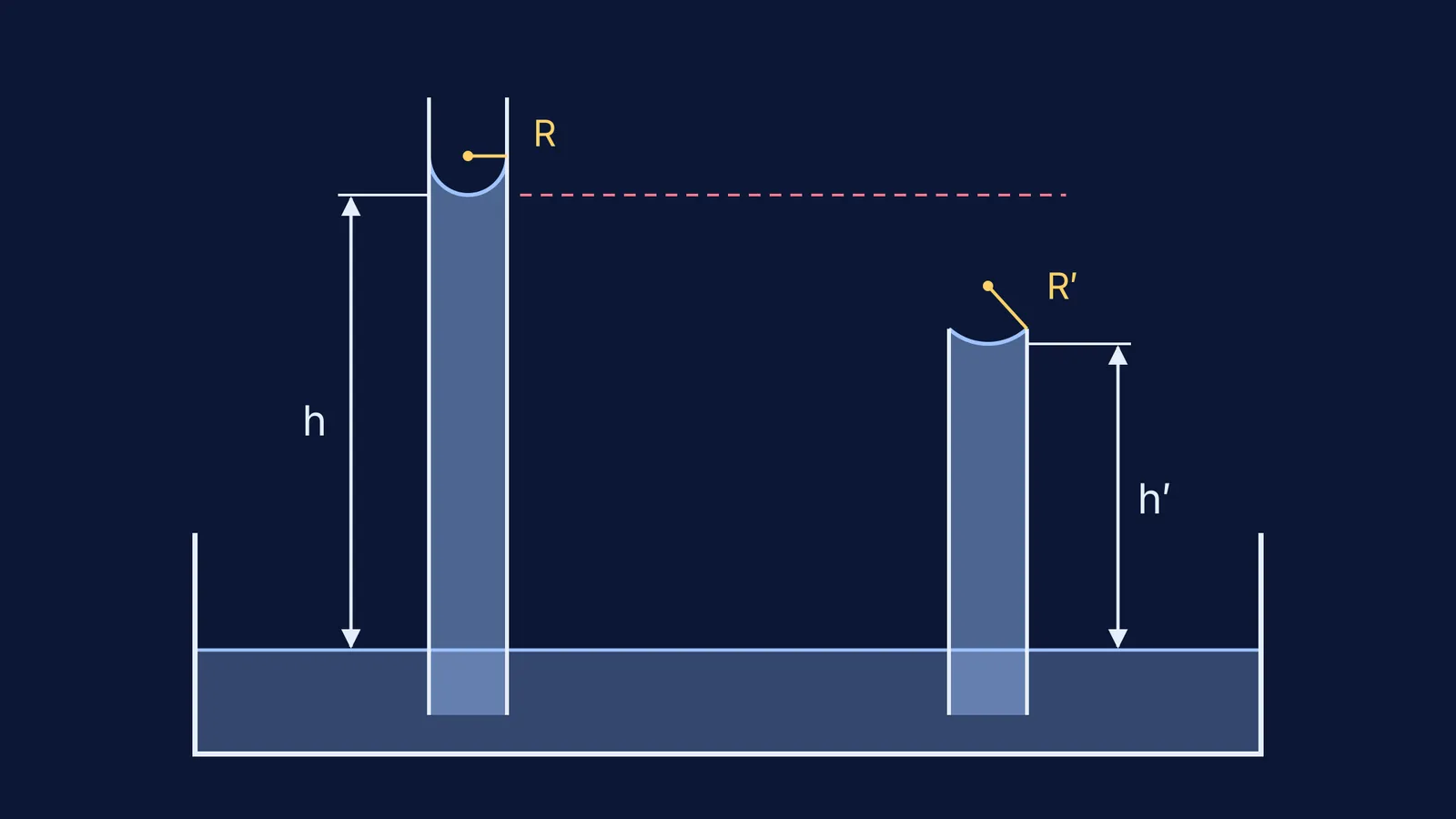
Now cut the tube short. The column cannot be taller than the tube, so h is capped at the tube's length L. Since hR must stay the same, R grows to 2T/(ρgL). The meniscus clings to the rim and flattens just enough for the smaller pressure deficit to hold the shorter column. If you have met excess pressure in soap bubbles and charged conductors, this is the same 2T/R idea.
Worked example: a 5 cm tube where water wants 7.4 cm
Take a clean glass tube of radius 0.2 mm, with T = 0.0728 N/m and θ = 0° (OpenStax section 11.8), ρ = 1000 kg/m³ and g = 9.8 m/s².
Free rise in a long tube: h = 2T/(ρgr) = 0.1456/(1000 × 9.8 × 0.0002) = 0.1456/1.96 ≈ 0.0743 m, or 7.43 cm.
With θ = 0°, the meniscus is a hemisphere, so R = r = 0.2 mm. The product hR is 0.0743 × 0.0002 ≈ 1.49 × 10⁻⁵ m².
Now the tube stands only 5 cm above the water. The column stops at h′ = 5 cm.
Keep hR fixed: R′ = hR/h′ = (1.49 × 10⁻⁵)/0.05 ≈ 2.97 × 10⁻⁴ m, or about 0.30 mm.
Check the shape: cos θ′ = r/R′ = 0.2/0.297 ≈ 0.67, so the surface meets the rim at about 48° instead of 0°. The surface is pinned at the sharp rim, so it simply gets shallower; surface tension has not changed.
What is the common wrong answer?
"It overflows and keeps flowing." If it did, you could put a small water wheel under the drip and run it forever off a beaker of still water. That would be energy from nothing. Surface tension can hold water up. It cannot pump it.
"R′ = R × h′/h." This upside-down ratio gives a smaller radius and a more curved meniscus, which would lift water higher, not lower. Since h × R is constant, a shorter column always means a larger radius.
"The surface tension drops." T is a property of water and air at that temperature. What changes is the radius of the meniscus, and with it the apparent angle at the rim.
If you keep mixing up which quantities are fixed and which adjust, the Fermi Problem Library has worked problems with a step-by-step solver that explains the reasoning rather than printing an answer.
How do you answer it in an exam?
Use this checklist for any "insufficient length" question:
Write h = 2T cos θ/(ρgr) and rewrite it as hR = 2T/(ρg), a constant.
State that h cannot exceed the tube length, so h′ = L.
Find R′ = hR/L and note that R′ > R, so the meniscus is flatter.
Conclude: water reaches the top, does not overflow, and the meniscus radius increases.
If the link between curvature and pressure still feels shaky, the Fermi Concept Library gives each concept, surface tension included, its own lesson and its place in the map. Then try the neighbouring topics: surface tension and viscosity, from capillary rise to terminal velocity, and the pressure, buoyancy and Bernoulli mistakes to avoid.


