

On this page
Capillary action is usually taught using a narrow glass tube, but exam papers often ask what happens when a liquid is drawn up between two flat, parallel plates. The physics is exactly the same—a balance between the upward pull of surface tension and the downward pull of gravity—but the geometry changes the final result.
How do you derive the capillary rise between two parallel plates?
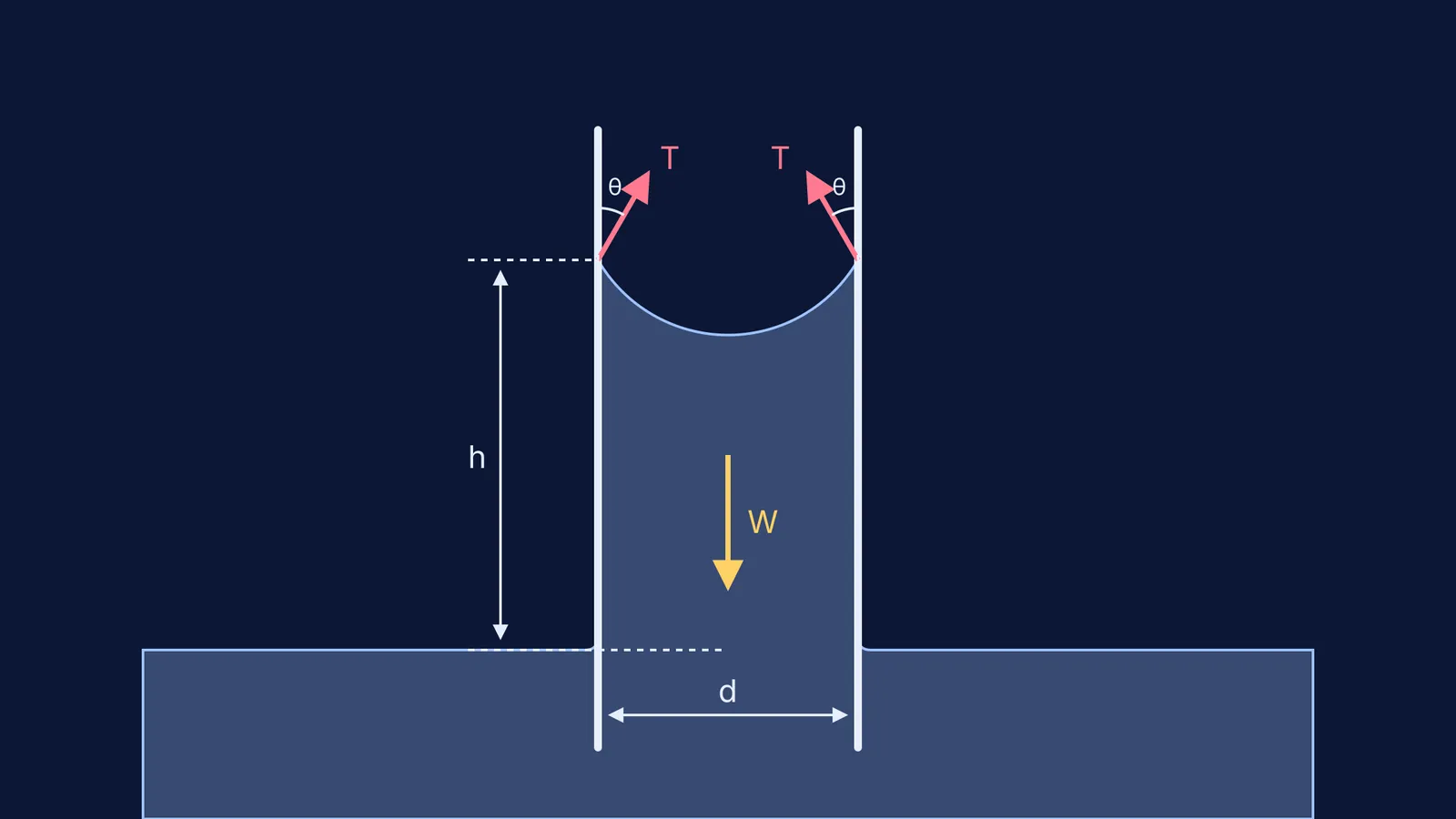
To find the height h that the liquid reaches, we set up an equilibrium equation. Imagine two parallel plates of width L, separated by a small distance d, dipped into a liquid with density ρ and surface tension T.
Calculate the upward force
Surface tension acts along the line where the liquid meets the solid. For two plates, there are two such contact lines, each of length L. The force on each line is T × L. If the liquid meets the plates at a contact angle θ, the vertical component of this force is TL cos θ. Since there are two plates, the total upward force pulling the liquid is F_up = 2TL cos θ.
Calculate the downward force
Gravity pulls down on the mass of the raised liquid. The volume of the liquid column between the plates is V = L × d × h. Its mass is density times volume (m = ρLdh), so its weight is W = ρLdhg.
Balance the forces
The liquid stops rising when the upward surface tension exactly balances the downward weight: 2TL cos θ = ρLdhg
Divide both sides by L (which cancels out, showing the rise does not depend on the width of the plates) and rearrange to make h the subject: h = 2T cos θ / ρgd
For more on setting up force equations, see our guide to Surface tension and viscosity: capillary rise to terminal velocity.
Why does liquid rise less between plates than in a tube?
You might assume that plates separated by a distance d would draw liquid up to the same height as a tube of diameter d. However, they do not.
Jurin's law states that for a capillary tube of radius r, the height is h = 2T cos θ / ρgr (Wikipedia). If we rewrite this using the tube's diameter D (where r = D/2), the formula becomes h = 4T cos θ / ρgD.
Comparing the two formulas reveals a factor of two. If the plate separation d equals the tube diameter D, the liquid rises twice as high in the tube as it does between the plates.
The reason lies in the ratio of perimeter to area. A tube encloses the liquid completely, providing a full circular perimeter (2πr) to pull up a relatively small cross-sectional area (πr²). Parallel plates only pull on two flat sides, leaving the open ends unsupported. With less solid surface per unit volume of liquid, the capillary force cannot support as tall a column.
What happens if the plates are not completely parallel?
Examiners sometimes test this concept by asking what happens if the two plates touch at one vertical edge and form a small angle (like a slightly open book).
In this wedge shape, the separation distance d increases as you move away from the joined edge. Because the capillary height is inversely proportional to the separation (h ∝ 1/d), the liquid rises highest where the plates are closest. The resulting curve on the surface of the liquid forms a hyperbola.
Recognising how variables relate to one another is a core skill in Fluid mechanics: pressure, buoyancy and Bernoulli mistakes to avoid. If you find yourself memorising formulas rather than seeing these relationships, the Fermi Problem Library has a step-by-step solver that explains the reasoning rather than just printing an answer, helping you solve variations on exam day.


