

On this page
You bite your cheek at lunch, it stings through dinner, and two days later you can barely find the spot. A scrape of the same size on your elbow takes far longer and may leave a mark. That difference is not in your head. Researchers have measured it, and the reasons line up neatly with the tissues chapter in your biology textbook.
Do mouth wounds really heal faster than skin?
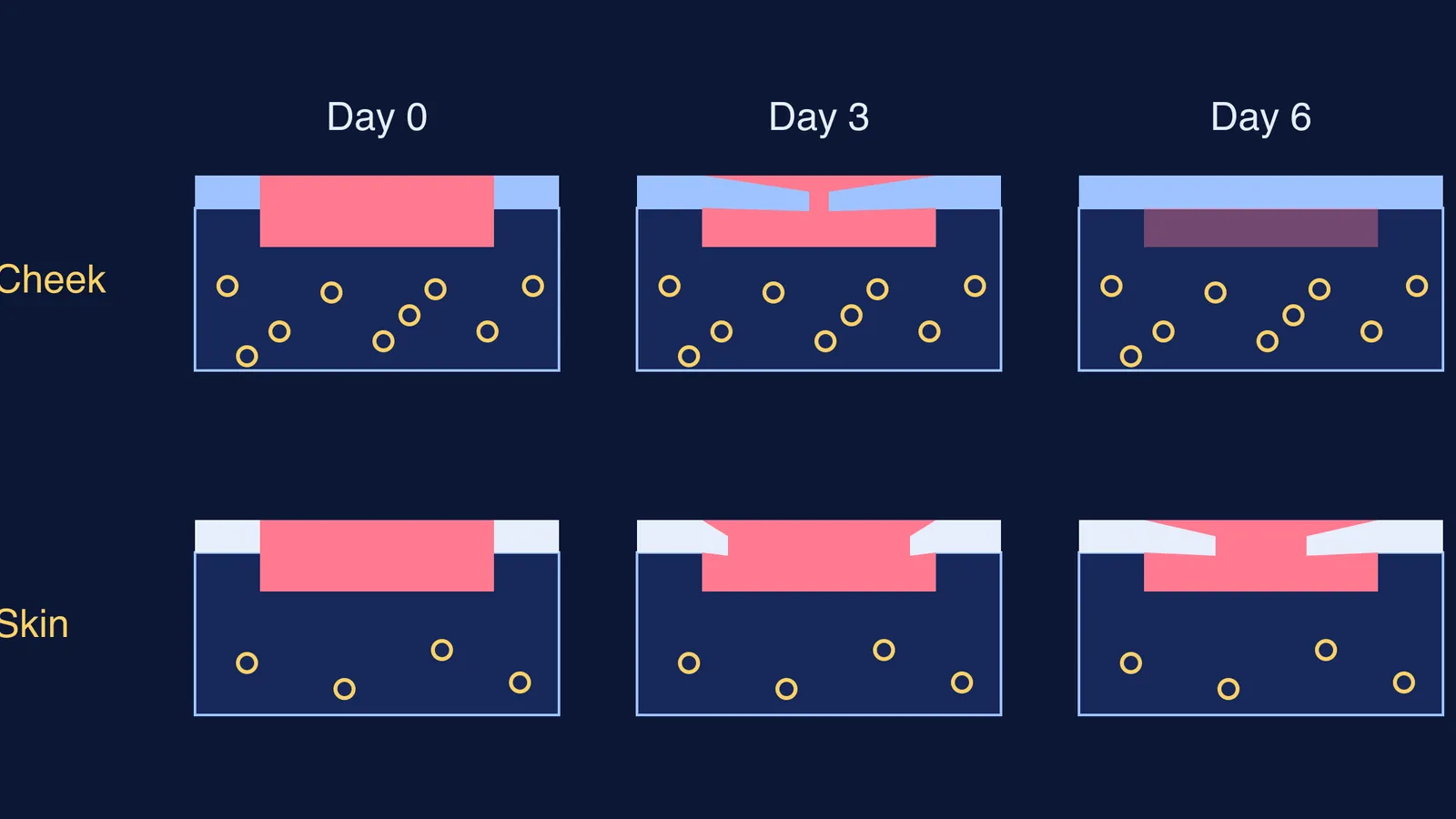
Yes, and a controlled human study shows it. In a 2018 study in Science Translational Medicine, researchers made 3 mm and 5 mm wounds in 30 healthy volunteers, pairing a wound on the inner cheek with one on the skin at the back of the upper arm, near the armpit (Iglesias-Bartolome et al., 2018). By day 3 the cheek wounds were almost completely covered by new epithelium, and by day 6 they had healed, while the skin wounds were still re-growing their surface layer (same study).
The mouth also scars less. A study that made matching wounds in the mouth lining and skin of pigs, and compared them with oral wounds in people, found significantly less scarring in the pig oral mucosa than in skin 49 days after wounding (Wong et al., 2009).
Why do cuts inside the mouth heal faster?
There is no single reason. Four things work together:
The cells are ready before the injury. The NIH team found that two genes that switch other genes on, PITX1 and SOX2, were much more active in uninjured mouth cells than in uninjured skin cells (NIH Intramural Research Program, 2018). The mouth lining starts out in a state that suits repair.
Inflammation stays calmer. A 2003 study of wounds of equal size found fewer macrophages, neutrophils and T cells in oral wounds than in skin wounds, and lower levels of the signal IL-6 and the scar-promoting signal TGF-β1 (Szpaderska et al., 2003). The authors concluded that weaker inflammation is a key feature of the mouth's faster repair.
More blood vessels. Studies of the human palate and of mouse tongue find more blood vessels in oral mucosa than in skin, which brings oxygen, nutrients and repair cells to a wound (Waasdorp et al., 2021).
Saliva bathes the wound. Saliva carries growth factors, including epidermal growth factor (EGF), vascular endothelial growth factor (VEGF) and fibroblast growth factors, plus small proteins called histatins (Waasdorp et al., 2021). Human saliva has far less EGF than rodent saliva, and in a cell culture assay, histatins 1 and 2 were the major factors in human saliva that helped wounds close, by making epithelial cells migrate (Oudhoff et al., 2008).
If you want the skin side of this story, our explainer on how a wound forms a scab walks through clotting and crust formation step by step.
How does this connect to the tissues you study?
This is a good example of structure explaining function. Both linings are stratified squamous epithelium sitting on connective tissue, but they differ in useful ways. If the tissue types feel fuzzy, revise them first with our guide to tissues for Class 9.
Here is a comparison you can turn into a short answer:
Surface: the inner cheek is non-keratinised epithelium (Waasdorp et al., 2021); skin has a dead, keratinised outer layer, covered in our post on skin structure, epidermis and dermis.
Layer below: the mouth's connective tissue (lamina propria) has more blood vessels than the dermis, according to the same review.
Environment: the mouth is always wet with saliva and its growth factors; skin is exposed to air and forms a scab.
Response: oral wounds show less inflammation and less of the scar-promoting signal TGF-β1.
A model 3-mark answer: "Oral mucosa heals faster than skin because its lamina propria has a richer blood supply, saliva keeps the wound moist and supplies growth factors and histatins that help epithelial cells migrate, and the inflammatory response is weaker, so repair is quicker and leaves less scar."
If processes like cells creeping across a gap are hard to picture from a textbook page, the Fermi Simulation Lab has interactive simulations for ideas that are easier to see than to read, and the Fermi Concept Library gives each biology concept its own lesson.
How long does a sore inside the mouth usually last?
Most small mouth injuries and ulcers settle on their own. The NHS says mouth ulcers should usually clear up on their own within a week or two (NHS, mouth ulcers).
The same NHS page advises seeing a GP or dentist if a mouth ulcer lasts longer than 3 weeks, looks different from ulcers you have had before, bleeds, or shows signs of infection such as more pain and redness. In India, that means your family doctor or a dentist.
Next time you bite your cheek, notice how fast it fades. You are watching blood supply, saliva and well-prepared cells do exactly what your textbook says they should.


