

On this page
The first heavy rains arrive, and a week or two later the evenings are full of whining mosquitoes. That delay is roughly how long a mosquito takes to grow from egg to flying adult, and rain gives every stage a place to happen.
Why are there more mosquitoes during the monsoon?
Mosquitoes cannot breed without water. Their eggs are laid on or just above standing water, and the larvae and pupae live in it. The monsoon fills puddles, blocked drains, old tyres, flower-pot trays, coolers and thrown-away plastic all at once.
A little water is enough. The US Centers for Disease Control and Prevention says *Aedes* mosquitoes, which spread dengue, "only need a small amount of water to lay eggs", and that females lay them on the inner walls of containers with water, above the waterline (CDC: life cycle of Aedes mosquitoes).
The rains also wake up eggs that were already waiting. *Aedes* eggs can survive drying out for up to 8 months, and the larvae hatch when water from rain or a sprinkler covers them (CDC).
Indian field data shows the same pattern. A 12-month survey of 75 houses in a rural area of Thrissur district, Kerala, found larvae in 180 of 959 wet containers. Wet containers, positive containers and positive houses were all more common in the rainy season, and plastic containers were the main breeding site (Mohamed Rafi M. and colleagues, 2023).
How long does a mosquito take to go from egg to adult?
About one to two weeks, depending on the type. From the CDC's life-cycle pages:
*Aedes* (dengue): egg to adult in 7 to 10 days, in small containers (CDC Aedes).
*Culex* (the common house mosquito): egg to adult in 7 to 10 days; rafts of 100 to 300 eggs on ponds, storm drains, buckets and tyres (CDC Culex).
*Anopheles* (malaria): egg to adult in 10 to 14 days; 50 to 200 eggs at a time in marshes and near the banks of shallow streams, and the eggs cannot survive drying out (CDC Anopheles).
For each stage in detail, read our guide to the mosquito life cycle, from egg and larva to pupa and adult.
Why does warm, wet weather make it faster?
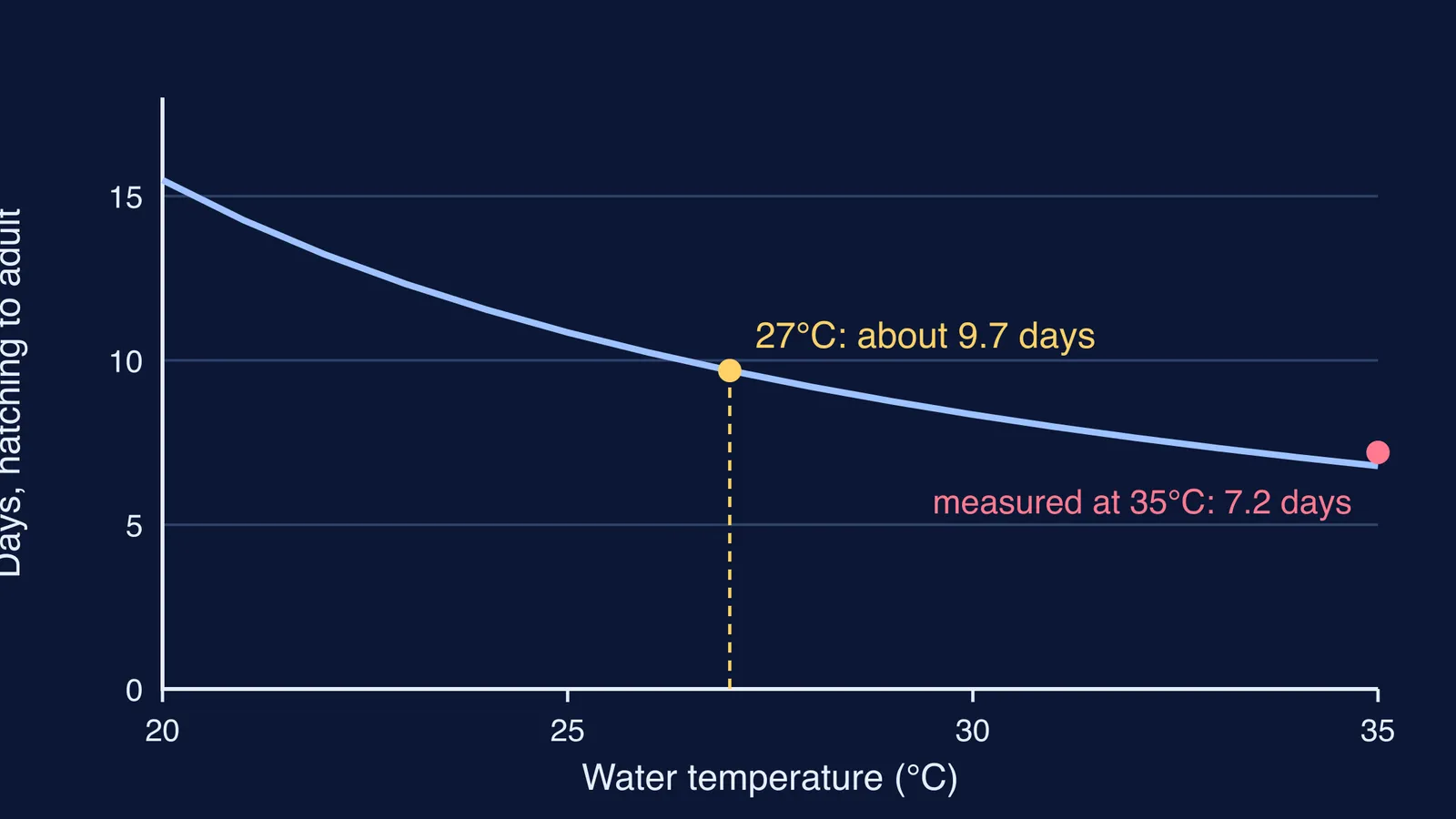
Mosquito larvae grow faster in warmer water. In a lab study of *Aedes aegypti*, the time from hatching to adult ranged from 7.2 days at 35°C to 39.7 days at 15°C, and the highest survival, 88 to 93%, came between 20 and 30°C (Tun-Lin, Burkot and Kay, 2000).
The same study gives a simple model you can calculate with. Development from hatching needs about 181.2 "day-degrees" above a threshold of 8.3°C, both estimates with wide error margins (Tun-Lin and colleagues, 2000). Each day the larva banks the degrees above 8.3°C; when the total reaches 181.2, it is an adult.
Worked example:
Water at 27°C is 27 − 8.3 = 18.7 degrees above the threshold.
Days needed = 181.2 ÷ 18.7 ≈ 9.7 days.
Water at 20°C is only 11.7 degrees above it, so 181.2 ÷ 11.7 ≈ 15.5 days.
Treat the formula as a rough guide: at 15°C the measured time (39.7 days) was longer than the 27 days it predicts. The World Health Organization also links climate change, with increasing temperatures, high rainfall and humidity, to the growing risk of dengue epidemics (WHO dengue fact sheet).
How can you stop mosquitoes breeding at home?
The WHO advises covering, emptying and cleaning household water-storage containers every week, and removing artificial habitats that can hold water (WHO). The weekly timing fits the 7 to 10 day cycle above. Pick one day, say Sunday, and do this round:
Empty and scrub flower-pot trays, buckets, pet bowls and bird baths. Scrub the walls, because *Aedes* eggs stick just above the waterline.
Drain and wipe the air cooler tank; here is why cooler water should be changed every week.
Tip out rainwater from old tyres, plastic sheets, cups and lids on the terrace and balcony.
Cover overhead tanks and drums tightly.
Clear blocked drains near the house, or report them to your local municipal office.
If anyone at home gets a fever during the monsoon, see a doctor rather than guessing at the cause.
How does this connect to your biology syllabus?
The mosquito is a textbook case of complete metamorphosis: egg, larva, pupa, adult. For revision, compare it with the silkworm life cycle, from egg to cocoon to moth: which stages feed, which live in water, and which stages a weekly clean-up targets (larva and pupa).
The day-degree model is also a neat bit of maths: a rate that depends on temperature, drawn as a curve. For ideas that are easier to see than to read, the Fermi Simulation Lab has interactive simulations.
This Sunday, do the round once and count the containers you tip out.


