On this page
On 20 July 1969, Buzz Aldrin walked on the Moon during Apollo 11 (NASA). The prints from that walk, and from the Apollo landings after it, should still be sitting in the grey dust. Here is why, and what will finally erase them.
Why do footprints on the Moon last so long?
Start with why footprints on Earth do not last. Weathering is the breaking down or dissolving of rocks and minerals at the surface, and erosion is what carries the broken bits away (National Geographic Education). On a beach in Goa or Puri, the next wave wipes out your footprint in seconds.
The Moon has almost none of these. It has no real atmosphere, only a very thin exosphere that is not breathable (NASA Moon facts). No air means no wind and no clouds, so no rain; there are also no rivers, plants or animals. NASA describes lunar "weather" as something that comes straight from space instead: the solar wind and a steady pelting by micrometeoroids (NASA Science).
The soil helps too. Nearly the whole Moon is covered in regolith, a layer of powdery dust and rocky debris (NASA Moon facts). Lunar dust is made of tiny jagged particles that interlock, not rounded grains like beach sand, which is why Aldrin observed that his footprints had sharp edges and the dust did not slip (DLR).
For the deeper reason the Moon lost its air, read our explainer on why the Moon has no air.
What will eventually erase the Apollo footprints?
Small impacts. At a 2011 NASA briefing, Mark Robinson, principal investigator of the Lunar Reconnaissance Orbiter Camera, said micrometeorite impacts happen at more than 53,000 km/h (NBC News). Each hit throws up a little dust. Over time, this "impact gardening" stirs the top layer of soil like a very slow plough.
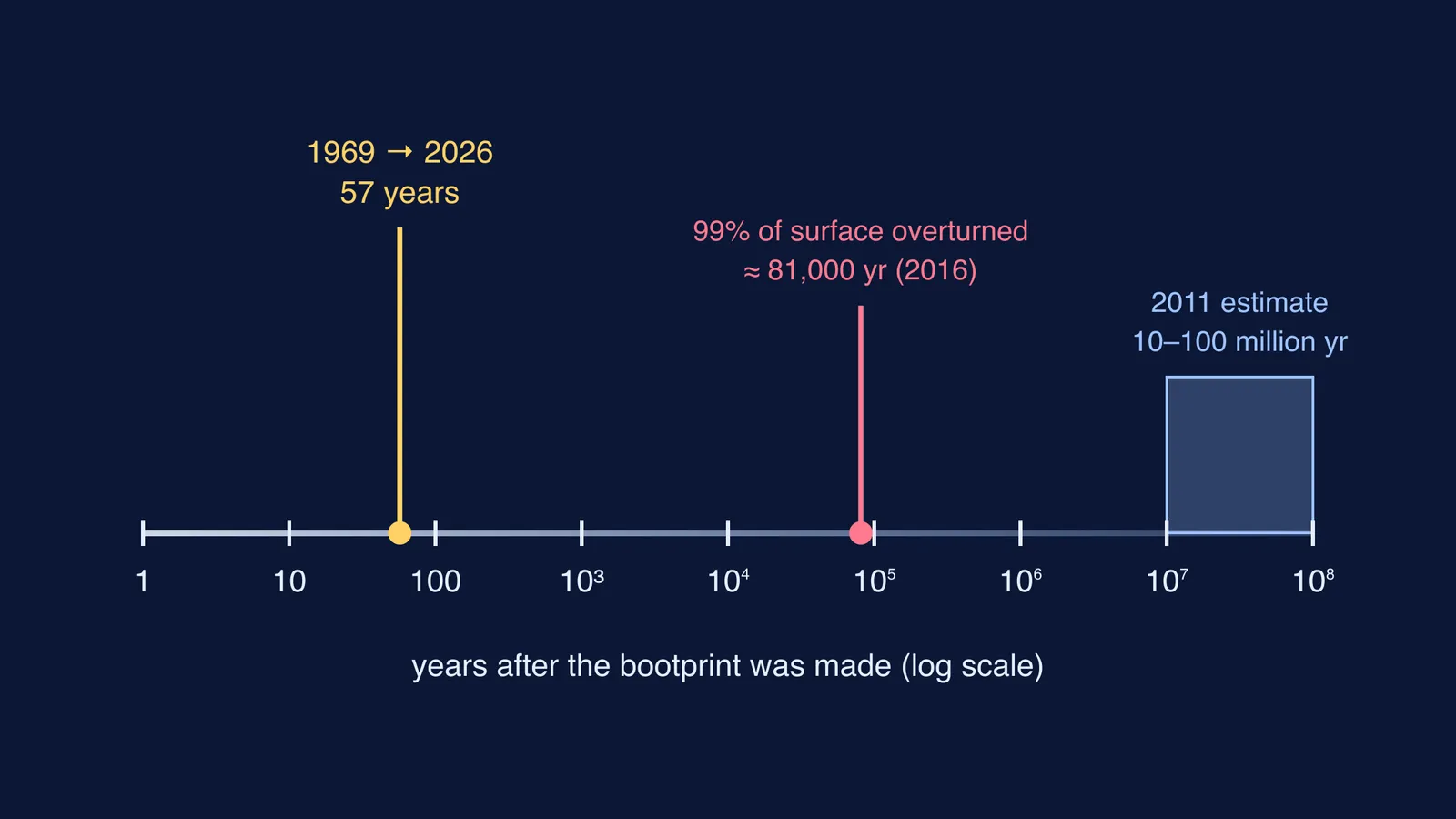
At that briefing, Robinson estimated that there would probably be no traces of Apollo exploration in "ten to a hundred million years". The same report notes that past studies of Apollo moon rocks found they erode by about 0.04 inches (about 1 mm) every million years (NBC News).
Then in 2016, a team led by Emerson Speyerer compared before-and-after images from NASA's Lunar Reconnaissance Orbiter and found over 200 new impact craters, about 30% more than earlier models predicted (NASA). From over 47,000 small surface changes, or "splotches", most likely caused by small impacts, the team found that 99% of the surface would be overturned after about 81,000 years, over 100 times faster than previous models that counted micrometeorite impacts alone (NASA). The study appeared in Nature (Speyerer et al., 2016). NASA's conclusion: the Apollo astronaut tracks will be gone in tens of thousands of years rather than millions.
The same steady bombardment explains a bigger puzzle, covered in why the Moon has craters and Earth does not.
How long is 81,000 years compared with now?
Here is a worked example using NASA's figure of about 81,000 years for 99% of the surface to be overturned (NASA).
Age of the Apollo 11 prints in 2026: 2026 minus 1969 gives 57 years.
Fraction of the overturn time used so far: 57 divided by 81,000 is about 0.0007, or 0.07%.
Scale it to one day: if 81,000 years were a 24-hour day (86,400 seconds), 57 years would be 0.0007 times 86,400, about 61 seconds.
So the first footprints are roughly one minute into a day-long fade.
Can we still see the footprints today?
Yes, from orbit. In September 2011, NASA released Lunar Reconnaissance Orbiter images of the Apollo 12, 14 and 17 sites showing the paths astronauts made as they explored, including astronaut footprints near the Apollo 14 site and the Apollo 17 lunar rover (NASA Scientific Visualization Studio).
The Moon does have harsh conditions of its own. Near the equator, temperatures can spike to over 121°C in daylight and plummet to -133°C at night (NASA Science), partly because a lunar day lasts about two weeks. But heat and cold alone cannot blow dust across a print. Moving dust sideways needs air, water or an impact.
A checklist for "why does it last?" questions
When a question asks why a mark, rock or object survives on the Moon, Mercury or an asteroid, run through the agents of weathering and erosion one by one:
Is there an atmosphere thick enough for wind?
Is there liquid water, ice or frost?
Are there living things, such as roots or burrowing animals?
What hits the surface from space, and how often?
Is the surface material loose and rounded, or jagged and cohesive?
Cross out each agent that is missing, and the one left standing is your answer. For the Moon, only the fourth survives.
When ideas like atmospheres and impacts are easier to see than to read, the Fermi Simulation Lab has interactive simulations you can try. If weathering itself is a gap, the Fermi Concept Library gives each concept in physics, chemistry and biology its own lesson.
That famous Apollo bootprint is about a minute into a very long day.