

On this page
When you look at the Moon through binoculars, its surface is pockmarked with thousands of circular depressions. Yet viewed from space, Earth looks almost completely smooth. According to the Earth Impact Database at the University of New Brunswick, scientists have confirmed only 190 impact craters across our planet. In contrast, a lunar census by Stuart J. Robbins in the Journal of Geophysical Research: Planets catalogued over 1.3 million craters larger than 1 kilometre across.
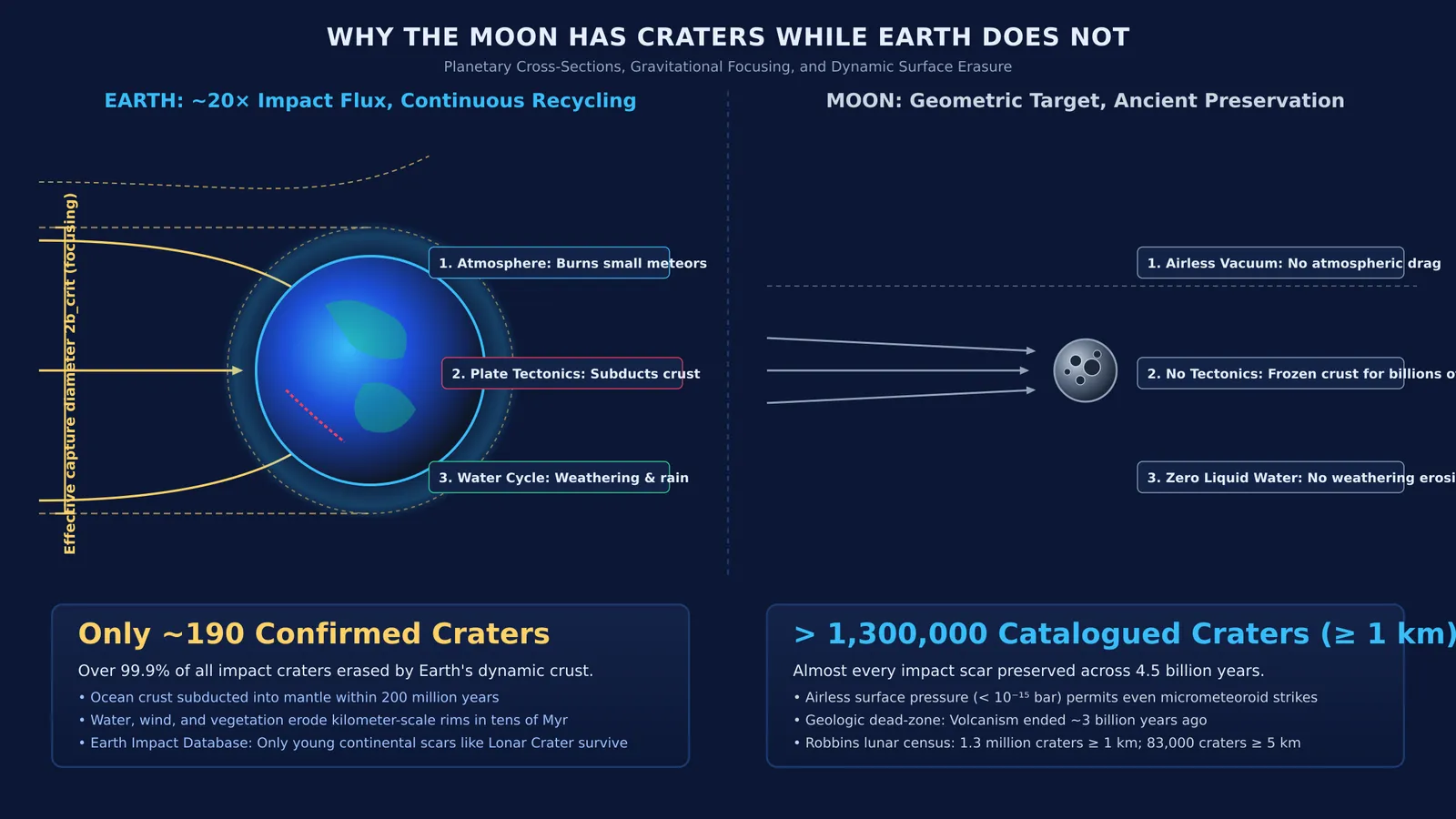
This contrast often leads students to assume that Earth escaped the solar system's collisions. In reality, Earth was struck far more often than the Moon. As NASA Space Place documents, the difference is not what hit each world, but how each world responded. The Moon is an airless, geologically inactive body that preserves collisions across billions of years. Earth is an active planet that continually recycles its crust.
Did Earth receive fewer asteroid impacts than the Moon?
Because Earth is larger and more massive than the Moon, it acts as a much bigger cosmic target. With Earth's radius at 6,371 kilometres compared to the Moon's 1,737 kilometres, Earth's physical cross-section is 13.5 times larger.
Earth's stronger gravity also bends passing asteroid trajectories inward through gravitational focusing. In planetary collision models published in Icarus, the effective collision cross-section σ is:
σ = πR² × [1 + (v_esc / v_inf)²]
Here, R is radius, v_esc is escape velocity (11.2 kilometres per second for Earth; 2.4 kilometres per second for the Moon), and v_inf is approach velocity (typically 15 to 20 kilometres per second). For an encounter speed of 15 kilometres per second, Earth intercepts roughly 20 times more impacts than the Moon, and 1.4 times more per unit area.
How do plate tectonics and water erase Earth's impact craters?
Earth erases its craters through three primary mechanisms:
Plate tectonics: Earth's lithospheric plates shift continuously above mantle convection currents, a mechanism explored in our study of Arthur Holmes and mantle convection. Research by R. Dietmar Müller in Geochemistry, Geophysics, Geosystems shows that oceanic crust is younger than 200 million years old due to subduction. Because oceans cover over 70% of Earth, ancient seafloor craters are recycled back into the mantle.
Weathering and erosion: Water, wind, and ice break down crater rims and fill basins with sediment. As Stefan Hergarten and Thomas Kenkmann demonstrated in Earth and Planetary Science Letters, terrestrial erosion erases craters under a few kilometres wide within tens of millions of years, reflecting James Hutton's discovery of deep time and rock cycles.
Atmospheric shielding: Atmospheric drag burns up stony meteoroids smaller than 25 to 50 metres across before they reach the ground. On the airless Moon, where surface pressure is below 10⁻¹⁵ bar, even micrometeoroids strike bedrock unimpeded, as seen during Chandrayaan-3's lunar landing.
Why does Lonar Crater in India survive when others vanished?
A few young impact structures on land still remain visible before erosion destroys them. A prominent example is Maharashtra's Lonar Crater. According to the NASA Earth Observatory, Lonar Crater measures 1.8 kilometres across and 150 metres deep, excavated from Deccan basalt roughly 52,000 years ago.
Because basalt forms the lunar plains, Lonar provides planetary scientists with a rare terrestrial analogue for lunar craters, as documented in Science. Its rim has survived only because 52,000 years is a geological blink of an eye. In several million years, monsoon rainfall and sediment will erase it as well.
How can students visualize cosmic collisions and crustal recycling?
For students studying planetary mechanics and gravitation, crater dynamics unites escape velocity, trajectory deflection, and kinetic energy. Calculating how impact parameters alter effective cross-sections grounds abstract mechanics in observable planetary science.
When processes involve 3D trajectories and internal mantle dynamics, static pages can make the concepts hard to visualize. The Fermi Simulation Lab provides interactive simulations for ideas that are easier to see than to read, helping you explore gravitational deflection and velocity vectors firsthand. To review mechanics formulas such as escape velocity and kinetic energy, visit the Fermi Concept Library, where every concept in physics has its own lesson and its place in the map.


