

On this page
When India's Chandrayaan-3 put the Vikram lander and Pragyan rover on the Moon, ISRO gave the pair a mission life of one lunar day, about 14 Earth days. That was not a random deadline. It is roughly how long the Sun stays up over one spot on the Moon, and you can work it out yourself from two numbers.
Does the Moon rotate at all?
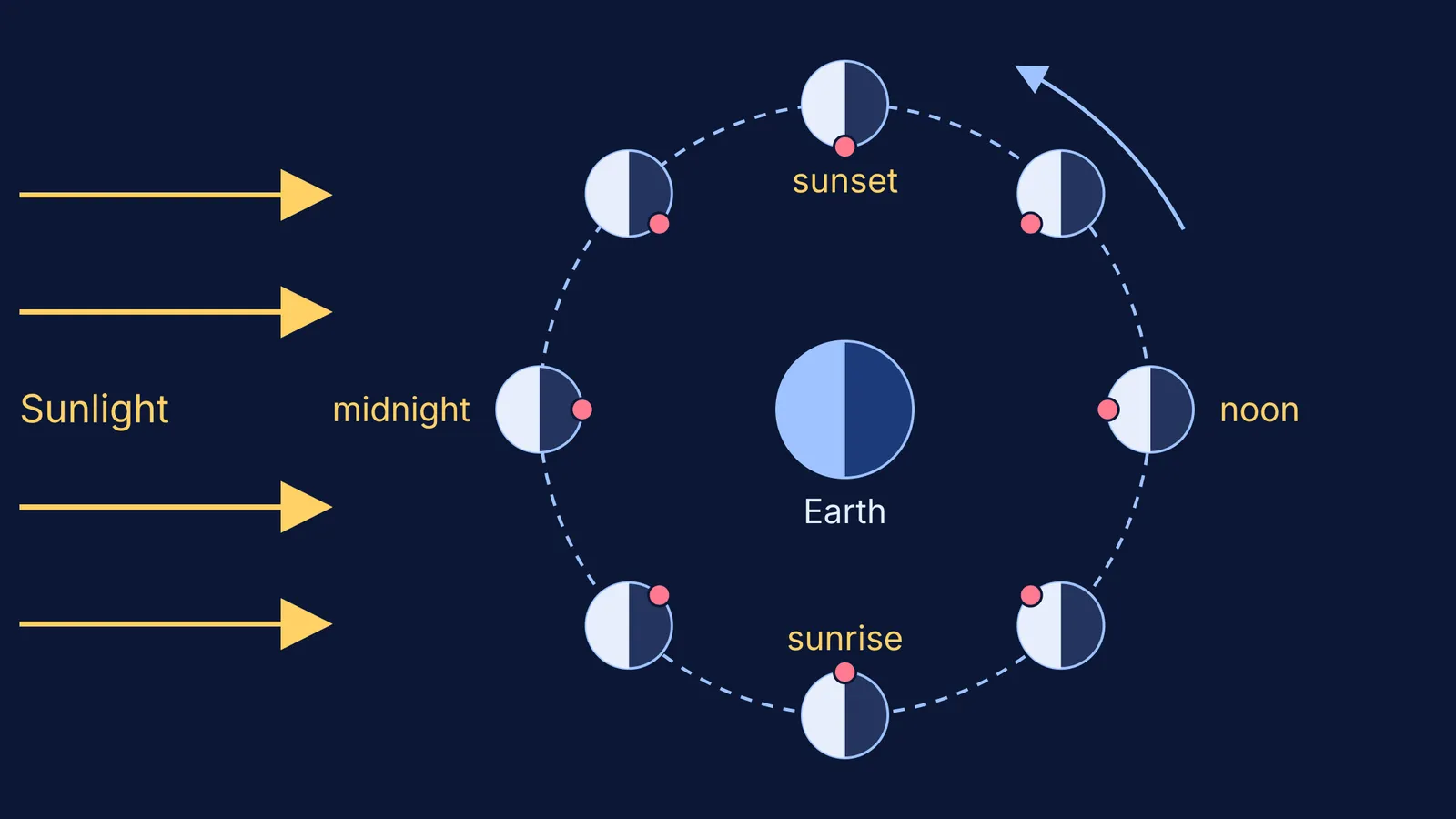
Yes, even though we always see the same face. NASA puts it plainly: it takes precisely as long for the Moon to spin on its axis as it does to complete its monthly orbit around Earth. This is called synchronous rotation, or tidal locking.
NASA's Moon fact sheet gives the two numbers. The Moon's sidereal rotation period is 655.72 hours, which is 27.32 days. Its orbital (revolution) period around Earth is 27.3217 days. Rotation (spinning on an axis) and revolution (going around something else) take the same time. That match is also why we always see the same side of the Moon.
Try this two-minute chair test:
Put a chair in the middle of the room. The chair is Earth, and you are the Moon.
Walk one slow circle around it, always facing the chair.
When you are back where you started, notice that you have faced every wall of the room once. You turned once while going around once.
Why does one day on the Moon last about two Earth weeks?
A day is the time from one sunrise to the next, and spin sets it. Earth turns once in about a day, so its length of day is 24 hours. The Moon turns once in about four weeks, so any point on it swings into sunlight and out again very slowly.
NASA's Scientific Visualization Studio says a mean solar day on the Moon, a lunar day for short, is 29.5306 Earth days, or 708.7 hours. Roughly half of that is daylight and half is night. Half of 29.53 days is about 14.8 Earth days, which is why the sunlit part alone is often called two Earth weeks long. ISRO's "one lunar day (~14 Earth days)" uses the term in that daylight sense.
Why is it 29.5 days and not 27.3?
While the Moon goes around Earth, Earth carries both of them around the Sun. After one 27.3-day turn, the Sun has shifted a little in the Moon's sky, so the Moon must turn a bit further before the Sun is back in the same place. The same idea explains why Earth's 24-hour solar day is about 4 minutes longer than its sidereal rotation period of 23.93 hours, which we unpack in why a sidereal day is shorter than a solar day.
Here is the worked example, using Earth's sidereal orbit period of 365.256 days and the Moon's 27.3217 days from the Moon fact sheet:
The Moon turns 360 / 27.3217 = 13.18 degrees per day against the stars.
The direction of the Sun shifts 360 / 365.256 = 0.99 degrees per day, the same way.
So the Moon gains on the Sun by 13.18 - 0.99 = 12.19 degrees per day.
One full sunrise-to-sunrise cycle needs 360 degrees: 360 / 12.19 = 29.53 days.
That matches the 29.53-day synodic period NASA lists. The shortcut formula is 1/T(day) = 1/T(spin) - 1/T(year), and it works for any planet or moon that spins and orbits in the same direction.
What does a two-week day mean for a Moon rover?
ISRO's Chandrayaan-3 page lists the Pragyan rover's power generation as 50 W. A solar-powered rover can only make power while the Sun is up, and after sunset that spot faces about two weeks of dark and cold. You can read more on how a Moon rover like Pragyan gets its power.
How do you know you have really understood it?
Cover the answers and test yourself, or ask your child these at dinner:
Does the Moon rotate? Yes, once per orbit.
Why do we see only one face? Because spin time equals orbit time.
At full moon, what time of day is it at the centre of the face we see? Noon, because that spot faces both Earth and the Sun.
At new moon? Midnight there.
Which is longer, the sidereal month or a lunar day, and why? The lunar day, by about two days, because Earth moves around the Sun.
If rotation and revolution still blur together, the Fermi Concept Library gives each physics concept its own lesson and shows its place in the map. The Fermi Simulation Lab has interactive simulations for the ideas that are easier to see than to read.
Next time you look at a half Moon, remember that someone standing at the centre of that face would be watching the Sun rise or set.


