

On this page
When Chandrayaan-3 put its rover Pragyan on the Moon in August 2023, the rover had no fuel tank and no plug. Everything it did, from driving to firing its instruments, ran on sunlight. That one design choice explains how the rover worked and why it went quiet after one lunar day.
How does Pragyan get its power?
ISRO's Chandrayaan-3 mission details give the rover's power generation as 50 W, against 738 W for the Vikram lander. The same page lists the rover's mass as 26 kg and the mission life as one lunar day, about 14 Earth days. It also notes that the rover talks only to the lander, which relays data to Earth, so its radio only has to reach the nearby lander.
The chain is simple. A solar panel turns sunlight into electric current, and a rechargeable battery stores energy for moments when the panel can't keep up. If the panel part is new to you, start with our explainer on how solar panels make electricity.
Why does a lunar day last about two weeks?
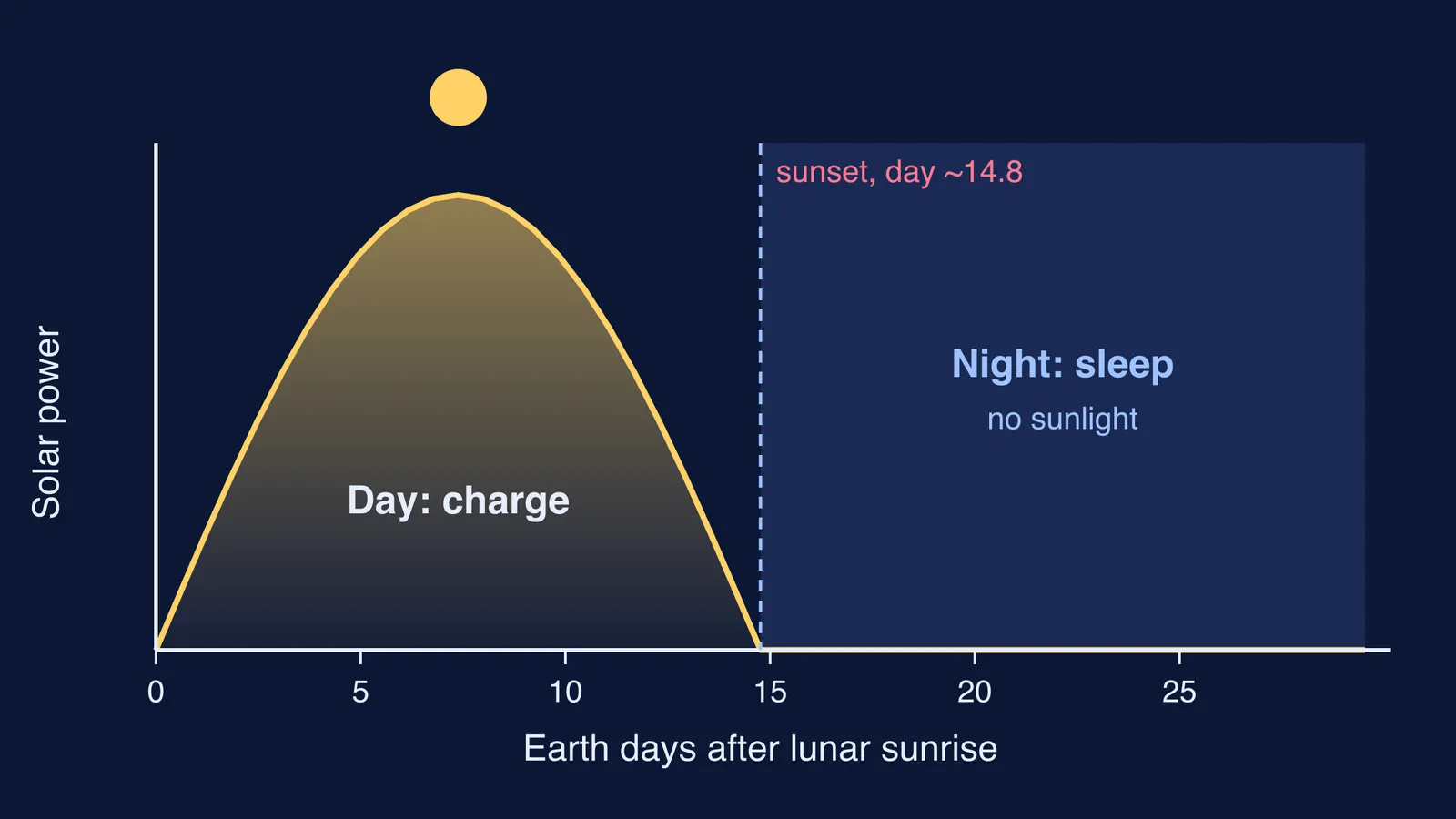
NASA's Moon facts page explains that the Moon spins once in the same time it takes to orbit Earth, about 27 days. Measured against the Sun, the cycle is longer: NASA's Moon phases page gives 29.5 days from new moon to new moon. Because the phases track where the Sun sits relative to the Moon, that same 29.5 days is also the time from one lunar sunrise to the next. Split it in half and any spot on the Moon gets roughly 14.8 Earth days of sunlight, then roughly 14.8 days of darkness.
The same idea gives Earth two kinds of day, which we unpack in sidereal day vs solar day. If spin and orbit feel hard to picture together, the Fermi Simulation Lab has interactive simulations for ideas that are easier to see than to read.
What happens to a rover during the lunar night?
Two things go wrong at sunset. The panel produces nothing, and the ground gets very cold. NASA's Moon facts page says the surface reaches about 127 °C in direct sunlight and falls to about −173 °C in darkness. All India Radio's report on the revival attempt said night temperatures on the Moon drop below −200 °C.
So ISRO did not try to keep Pragyan running. On 2 September 2023 it announced, as reported by The News Minute: "Currently, the battery is fully charged. The solar panel is oriented to receive the light at the next sunrise expected on September 22, 2023." It added that "The receiver is kept on." Pointing the panel toward the sunrise meant it could start charging as soon as the next lunar day began.
ISRO's Chandrayaan-3 page records that on 22 September 2023 "Efforts to establish communication with lander and rover are underway." By then the rover had already finished the one lunar day it was designed for.
How much energy would staying awake take?
Here is a worked example you can check with a calculator, using the 29.5-day cycle from NASA and the 50 W rating from ISRO. The 10 W figure is our assumption for the sum, not an ISRO number.
Night length: 14.8 days × 24 h = about 355 hours.
Suppose the rover needed just 10 W all night to keep its electronics warm and its radio listening.
Energy = power × time = 10 W × 355 h = 3,550 Wh.
A phone battery labelled 5,000 mAh at 3.7 V stores 5 Ah × 3.7 V = 18.5 Wh.
3,550 Wh ÷ 18.5 Wh = about 192 such batteries.
To bank 3,550 Wh, a 50 W panel would need 71 hours at full output, before any driving or science.
For a rover whose whole mass is 26 kg, that trade makes no sense. Sleeping through the night is the sensible design. If the mAh-to-watt-hours step was new, our post on how battery mAh sets run time under a load walks through it.
How can you work out any rover's power budget?
Use these five questions for a Moon rover, a Mars rover or a solar lamp at home:
What is the power source, and what is its rating in watts?
How long is the source available, and how long is it gone?
How much energy is needed through the gap (watts × hours)?
How much can the battery store (mAh × volts ÷ 1,000 gives Wh)?
What else drains it: cold, heaters, radio, motors?
If a step in a problem like this keeps tripping you up, the Fermi Problem Library has worked problems with a step-by-step solver that explains the reasoning rather than printing an answer.
Next time you see a rover photo, find the solar panel and ask one question: how long until sunset?


