On this page
Drop a Mentos into a bottle of cola and foam leaves the neck almost at once. It looks like an explosion, but nothing new is made. The fountain is carbon dioxide that was already dissolved in the drink, leaving all at once because the sweet gives it a huge number of places to turn into bubbles.
Why does Mentos in cola make a fountain?
Cola is sealed with carbon dioxide dissolved in it under pressure. Henry's law says the amount of gas dissolved in a liquid is directly proportional to the pressure of that gas above the liquid (Henry's law). When you open the bottle, the pressure drops to atmospheric, the drink can hold less gas, and the extra carbon dioxide starts to leave as bubbles (same source).
On its own, that happens slowly, because a brand-new bubble is hard to start in smooth liquid. Our post on why fizzy drinks go flat walks through that side of Henry's law.
What is nucleation, and why do the pits matter?
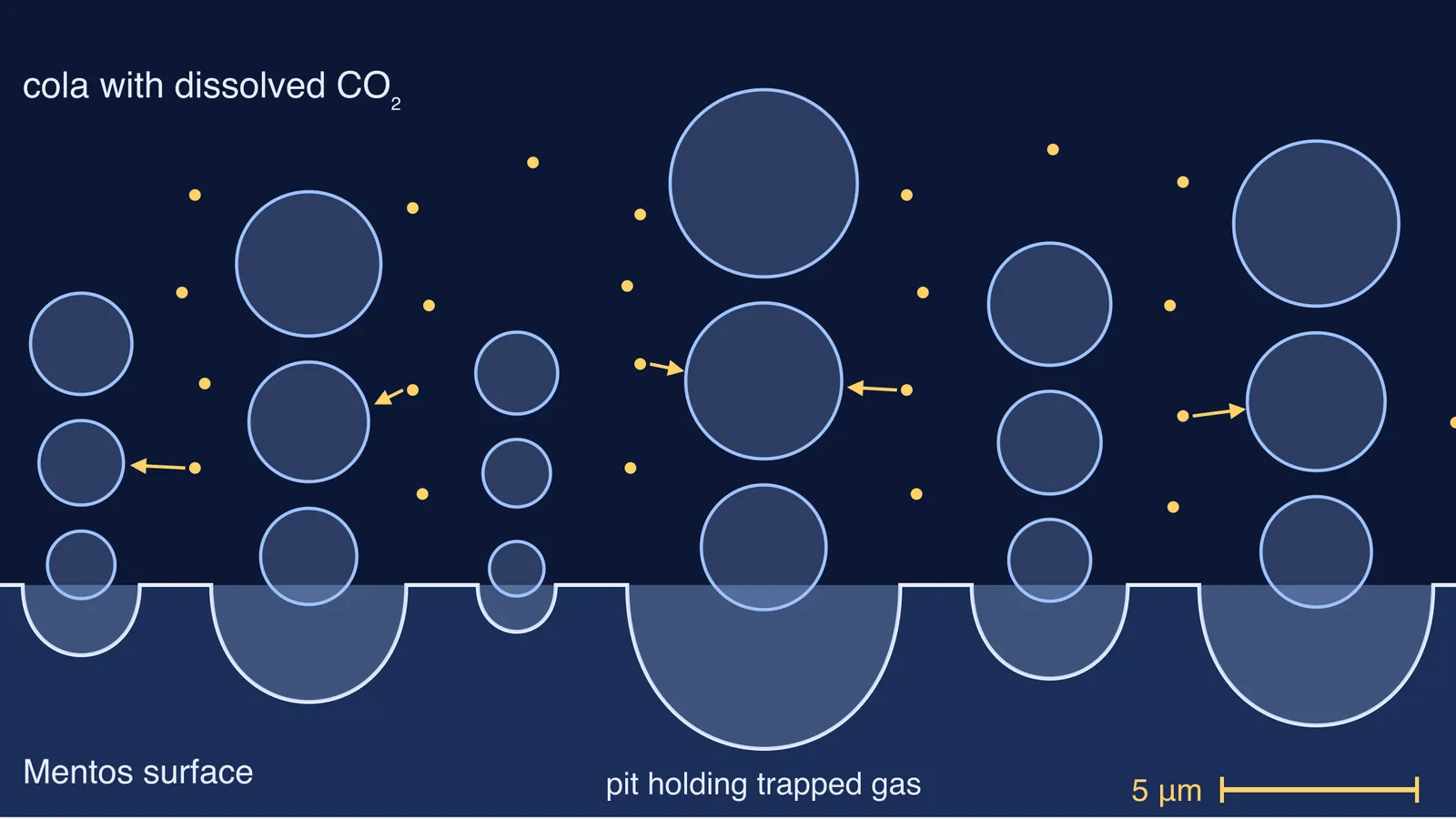
Nucleation is the first step in making a bubble: a pocket of gas big enough to keep growing. In a soda geyser, dissolved gas diffuses into tiny gas pockets that already exist on a rough surface, which is far easier than starting a bubble from nothing (soda geyser overview).
A Mentos is covered in these starting points. Physicist Tonya Shea Coffey and her students at Appalachian State University examined the candy with scanning-electron and atomic-force microscopes and found the surface roughness that gives the gas places to grow (ScienceDaily). Their study appeared in the American Journal of Physics in 2008 (Coffey, 2008).
Chemist Thomas Kuntzleman and Ryan Johnson of Doherty High School later linked how fast the drink degasses to the size of the pores on the candy. Using that link, their students estimated that the nucleation sites on Mentos are about 2 to 7 micrometres across (Kuntzleman and Johnson, 2020). A micrometre is a thousandth of a millimetre, so one sweet has room for an enormous number of sites, and they can all start at once.
Speed matters too. Coffey's team found that Mentos sink to the bottom of a 2-litre bottle faster than rock salt, Wint-O-Green Life Savers or sand, which helps them set off bubbles through more of the drink (summary of Coffey's results). Sand, salt and Life Savers also make a geyser, but a far weaker one (ScienceDaily). The rising bubbles push the cola up and out, and the liquid can spew up to 30 feet, about 9 metres (same source).
Does warm cola or Diet Coke make a bigger fountain?
Warm cola wins. Coffey's experiments showed the reaction is more vigorous at higher temperatures, because carbon dioxide is less soluble in warmer liquid (summary of Coffey's results).
Diet cola's ingredients play a part too. The same study found that aspartame and potassium benzoate, both in Diet Coke, lower the surface tension of water, which makes bubbles easier to form (same source).
Altitude changes things. Kuntzleman and Johnson tested the geyser at different heights above sea level and confirmed that more foam comes out where air pressure is lower (Kuntzleman and Johnson, 2020).
How do you do the Mentos experiment safely?
Scientific American's home version asks for an outdoor area at least two metres from buildings, and eye protection for everyone (Scientific American). A classroom lab from the American Association of Chemistry Teachers warns that the soda can spray into eyes, and keeps testing outdoors (AACT).
Your safety checklist:
Go outdoors, on level ground, well away from walls, cars and windows.
Everyone near the bottle wears goggles or safety glasses.
An adult stays with younger children.
Drop the sweets, then step back at once. Never lean over the bottle or put the cap back on.
A fair-test plan you can run this weekend
Change one thing at a time. Ask one question: does temperature change the size of the fountain?
Use two 2-litre bottles of the same diet cola. Keep one in the fridge overnight and leave the other in the shade at room temperature.
Roll an index card into a tube so you can drop the same number of Mentos, say five, all at once, as the Scientific American version does.
Weigh each bottle before and after. The mass lost is a fairer measure than height, which wind can change.
Write your prediction first: warm cola holds less gas, so it should lose more.
Repeat at least twice, then try a new variable: whole versus crushed Mentos, or Mentos versus salt.
Parents, ask before the drop: "Which bottle will lose more mass, and why?" An answer like "warm cola holds less gas" shows your child understands how temperature changes solubility.
The same nucleation idea explains why boiling chips are added before heating a liquid. For a younger sibling, the baking soda volcano is a good contrast, because that fizz really is a chemical reaction.
Gas leaving a liquid is hard to picture from a textbook page. The Fermi Simulation Lab has interactive simulations for ideas that are easier to see than to read.