On this page
For much of a marathon, a runner can feel fine. Then the legs turn heavy and the pace falls apart, even after months of training. Runners call this hitting the wall. In biology terms, the runner has used up an energy store from your respiration chapter: glycogen.
What is hitting the wall in a marathon?
Hitting the wall is "severe and performance-limiting depletion of physiologic carbohydrate reserves", in the words of a 2010 study by Benjamin Rapoport in PLoS Computational Biology. The same paper reports that more than two-fifths of people who attempt a marathon experience it. Citing work on recreational runners by Buman and colleagues, Rapoport notes that the likelihood of hitting the wall peaks around mile 21, which is kilometre 33 to 34 of the 42.195 km race.
The wall is a fuel problem, not the sharp pain under the ribs covered in why we get a side stitch when running.
Why do marathon runners hit the wall?
Muscles run on ATP, made by respiration: breaking down glucose and fat using oxygen (our post on the difference between breathing and respiration separates the two words). Glucose reaches working muscle from the blood, which the liver tops up from its own glycogen, and from glycogen stored inside the muscle fibres. Glycogen is many glucose units joined in a branched chain: sugar packed and ready.
Each of the two main fuels comes with a catch.
Carbohydrate is fast but limited. Rapoport's paper gives about 5.0 kcal of energy for carbohydrate, compared with about 4.7 kcal for fat, from the same amount of oxygen. At race pace, when oxygen supply is the limit, carbohydrate gets more work out of each breath.
Fat is plentiful but slow. The same paper says that even the leanest athletes store enough energy to power "multiple, back-to-back marathons, if only the working muscles could derive their power exclusively from fat."
But muscles cannot run on fat alone at race pace. In a 2002 study by Achten, Gleeson and Jeukendrup in Medicine & Science in Sports & Exercise, 18 moderately trained cyclists burned fat fastest at about 64% of their maximal oxygen uptake (VO2max), and fat's share of the energy became negligible above about 89% of VO2max. Rapoport's model also has carbohydrate's share rising more and more steeply as a runner speeds up. So the faster you run, the faster the glycogen tank empties. Once it is nearly empty, the muscles must lean on fat, which cannot supply ATP quickly enough for the old pace, and the runner is forced to slow down.
How much glycogen does the body store?
Here is the arithmetic, using the figures in Rapoport's paper for a lean 70 kg runner.
Energy needed to run a marathon: about 2,950 kcal.
Typical leg muscle glycogen: about 310 g, worth about 1,250 kcal.
Typical liver glycogen: about 350 kcal.
Total glycogen: 1,250 + 350 = about 1,600 kcal.
The gap: 2,950 - 1,600 = about 1,350 kcal, nearly half the race, which must come from fat or from carbohydrate eaten on the way.
So the paper notes that normal carbohydrate stores alone would not fuel a marathon. It also stresses that the real limit differs from runner to runner. This suggests why pacing matters: a runner who starts too fast burns more carbohydrate early and reaches empty sooner.
Can diet delay the wall?
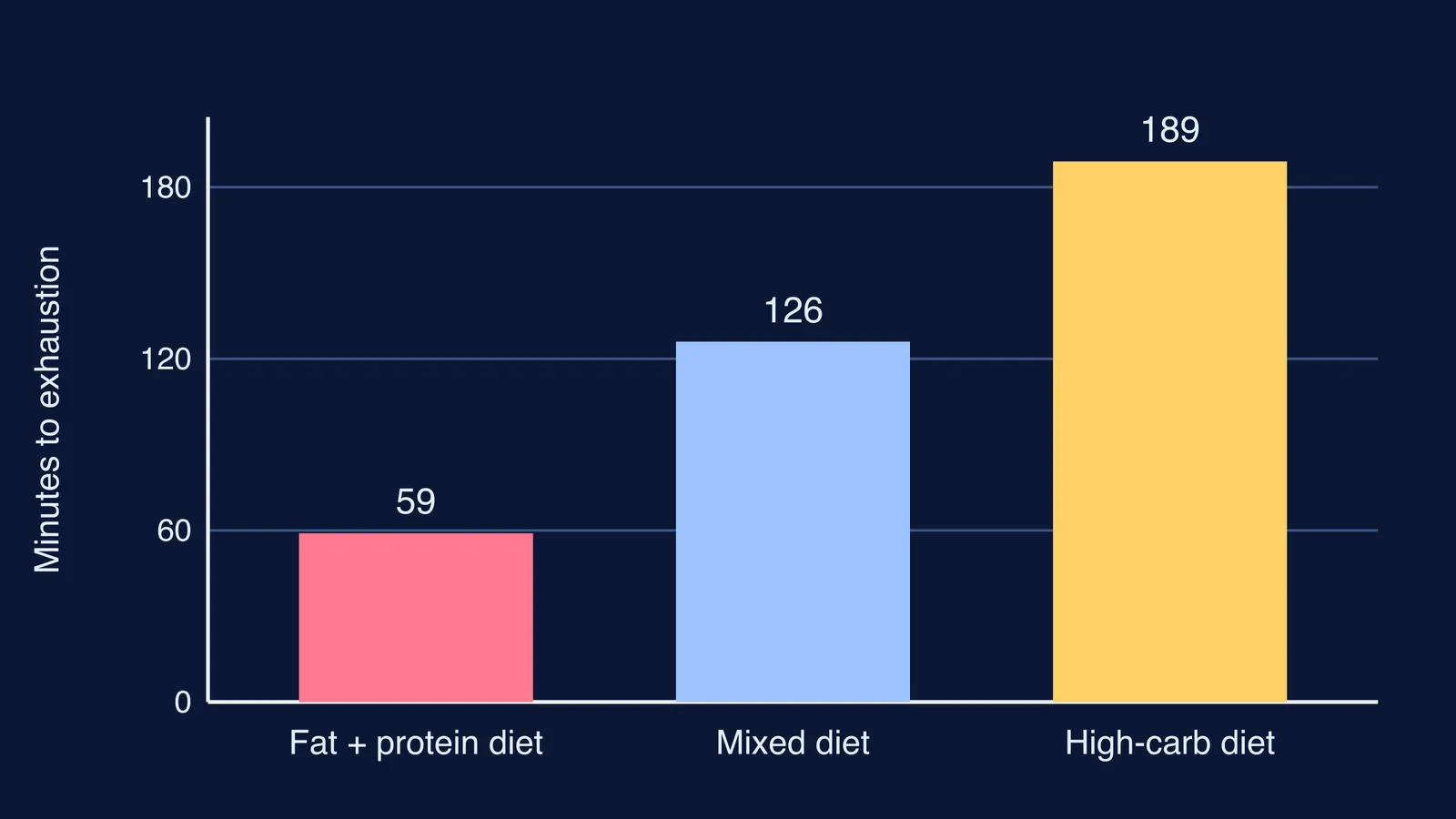
The classic evidence is from 1967. In a study by Bergström, Hermansen, Hultman and Saltin, nine healthy subjects pedalled an exercise bike at 75% of their maximal oxygen uptake until exhaustion after periods on different diets. They lasted 59 minutes on average after a fat-and-protein diet, 126 minutes after a mixed diet and 189 minutes after a carbohydrate-rich diet. How long they lasted correlated well with how much glycogen was in their thigh muscle at the start. This work is the basis of carbohydrate loading before endurance events.
Eating during the race helps close the gap too. A 2014 review in Sports Medicine recommends about 60 g of carbohydrate per hour for exercise lasting 2 to 3 hours.
How do you explain the wall in a biology answer?
Use this four-step chain.
Fuel: muscles make ATP by respiring glucose (from glycogen) and fatty acids.
Store: glycogen in muscle and liver is limited; fat stores are large.
Rate: carbohydrate gives more energy per unit of oxygen and can be used faster, so fast running relies on it.
Result: when glycogen runs low, fat cannot supply ATP fast enough, so the pace drops.
Our post on how glycolysis nets two ATP shows where the first ATP comes from. If you find the fuel switch hard to picture, the Fermi Simulation Lab has interactive simulations for ideas that are easier to see than to read. If a term such as glycogen or ATP is shaky, the Fermi Concept Library gives each concept in biology its own lesson.
Next time you watch a marathon, look at the runners in the final third of the race: that is where the biology shows.