On this page
In a monsoon storm, a bright line jerks left, then right, then splits into forks before it reaches the ground. Lightning builds its path about 50 metres at a time, and each new piece goes wherever the air just ahead gives way first.
What does Class 8 science already tell you about lightning?
The NCERT Class 8 chapter Some Natural Phenomena shows that rubbing can charge objects, that like charges repel and unlike charges attract, and that lightning is an electric spark on a huge scale. In a thundercloud, the chapter says, negative charges collect near the lower edges of the cloud and positive charges collect near the ground. When the charge becomes very large, air, normally a poor conductor, is no longer able to resist the flow, and the result is an electric discharge.
That last idea is the key. Air is an insulator until the electric field across it is strong enough. The breakdown strength of air is about 3 million volts per metre, according to this table of dielectric strengths. Lightning does not break down the whole gap from cloud to ground at once. It opens a path one short piece at a time.
What is a stepped leader?
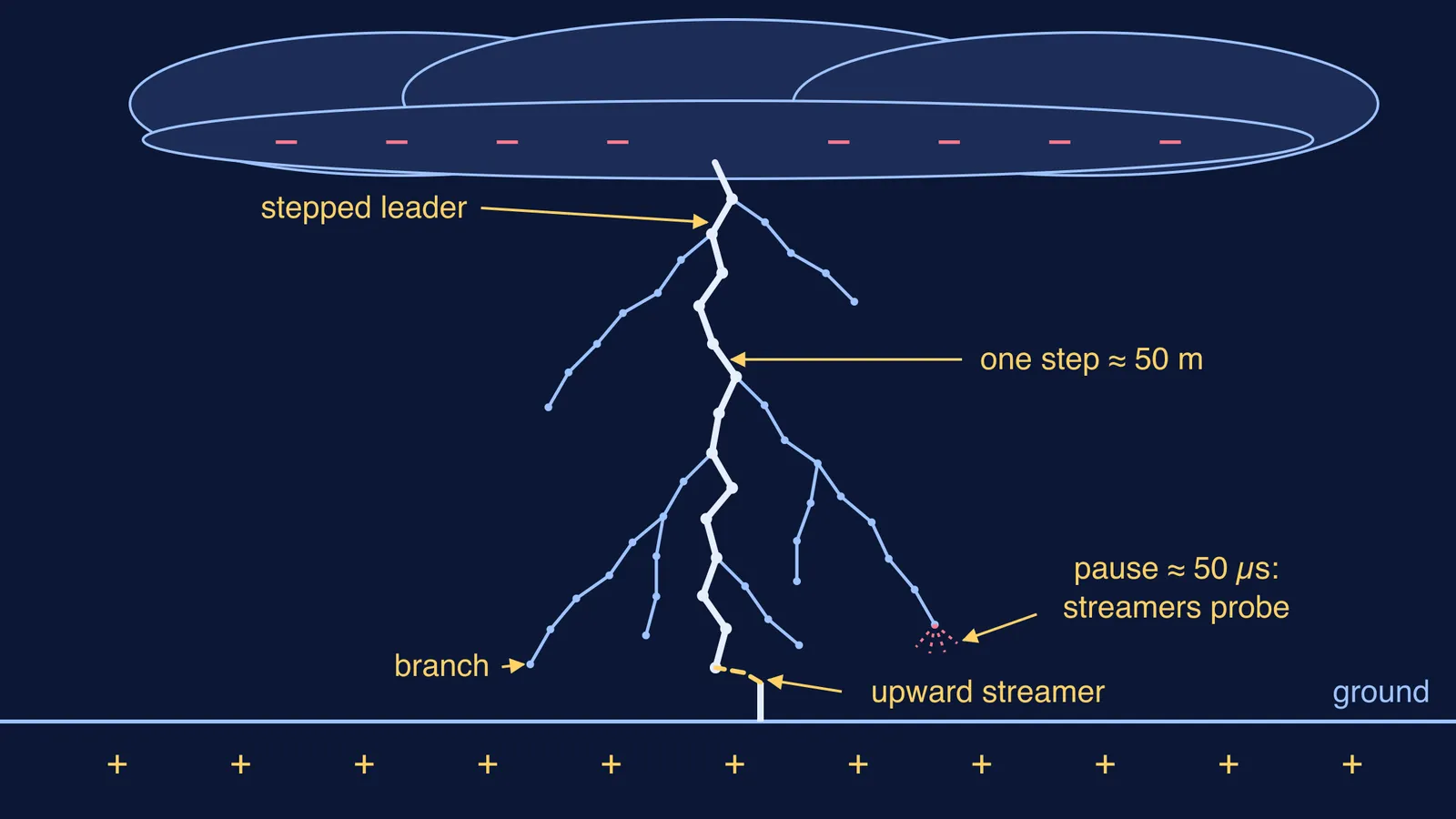
A stepped leader is the development of the downward lightning channel, according to the US National Severe Storms Laboratory. The NSSL explains that negatively charged channels do not move continuously but in short steps: the air ahead becomes ionised as several weak streamers, and a streamer that develops more current can become the next step.
Each step is about 50 metres long and lasts about 1 microsecond, with a pause of about 50 microseconds before the next step, according to NOAA's JetStream weather school.
Why does lightning travel in a zigzag path?
Because each step responds only to what is close by. The leader senses charges only within about 50 metres of its tip and surges ahead based on the charges in the air immediately around it, says the US National Weather Service. It just takes the next locally favoured direction.
Here is the cycle:
Negative charge from the cloud makes the field at the leader's tip very strong.
The air just ahead breaks down into several weak streamers pointing slightly different ways.
The streamer that develops the most current becomes the next step.
The tip is now in a new spot, so the next streamers start from there.
A small change of direction, repeated dozens of times, is a zigzag.
Why does one flash grow branches?
Sometimes more than one streamer at a tip keeps growing, and the channel splits. NOAA's JetStream page notes that the stepped leader usually branches out in many directions as it approaches the ground. Each branch then keeps stepping on its own, as the diagram above shows.
As the leader nears the ground, it induces upward channels called streamers from the ground and tall objects, the same NOAA page explains. When a streamer connects with the leader, typically 30 to 100 metres above the ground, a return stroke shoots up that channel. Its current reaches its peak in about 1 microsecond and averages around 30,000 amperes (NOAA).
How the charges separate in the first place is covered in our explainer on how lightning forms inside a thundercloud.
A worked example: how much of its time does the leader spend waiting?
Use NOAA's JetStream numbers: steps of about 50 m, 1 µs per step, 50 µs pause.
Steps per kilometre, if every step pointed straight down: 1,000 m ÷ 50 m = 20 steps. Real steps are tilted, so the true count is higher.
Time spent moving: 20 × 1 µs = 20 µs.
Time spent paused: 20 × 50 µs = 1,000 µs, or 1 millisecond.
Share of time paused: 1,000 ÷ 1,020 ≈ 98%.
The leader spends almost all its time paused. NOAA describes the pause as the time when the leader "looks" around for an object to strike before taking another step.
How do you explain the zigzag in a school answer?
Write these five points, in order:
Charges separate: negative near the cloud base, positive near the ground.
Air insulates until the field is strong enough to break it down.
Breakdown happens in steps of about 50 m, with pauses (the stepped leader).
Each step follows the strongest local streamer, so direction keeps changing; two growing streamers make a branch.
A branch meets an upward streamer, and the return stroke makes the bright flash.
If step-by-step growth is hard to picture, the Fermi Simulation Lab has interactive simulations for ideas that are easier to see than to read. If charge, field and potential still feel shaky, the Fermi Concept Library gives each physics concept its own lesson and shows where it fits.
The same physics explains why charge collects at sharp points and how lightning rods work. Next storm, count the seconds after the flash to work out how far away the lightning is, and watch from indoors.