

On this page
You pour a cup of strong black tea, squeeze in some lemon, and the colour turns noticeably paler as soon as you stir. Nothing has been filtered out, and the juice brings no bleach with it. What changed is the acidity, and that makes your teacup a working pH indicator.
This is the same idea behind the litmus, turmeric and China rose indicators in your Class 7 and Class 10 science books, so it is worth understanding properly.
What gives black tea its colour?
When tea leaves are processed into black tea, their polyphenols oxidise into two main families of pigments. According to the Tocklai Tea Research Institute in Assam, theaflavins are golden-yellow pigments that make up around 0.5 to 2% of the dry weight of black tea, and they are responsible for the bright colour of the liquor.
Thearubigins are orange-brown compounds that make up about 6 to 18% of the dry weight of black tea, per the same Tocklai explainer. Tocklai puts their share of total liquor colour at around 35%, against about 30% for theaflavins.
Tea chemists have measured these pigments for decades: E. A. H. Roberts and R. F. Smith described a spectrophotometric method for tea liquors in the Journal of the Science of Food and Agriculture in 1963.
Why does tea become lighter when you add lemon?
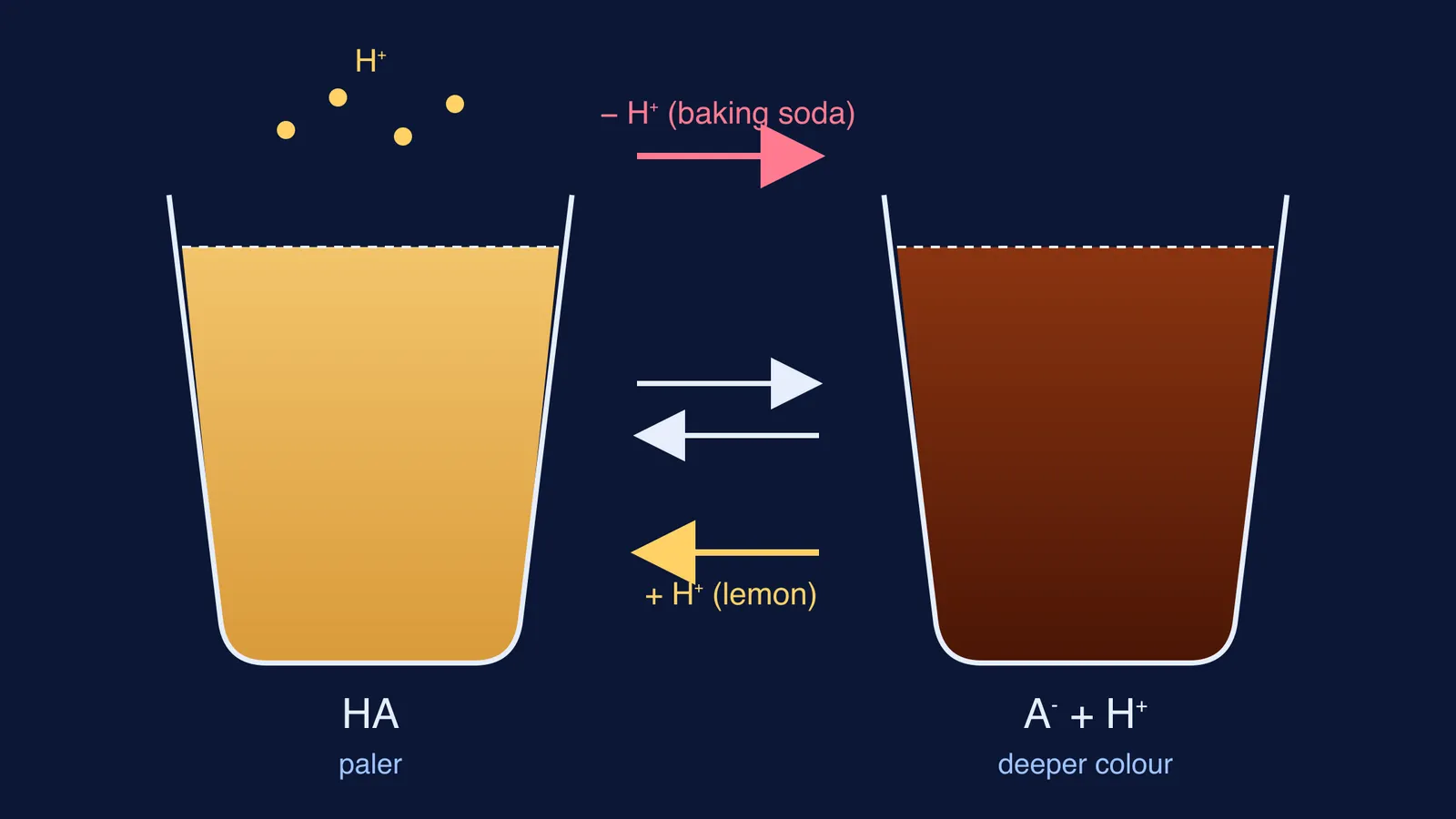
Tocklai describes thearubigins as acidic pigments, so you can treat them like a weak acid. Picture each pigment molecule as HA. In water, some of it gives up a hydrogen ion and becomes the anion A⁻:
HA (un-ionised, paler) ⇌ H⁺ + A⁻ (ionised, deeper colour)
The key fact, in Tocklai's words: "The thearubigin anions are more deeply coloured than the undissociate form", so the colour depends on the ratio of anions to un-ionised molecules (Tocklai Tea Research Institute).
Lemon juice is rich in citric acid, so it adds H⁺ ions to the cup. By Le Chatelier's principle, extra H⁺ pushes the equilibrium to the left. More pigment sits in the paler HA form, and the tea lightens. Tocklai sums it up: acidic pH reduces the intensity of colour.
Not every pigment joins in. Food scientists Nenad Naumovski (University of Canberra) and Duane Mellor (Coventry University) note in The Conversation that thearubigins change with acidity while theaflavins "are not that affected by the change in acidity". That helps explain why lemon tea gets paler but keeps its colour instead of turning clear.
Does the opposite happen with a base?
Yes. If acid pushes the equilibrium left, removing H⁺ should pull it right. CSIRO's science-education blog Double Helix runs exactly this test: lemon juice makes tea paler, and a little bicarbonate of soda (baking soda) makes it more alkaline and darker.
This also explains a kitchen puzzle. Tocklai notes that tea brewed in hard water is darker in colour (Tocklai), and Naumovski and Mellor link this to hard water being relatively alkaline (The Conversation). That fits the same equilibrium: anything that mops up H⁺ favours the darker anion form.
How can you test this at home?
Try this predict-observe-explain routine, adapted from the CSIRO Double Helix activity. It is quick and works as a short practical write-up.
Brew one strong cup of black tea without milk or sugar and let it cool a little.
Pour it equally into three clear glasses and label them A, B and C.
Leave A alone as your control.
Add about a tablespoon of lemon juice to B (the amount CSIRO suggests).
Add no more than a quarter teaspoon of baking soda to C.
Before stirring, write down your prediction for each glass.
Stir, hold all three against a white sheet of paper, and note the colours.
Now add baking soda, a pinch at a time, to glass B. Does the dark colour come back?
Step 8 is our addition to the CSIRO version, and it is the one worth doing. If the colour returns, you have shown that the change is a reversible equilibrium, not the pigment being destroyed. That is the difference between an indicator and a bleach. Do not drink glass C; CSIRO warns the bicarb tea tastes bad.
How is tea like other natural indicators?
Tea is one of many plant-based indicators. Anthocyanins in flowers shift colour with pH too, as we explain in why flowers have different colours, and you can make your own China rose indicator at home. For how these fit the board syllabus, see our guide to indicators, pH and common salts in Class 10.
The hard part for most students is picturing an equilibrium that keeps shifting as you add acid or base. Equilibrium shifts are among the ideas easier to see than to read, which is what the Fermi Simulation Lab is for: interactive simulations for ideas like this one. If the terms themselves feel shaky, the Fermi Concept Library gives every concept in chemistry its own lesson, from weak acids to Le Chatelier's principle.
Next time someone asks why their lemon tea looks pale, you can give the one-line answer: acid suppresses the ionisation of thearubigins.


