

On this page
A few drops of lemon juice land on the marble floor, and later there is a pale, cloudy patch that wiping won't remove. A thin layer of the stone has dissolved, through a reaction from Class 10 chemistry.
What is marble made of?
Marble is calcium carbonate. NCERT's Class 10 science textbook says it plainly in the chapter Acids, Bases and Salts: "Limestone, chalk and marble are different forms of calcium carbonate."
The Natural Stone Institute calls the calcite crystal "the basic building block of true marbles" and warns that it "is vulnerable to attack by mild acids, including those commonly found in kitchen and bar settings."
Why does lemon juice leave dull marks on marble?
The chemistry. Lemon juice is very acidic for a food, even though citric acid itself is a weak acid. A pH table from Clemson University's food extension service lists lemon juice at pH 2.00 to 2.60. Citric acid is a big part of that. A 2008 study in the Journal of Endourology by Penniston and colleagues measured 1.44 g of citric acid per ounce of lemon juice.
Section 2.1.3 of the NCERT chapter gives the rule for what happens next: metal carbonate + acid → salt + carbon dioxide + water. For citric acid (C₆H₈O₇) and marble, the balanced equation is:
2 C₆H₈O₇ + 3 CaCO₃ → Ca₃(C₆H₅O₇)₂ + 3 CO₂ + 3 H₂O
The salt (calcium citrate) and the water get wiped away, and the carbon dioxide escapes as tiny bubbles. What's left is a patch where some stone is missing.
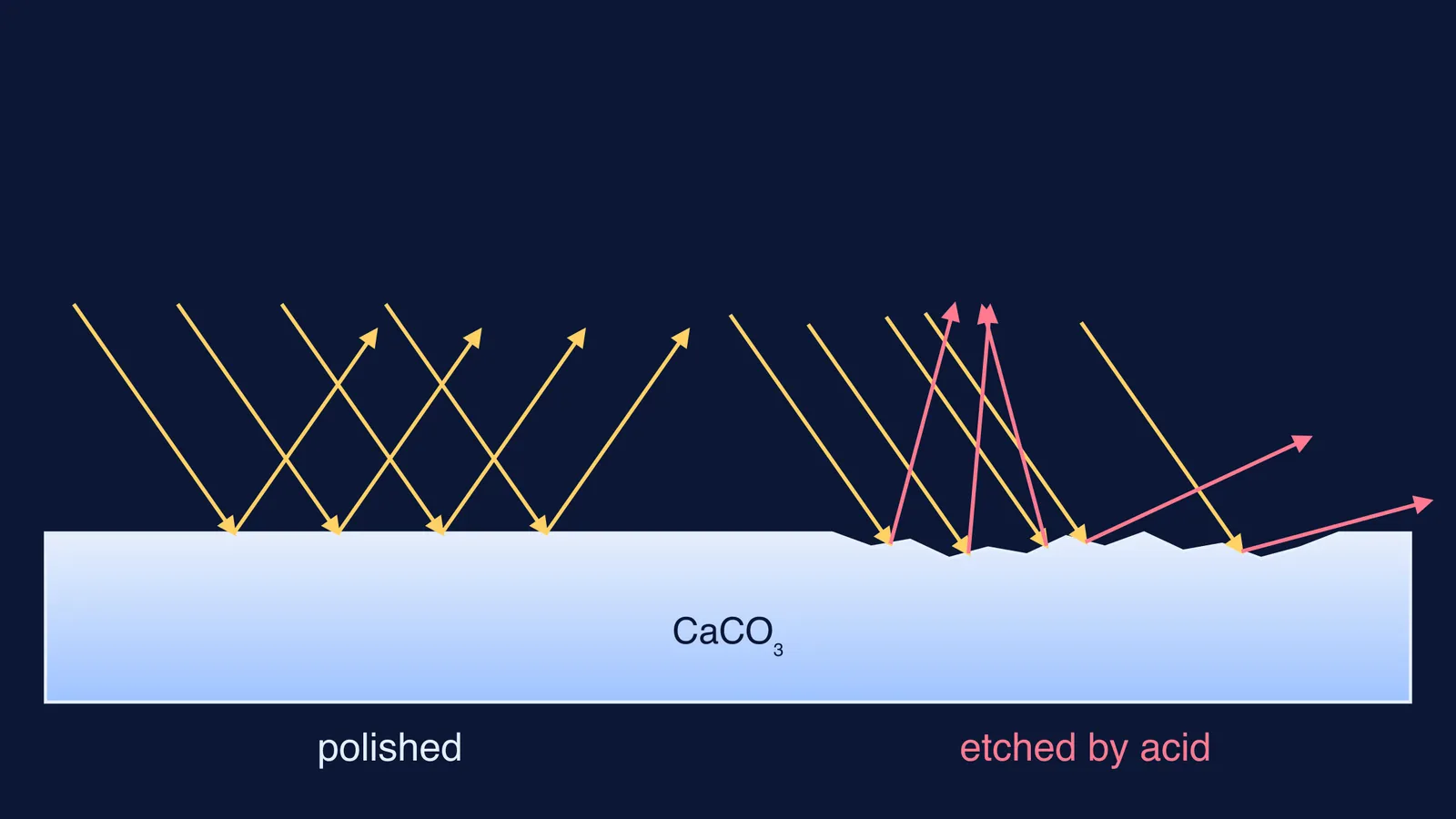
The light. A polished floor is very flat, so light bounces off it at one angle, like a mirror. The acid doesn't eat the surface evenly. It leaves tiny pits and ridges tilted every which way, and each one sends light off in a different direction. That scattered light makes the spot look whitish and matte instead of glossy. The diagram above traces both cases.
How much marble can a teaspoon of lemon juice dissolve?
Here is a worked example using the Penniston study figure.
Citric acid in the spill: 1.44 g per fluid ounce (about 29.6 mL) is about 0.049 g per mL, so a 5 mL teaspoon holds about 0.24 g.
Moles of citric acid: its molar mass is about 192 g/mol, so 0.24 ÷ 192 ≈ 0.00125 mol.
Use the equation: 2 mol of citric acid react with 3 mol of CaCO₃, so 0.00125 × 3/2 ≈ 0.0019 mol of CaCO₃.
Convert to mass: CaCO₃ is about 100 g/mol, so that is about 0.19 g of marble.
That is an upper limit, since a quick wipe stops the reaction early. But you don't need to remove much stone to lose the shine: the dullness comes from roughness at the very surface, not from a deep hole.
The same reasoning answers an in-text question in that NCERT chapter, where metal compound A fizzes with dilute hydrochloric acid, gives off a gas that puts out a burning candle, and forms calcium chloride. The expected answer is calcium carbonate. If writing these equations still feels shaky, the Fermi Concept Library has a lesson for every concept in chemistry, from carbonates to moles. For a fuller walk-through of the reaction, read our post on how acids react with metal carbonates in Class 10.
What should you do when lemon juice spills on marble?
The Natural Stone Institute's care guidance and its page on stains and etch marks come down to a short checklist:
Blot the spill with a paper towel straight away. Don't wipe it, because wiping spreads it.
Rinse with plain water, then clean with a neutral cleaner, stone soap, or mild dishwashing liquid in warm water.
Skip home cleaning tips that use lemon or vinegar on marble. The institute says products containing lemon, vinegar or other acids "may dull or etch calcareous stones", and the Clemson pH table puts vinegar at pH 2.40 to 3.40.
Put coasters under glasses of nimbu pani and other citrus drinks.
For a light etch on polished marble, the institute suggests wetting the spot and buffing it with marble polishing powder until the shine returns. If that doesn't work, call a professional stone restorer.
Can you watch the reaction at home?
Yes. Put lemon juice on one end of a small marble offcut and plain water on the other as a control. You may see tiny carbon dioxide bubbles on the lemon side. After a few minutes, rinse, dry and tilt the chip under a lamp to compare the shine.
Why powder reacts faster than chips is in marble chips versus powder and reaction rate, and acid rain and the Taj Mahal looks at the same kind of reaction on a marble monument. The light half of this story is easier to see than to read. The Fermi Simulation Lab has interactive simulations for ideas like that.
Next time lemon juice drips on the floor, blot it fast, then write the equation.


