On this page
Every physics textbook says a projectile goes farthest when you launch it at 45°. Then you watch a javelin final, such as the one where Neeraj Chopra won India's first Olympic athletics gold with a throw of 87.58 m on 7 August 2021, and the javelin leaves the hand much flatter than that.
The textbook answers a simpler question than the one a thrower faces.
Why is 45° the best angle in textbook physics?
A steeper launch keeps the projectile in the air longer, but a flatter launch gives it more horizontal speed. With range R = v² sin 2θ / g, the best trade-off is where sin 2θ = 1, which is θ = 45°. Our guide to range, height and time of flight on level ground derives this step by step.
That result rests on three assumptions:
The projectile lands at the same height it was launched from.
There is no air, so no lift and no drag.
The launch speed is the same at every angle.
A javelin breaks all three. It leaves the hand above head height, it flies through air, and a human arm cannot throw equally hard at every angle.
Does release height lower the best angle?
Yes, but only a little. Physicist Nick Linthorne gives the range for a launch from height h in his Physics World feature on throwing: R = (v² sin 2θ / 2g)[1 + √(1 + 2gh / (v² sin²θ))]. Without air, the best angle then satisfies sin θ = 1/√(2 + 2gh/v²).
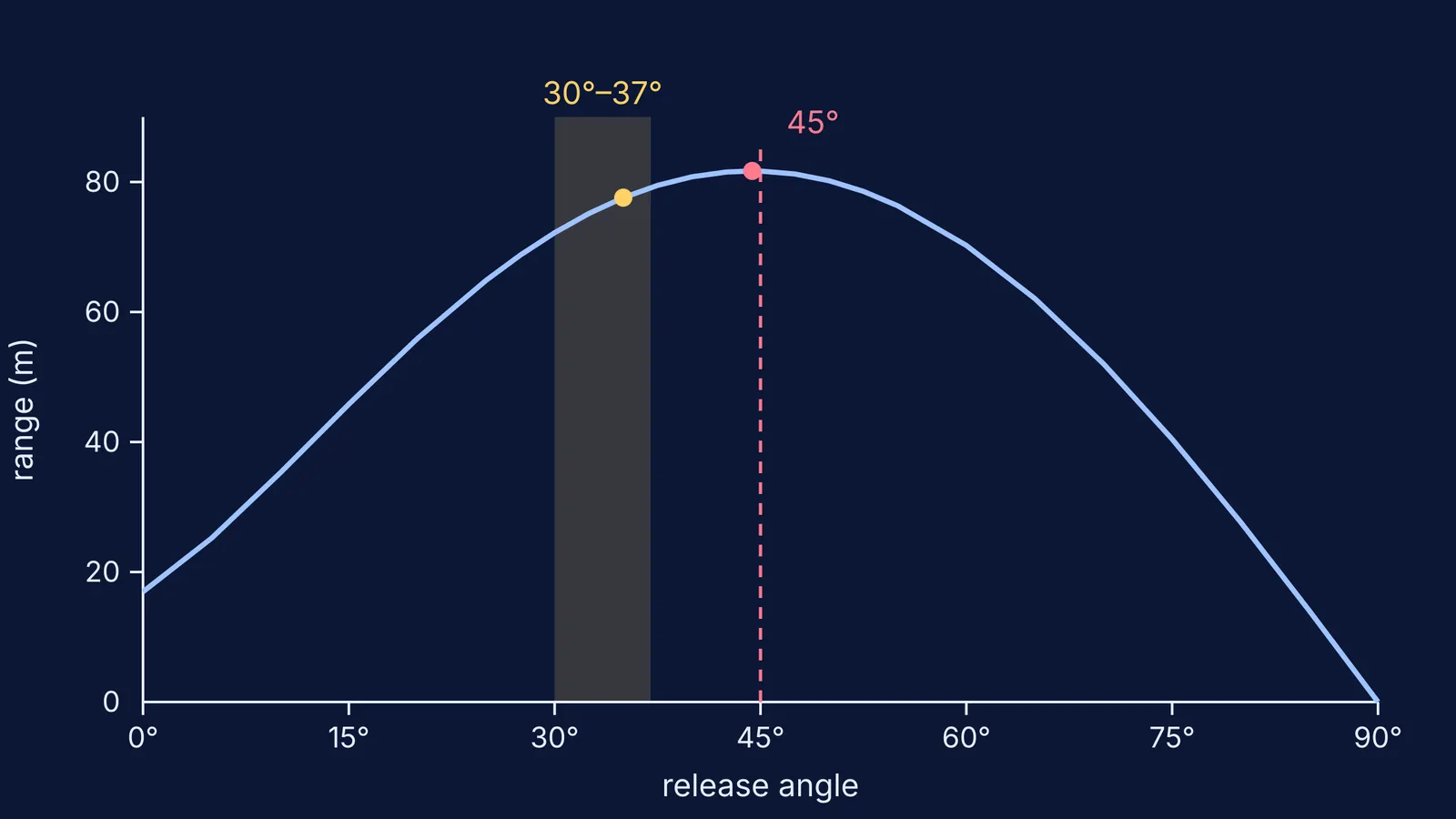
Elite throwers release the javelin at 28–30 m/s, according to biomechanics researcher Mike Barber. Here is the worked example, with v = 28 m/s, g = 9.81 m/s² and an assumed release height of 1.8 m:
2gh/v² = 35.3/784 = 0.045.
sin θ = 1/√2.045 = 0.699, so the best angle is about 44.4°.
At 45° the range is about 81.7 m.
At 35° the range is about 77.6 m, only 5% shorter.
At 30° it is about 72.2 m.
So height moves the vacuum optimum by about half a degree. It matters more when the drop is large, as in throwing from a cliff, but for a javelin it is not the main story.
Why do javelin throwers release below 45 degrees?
Two bigger effects push the angle down: the body and the air.
First, people throw faster at flatter angles. Linthorne describes how Ed Red, a mechanical engineer and former Olympic javelin thrower, measured how release speed fell with release angle in three athletes and calculated an optimum of about 37°, which matched the angles javelin throwers actually use (Physics World, June 2006). Red and A. J. Zogaib published a javelin model that includes the thrower's body in the Journal of Applied Mechanics in 1977. Barber puts the best release angle for a javelin at 32°–36°.
The worked example shows why a small speed difference is enough. Near 45° the range curve is almost flat, so the 35° throw gives up only about 4 m. If your speed at 45° drops from 28 to 27.25 m/s, a loss of under 3%, the 45° throw lands at about 77.4 m and the 35° throw wins.
How do lift and drag change a javelin's flight?
A javelin is a long, thin body. When it is tilted relative to the direction it is moving, air pushes it upward (lift) and backward (drag). That tilt is called the angle of attack, and the ideal angle of attack is zero degrees, so the javelin points along its flight path at release.
Mont Hubbard and LeRoy Alaways calculated the best release conditions for the new-rules men's javelin in the International Journal of Sport Biomechanics in 1987. They found the optimal release angle stays roughly constant near 30° for release speeds of 20–35 m/s. They also found the rule change cut achievable range at 30 m/s by about 10%, because it stopped throwers from using the javelin's potentially large lift.
In 1984 Uwe Hohn threw 104.80 m, and in 1986 the javelin was redesigned to move its centre of gravity forward by four centimetres, according to World Athletics.
Drag works against the javelin for the whole flight. A high, looping throw spends longer in the air, so drag has more time to slow it. Our post on why 45° stops working once air resistance is added shows the same shift for a ball.
How can you test this yourself?
Use this four-step check on any "best angle" problem:
List the assumptions. Same launch and landing height? No air? Same speed at every angle?
Compute the range at 30°, 35°, 40° and 45°. You will see how flat the top of the curve is.
Ask what speed loss would make the lower angle win.
Add drag and watch where the peak moves.
Step 4 is easier to see than to calculate. The Fermi Simulation Lab has interactive simulations for ideas that are easier to see than to read.
In JEE Main and board exams, 45° is still the right answer when a question assumes level ground and no air. Read the assumptions first.