

On this page
We learn early in physics that to throw a ball as far as possible, you should launch it at exactly 45°. This rule perfectly balances the time the ball spends in the air with the speed at which it travels forward. But there is a catch: the 45-degree rule only works if the launch point and the landing point are at exactly the same elevation.
If you are standing on a cliff or a balcony and throwing an object to the ground below, 45° is a trap. The true optimal angle is lower.
Why does 45° fall short from a height?
When you throw an object from a cliff, it already has "extra" time in the air simply because it starts higher up. You do not need to waste as much of your throwing effort launching it upwards to gain hang time.
Instead, if you lower your launch angle, you can direct more of your initial speed into moving forward horizontally. The trade-off favours a shallower, faster forward throw. The higher the cliff relative to your throwing speed, the closer the optimal angle for maximum range gets to horizontal (0°).
According to classical mechanics, the angle θ that gives the maximum horizontal range from a starting height h with an initial velocity v is given by the formula:
tan θ = v / √(v² + 2gh)
Because the height h is positive, the denominator is larger than the numerator, meaning tan θ is less than 1. This mathematically proves that the ideal angle is always less than 45° when throwing to a lower elevation.
How far does a stone travel from a 50-metre cliff?
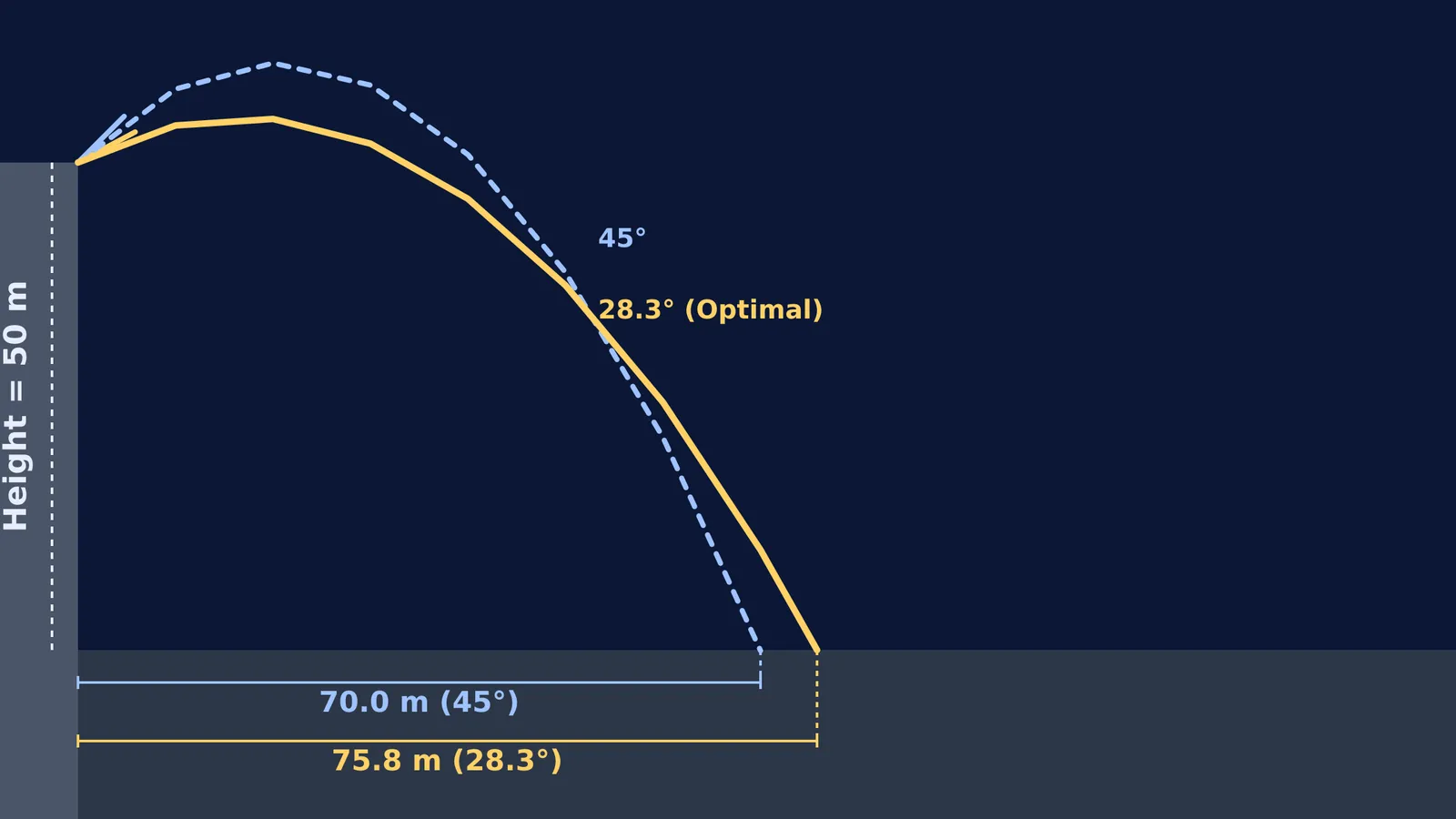
Imagine you are standing on a 50-metre cliff and you throw a stone at 20 metres per second (m/s). Let us compare the textbook 45° throw with the true optimal angle predicted by the classical formula.
If you throw at 45°, your stone travels about 70.0 metres horizontally before hitting the ground below.
Using our formula for the optimal angle:
tan θ = 20 / √(20² + 2 × 9.8 × 50) = 20 / √(1380) ≈ 0.538
This gives an optimal launch angle of about 28.3°. If you launch the stone at 28.3° instead, it travels 75.8 metres. Simply by adjusting your angle, you gain nearly 6 extra metres of distance without throwing any harder.
How can you use this for exam prep?
In competitive exams like JEE and NEET, projectile motion questions frequently test your ability to spot this exact trap. Examiners know that students blindly memorise the maximum range formula for level ground and will quickly choose 45° in multiple-choice questions.
To avoid being caught out, never separate the formula from the physical situation it describes. When a problem introduces a cliff, ask yourself what happens to the time of flight. This is where interactive tools can be incredibly helpful.
Before you look up the formula for a horizontal projectile from a cliff, use the Fermi Simulation Lab to launch a virtual object and see the trajectory stretch out as you lower the angle. Ask Fermi's AI tutor "Why does the curve look like this?" rather than "What is the answer?". Understanding the trade-off between horizontal speed and hang time will help you instantly verify whether your calculated equation of trajectory of a projectile makes sense, keeping you safe from the examiner's favourite traps.


