On this page
Open a dabba of hing and the whole kitchen knows. A pinch is enough to flavour a pot of dal, yet a raw lump of asafoetida smells harsh enough to make you step back. The reason is chemistry you already study: volatile molecules, intermolecular forces and solubility.
What is hing, exactly?
Asafoetida is an oleo-gum-resin, the dried sap obtained from the rhizome and roots of the Ferula asafoetida plant, according to a 2012 review in Pharmacognosy Reviews by Poonam Mahendra and Shradha Bisht. The same review says the plant is native to central Asia, from eastern Iran to Afghanistan, and is not native to India, though it has been used in Indian cookery for ages.
The review splits the resin into three parts:
resinous material, 40 to 64% of the mass
gum, about 25%
volatile oil, 3 to 17%, with disulphides as its major components
That small oily fraction does almost all the smelling.
Why does hing smell so strong?
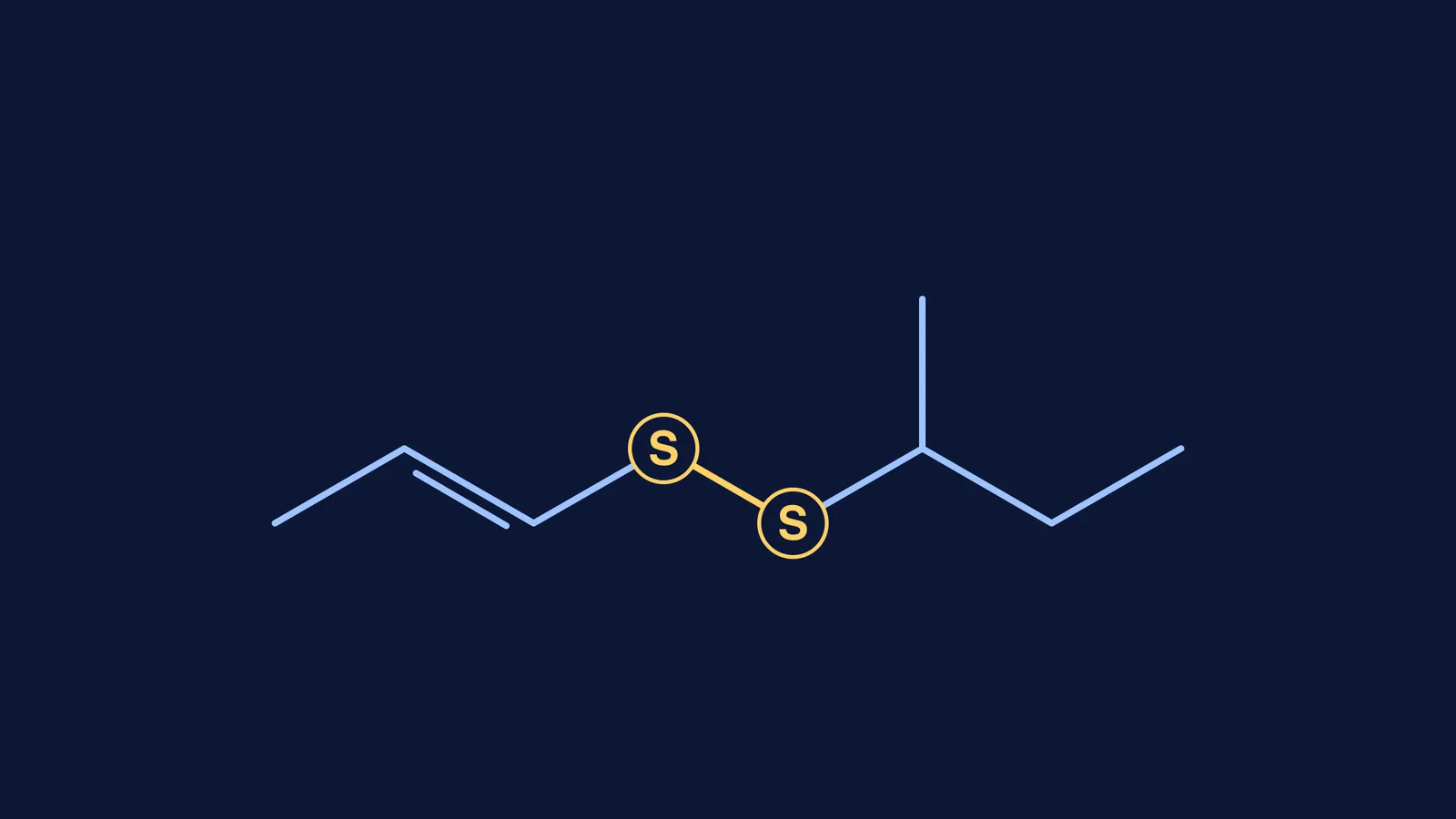
A disulphide is a molecule with two sulphur atoms bonded to each other, written R–S–S–R′. The Pharmacognosy Reviews paper names 2-butyl propenyl disulphide, in E and Z forms, as a major component of the oil, and says the oil's disagreeable odour is reported to be due mainly to a disulphide with the formula C11H20S2.
Two things make these molecules loud.
First, they are volatile. They are small molecules with little polarity, held to each other mainly by weak dispersion forces, so at room temperature many of them escape into the air and drift to your nose, much as perfume smell spreads across a room.
Second, your nose is tuned to sulphur. A 2022 review in Molecules by Monika Marcinkowska and Henryk Jeleń describes volatile sulphur compounds as often potent odorants with low odour thresholds, the smallest concentration a person can detect. It lists dimethyl trisulphide, a cabbage-smelling relative found in vegetables, at a threshold of 0.009 micrograms per litre of water. That is 9 nanograms in a whole litre. Hing's own disulphides are not in that table, but sulphur odorants this potent help explain why a closed hing box still smells.
Why does hing smell milder when fried in oil?
In a tadka, hing goes into hot ghee or oil for a few seconds; the Mahendra and Bisht review describes dissolving asafoetida in hot oil before adding it to food. Three things happen in the pan.
The sulphur compounds dissolve in the fat. Disulphides and oil are both non-polar, the rule explained in why like dissolves like. Held in oil, they escape more slowly, and the oil spreads them through the dish.
The most volatile molecules boil off. Vapour pressure rises with temperature, so the sharpest smell rushes out first, then fades.
Heat changes the molecules. The Molecules review says heating, cooking, frying or roasting can set off oxidation, degradation and other reactions in sulphur compounds; in garlic, it reports that allicin decomposes rapidly above 50 °C. Asafoetida has been studied far less, so treat this as the likely mechanism, not a measured result.
Garlic's smell builds in a different way, explained in why crushed garlic smells stronger than a whole clove.
Is the hing powder in your kitchen pure asafoetida?
Usually not. Indian food rules have long defined compounded asafoetida, or bandhani hing, as asafoetida mixed with gum arabic, edible starches or edible cereal flour, as in this text of the food adulteration rules. FSSAI sets today's standard, so read your pack's ingredients. The flour dilutes the resin, which likely helps explain why compounded powder smells gentler than a pure lump.
Try it: a five-minute kitchen experiment
Ask an adult to handle the hot oil. Before each step, write down your prediction, then rate the smell from 1 (faint) to 5 (strong).
Smell a pinch of dry hing on a spoon held at arm's length.
Stir a pinch into a spoon of water and smell again.
Heat a teaspoon of oil, add a pinch for five seconds, then switch off. Smell straight away, then again after two minutes.
What you will probably notice, and the likely reason:
Dry: sharp and strong, as volatile disulphides escape from the powder's large surface.
Water: still strong, because non-polar disulphides dissolve poorly in water and keep escaping.
Hot oil: a burst, then a fade, as the most volatile molecules leave and the rest dissolve or react.
How does this connect to your chemistry syllabus?
One spice touches several Class 11 and 12 ideas: intermolecular forces, polarity and solubility, and vapour pressure. If molecules escaping into the air are hard to picture, the Fermi Simulation Lab has interactive simulations for ideas that are easier to see than to read. For a gap in one idea such as polarity, the Fermi Concept Library gives each concept its own lesson.
Next time the tadka hisses, name the chemistry before the dal goes in.