On this page
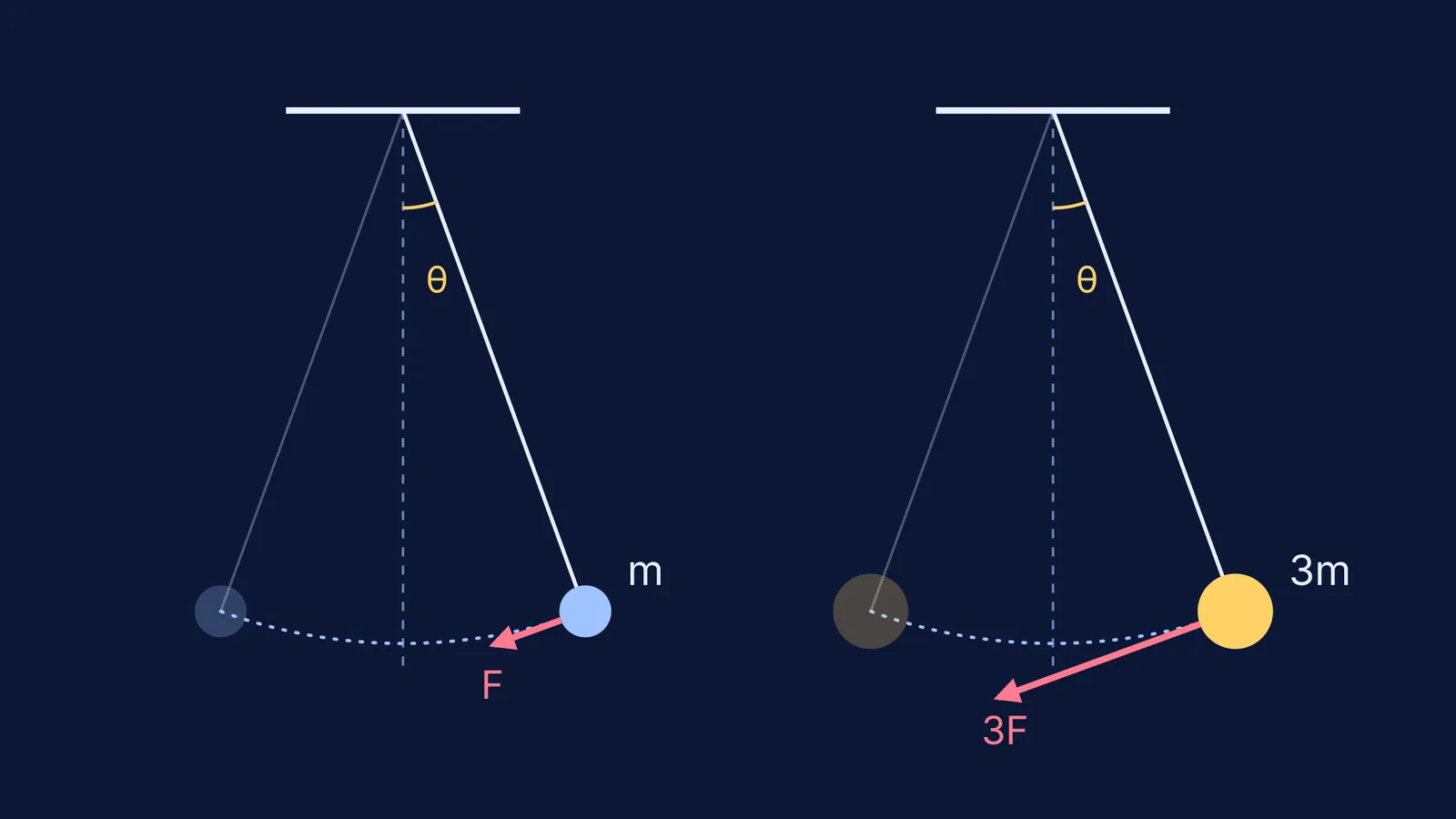
You tie a 50 g bob to a 1 m string, time ten swings, then swap in a 500 g bob. The ten swings take the same time. That feels wrong, because the heavier bob is pulled harder. It is, but that is only half of the story.
Does the mass of the bob affect the time period of a pendulum?
For small swings, no. The period of a simple pendulum is T = 2π√(L/g), where L is the length from the pivot to the centre of the bob and g is the acceleration due to gravity, and the formula is reasonably accurate for angles of a few degrees (HyperPhysics, Georgia State University).
Mass does not appear in that formula. So a 1 m pendulum with g = 9.8 m/s² has T = 2π√(1/9.8), about 2.0 s, whether the bob is a marble or a cricket ball.
Why does the mass cancel out?
How fast anything speeds up depends on two things: the force pushing it, and how hard it is to push. For a pendulum, both are proportional to the mass.
Restoring force. Pull the bob aside by an angle θ. The part of its weight along the arc is mg sin θ, pointing back towards the lowest point.
Inertia. Newton's second law says this force gives an acceleration a = F/m.
Divide. a = (mg sin θ)/m = g sin θ. The m has gone.
Small angles. For small θ, sin θ ≈ θ = x/L, where x is the distance along the arc, so a ≈ −(g/L)x. That is simple harmonic motion with ω² = g/L, which gives T = 2π√(L/g).
A worked example with real numbers
Take θ = 5° (sin θ ≈ 0.0872) and g = 9.8 m/s², using the force-along-the-arc idea from HyperPhysics.
50 g bob: F = 0.05 × 9.8 × 0.0872 ≈ 0.0427 N, so a = 0.0427 ÷ 0.05 ≈ 0.854 m/s².
500 g bob: F = 0.5 × 9.8 × 0.0872 ≈ 0.427 N, so a = 0.427 ÷ 0.5 ≈ 0.854 m/s².
Ten times the force, ten times the inertia, the same acceleration. Because a = g sin θ holds at every angle, the two bobs keep pace through the whole swing and share one period. To check it yourself, see how to test a heavier bob fairly at home.
Is the m in the weight really the same as the m in F = ma?
The m in mg measures how strongly gravity pulls on a body. The m in F = ma measures how much the body resists being accelerated. Nothing in Newton's laws says these must be equal. It is an experimental fact.
In the Principia (Book 3, Proposition 6), Newton describes filling one of two identical round boxes with wood and hanging the same weight of gold in the other, on equal eleven-foot cords, and seeing them swing together "for a very long time" (MathPages, quoting a translation of Newton's text). He repeated the test with silver, lead, glass, sand, salt, water and wheat, and wrote that a difference of even less than a thousandth part would have been clearly noticed.
Modern tests are far sharper. The MICROSCOPE satellite compared the accelerations of titanium-alloy and platinum-alloy test masses in orbit. It was designed for a precision of 10⁻¹⁵ and found no difference: the measured Eötvös ratio, (−1.5 ± 2.3 ± 1.5) × 10⁻¹⁵, is consistent with zero (Touboul et al., Physical Review Letters, 2022).
When does mass change the period?
The cancellation only works when the restoring force is proportional to the mass. Watch for these:
Mass on a spring. The spring force is −kx, which does not depend on m, so T = 2π√(m/k). A heavier block oscillates more slowly.
Charged bob in an electric field. The extra force qE does not scale with m. In a vertical field the effective g becomes g ± qE/m, so the period depends on mass. See a charged pendulum in a uniform electric field for the full working.
Air resistance. Drag does not depend on mass, so a ping-pong ball's swing dies away much sooner than a steel ball's of the same size.
A bigger bob on the same string. L is measured to the centre of the bob. If the heavier bob is also larger, L grows and T grows a little. That is a length effect, not a mass effect.
Large swings. Beyond a few degrees the formula is only an approximation, whatever the mass. Galileo noticed that small swings take nearly the same time.
If you get stuck when a question adds a spring or a field, the Fermi Problem Library has worked problems with a step-by-step solver that explains the reasoning rather than printing an answer. To place this idea next to SHM and Newton's laws, the Fermi Concept Library gives each concept its own lesson and its place in the map.
Next time an exam question hands you a bob's mass, check for springs, charges or fields before you use it.