

On this page
Before you read on, make a prediction. You hang a light bob and a heavy bob on strings of the same length, pull both back by the same small angle and let go together. Does the heavy one finish its swing first, last, or at the same time? Write your answer down.
Does a heavier pendulum bob swing faster?
No. For a simple pendulum swinging through a small angle, the period is T = 2π√(L/g), where L is the length and g is the acceleration due to gravity, according to OpenStax University Physics, Volume 1. The same text says the period "is completely independent of other factors, such as mass and the maximum displacement."
A heavier bob feels a bigger pull from gravity, but it also has more inertia, so it needs more force to get the same acceleration. The two grow together and cancel. The mass appears on both sides of Newton's second law and drops out, which leaves only L and g.
"Small angle" has a real meaning here. OpenStax notes that for angles below about 15 degrees, sin θ and θ (in radians) differ by less than 1%, and that is the approximation the formula relies on (OpenStax). Keep your release angle small and the same for every trial.
Does the material of a pendulum bob change its swing time?
Isaac Newton ran a closely related test with great care. In Book III of the Principia he describes two equal round wooden boxes: he filled one with wood and hung an equal weight of gold inside the other, both on equal eleven-foot cords, so the two pendulums matched in weight, shape and air resistance (translation quoted on MathPages). The two boxes kept swinging together for a very long time. He reported the same result with gold, silver, lead, glass, sand, common salt, wood, water and wheat, and said a difference "even less than a thousandth part of the whole could have been clearly noticed".
Newton kept the weight, size and length the same and changed only the material. That is the habit worth copying.
The swing time does depend on length, though, and that difference is what makes a row of unequal pendulums drift in and out of step, as in why pendulums of different lengths make wave patterns. For the history of the small-swing rule itself, see Galileo's pendulum and why small swings take nearly the same time.
How do you separate mass from length in a fair test?
The method is called the control of variables strategy: change one thing, keep everything else the same. In a 1999 study in Child Development, Zhe Chen and David Klahr found that children aged 7 to 10 could learn this strategy and transfer it to new problems when they were given explicit instruction along with probe questions (Chen and Klahr, 1999).
Run two separate tests.
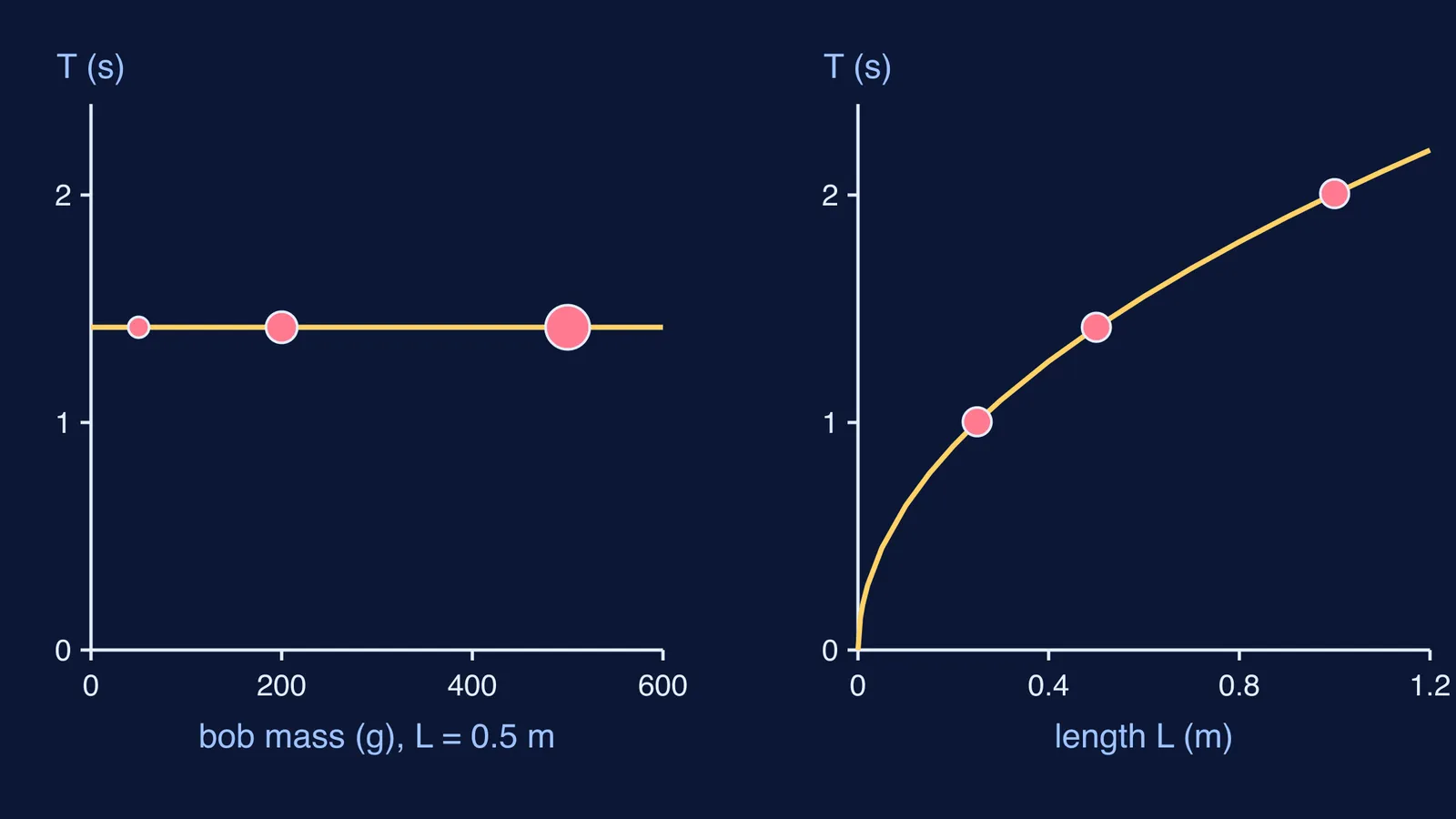
Test A, mass only: set all strings to the same length, say 0.5 m. Use bobs of different mass, release each from the same small angle, and time 20 full back-and-forth swings. Repeat three times per bob.
Test B, length only: use one bob. Time 20 swings at 0.25 m, 0.5 m and 1.0 m, three times each.
Divide each total by 20 to get T, average your three runs, and compare.
What numbers should you expect?
Here is a worked example using T = 2π√(L/g) from OpenStax, with g taken as 9.81 m/s².
L = 0.25 m: T ≈ 1.00 s, so 20 swings take about 20.1 s.
L = 0.50 m: T ≈ 1.42 s, so 20 swings take about 28.4 s.
L = 1.00 m: T ≈ 2.01 s, so 20 swings take about 40.1 s.
Making the string four times longer doubles the period. In Test A, every bob at 0.5 m should come in near 28.4 s for 20 swings, whatever its mass.
If your light and heavy bobs differ by a small fraction of a second over 20 swings, compare that gap with the spread between your own repeat runs. A gap smaller than your spread is timing error, not physics. One thing you may really see is the light bob dying down sooner, because air drag slows a light bob more. That mainly changes how long it keeps swinging, not the time each swing takes. Things do change when the mass moves during the swing, as in the leaking pendulum, whose period first rises and then falls.
What if you cannot set this up at home?
You still need the same rule: change one variable at a time. The Fermi Simulation Lab has interactive simulations for ideas that are easier to see than to read, so you can practise the predict-then-test habit there. If your measured periods do not match the formula and you cannot see why, Fermi's AI tutor works through it with you, drawing the figure and checking your understanding as it goes.
Write your prediction down, time 20 swings, and let the stopwatch settle it.


