

On this page
If you line up 15 pendulums of slightly different lengths and release them all at once, they don't swing randomly. Instead, they perform a choreographed dance. Over exactly 60 seconds [[1]](https://sciencedemonstrations.fas.harvard.edu/presentations/pendulum-waves), the line transforms into a slithering snake, breaks into independent pairs, dissolves into complete chaos, and then suddenly snaps back into a perfect, straight line.
This demonstration, known as a pendulum wave, isn't magic. It is a brilliant trick of physics and a phenomenon called spatial aliasing, making it one of those hard physics ideas you have to visualise to truly understand.
What is the hidden math in the string length?
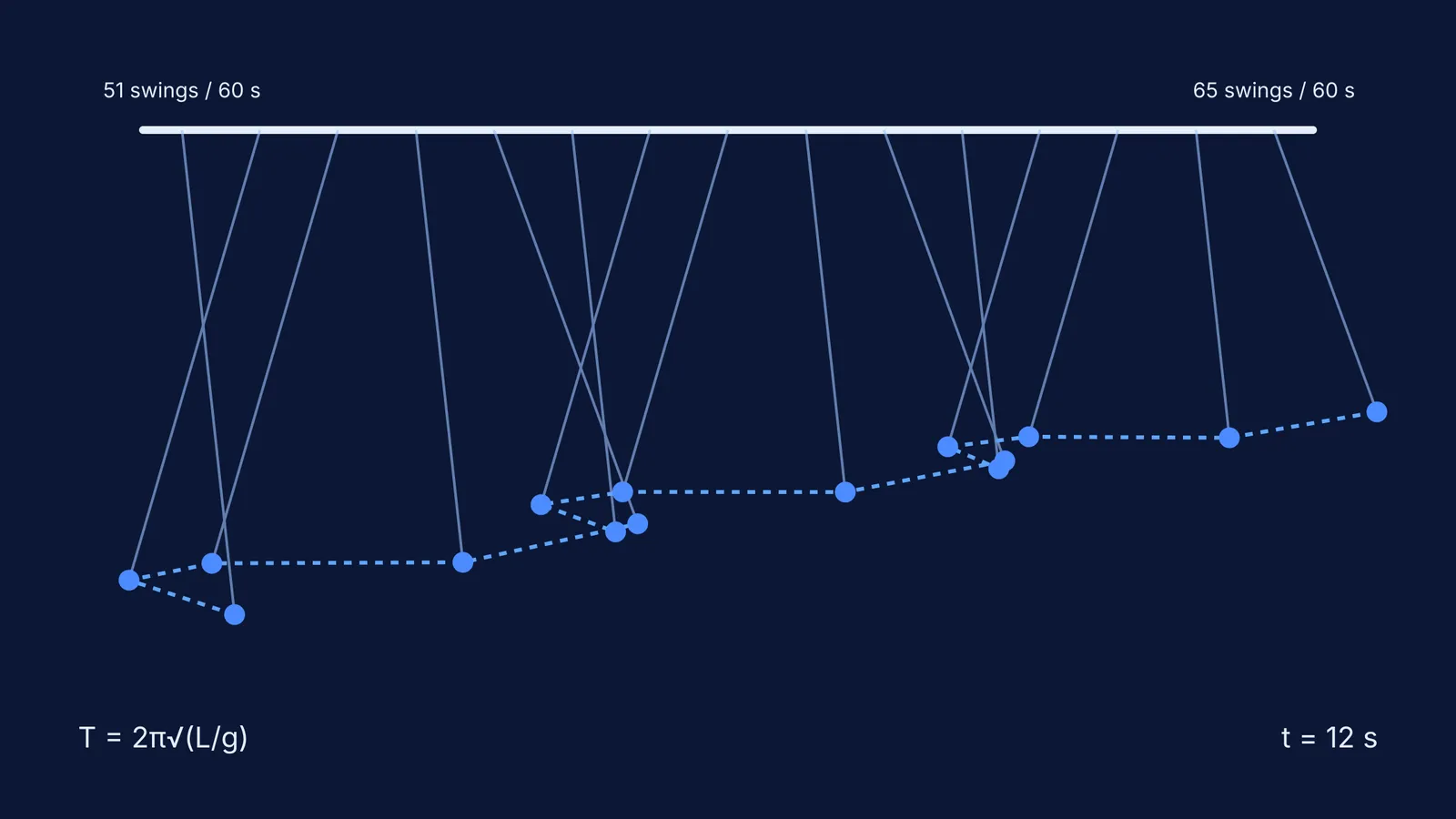
Every pendulum follows a strict rule: its swing time, or period (T), depends entirely on the length of its string (L) and gravity (g). The formula is T = 2π√(L/g), a foundational equation in simple harmonic motion.
Because gravity is constant, a shorter pendulum will always swing faster than a longer one. To create the wave pattern, the lengths cannot be random. In the classic demonstration, they are tuned to a 60-second grand cycle.
The longest pendulum is set so that it completes exactly 51 oscillations in 60 seconds [[1]](https://sciencedemonstrations.fas.harvard.edu/presentations/pendulum-waves). The next one is made just short enough to complete 52 oscillations in the same time. The pattern continues down the line until the 15th and shortest pendulum, which completes exactly 65 oscillations in 60 seconds.
How does the wave change from a snake to chaos?
When released, they all start in sync. But because the shorter ones are moving slightly faster, they immediately begin to drift apart.
The traveling wave: Early on, the slight phase difference between neighbours creates what looks like a single continuous wave travelling down the line.
Standing waves: Halfway through the cycle, the pendulums have drifted far enough that every alternating pendulum is swinging in the exact opposite direction.
Chaos and groups: At specific fractions of the cycle, they divide into distinct groups. In between these moments, their movements appear completely random.
The grand reset: At the end of the cycle, the math aligns. The longest and shortest pendulums finish their final swings at the exact same instant, recreating the straight line.
Why do we see a wave that isn't there?
The most fascinating part of a pendulum wave is that the "wave" itself is an illusion. The pendulums are not physically connected, nor are they transferring energy to one another like a real wave on a string.
What you are watching is spatial aliasing [[2]](https://doi.org/10.1119/1.1349543). Our brains try to connect the dots between the distinct bobs. When they are close together, we see a smooth curve. When they drift further apart, the "wavelength" we perceive becomes so short that our eyes can no longer accurately track it. Instead, our brains "alias" the pattern into a lower-frequency wave, making us see a simpler, slower wave that doesn't actually exist.
How can you test this in a simulation?
Reading about the phases of a pendulum wave is one thing, but timing them helps you understand the period formula intuitively. If you change the length of the longest pendulum without adjusting the others, the cycle will completely break.
You can build and test this setup yourself in the Fermi Simulation Lab. Try setting a group of pendulums to complete consecutive numbers of swings in a specific time window. Release them together, predict what will happen halfway through the cycle, and watch the physics unfold.


