

On this page
It is a classic physics trap that catches many students in competitive exams. A hollow pendulum bob is filled with water, and a small hole at the bottom lets the water leak out slowly. Does the time period of the pendulum increase, decrease, stay the same, or do something else entirely?
The answer is not a straight line. The time period first increases, then decreases, and finally returns to its original value when the bob is completely empty.
Here is the exact physics of why the leaking pendulum behaves this way, and how to track the changing center of mass step by step.
Why does the period change?
The key to the problem lies in the formula for the time period of a simple pendulum. According to HyperPhysics at Georgia State University, the period T of a simple pendulum for small amplitudes is:
T = 2π√(L/g)
In this equation, g is the acceleration due to gravity, and L is the effective length of the pendulum.
The trap is that L is not just the length of the string. The effective length L is the distance from the point of suspension to the center of mass of the entire bob system (the hollow shell plus whatever water is inside it). The time period is independent of the mass itself, but it depends entirely on *where* that mass is located. This detail is just as crucial as remembering how a seconds pendulum changes its period with length and g.
This continuous shift is not always intuitive. Because the pendulum's restoring force depends on gravity acting on the entire system's mass, the center of gravity effectively acts as the single point mass of an equivalent simple pendulum. The water's shape as it flows out constantly redefines this balance point.
What happens to the time period of a leaking pendulum?
As water leaks from the bottom of the hollow bob, the system's center of mass shifts dramatically, which we can map across four distinct stages. Mires and Peters explored the exact mathematics of this shift in the *American Journal of Physics*.
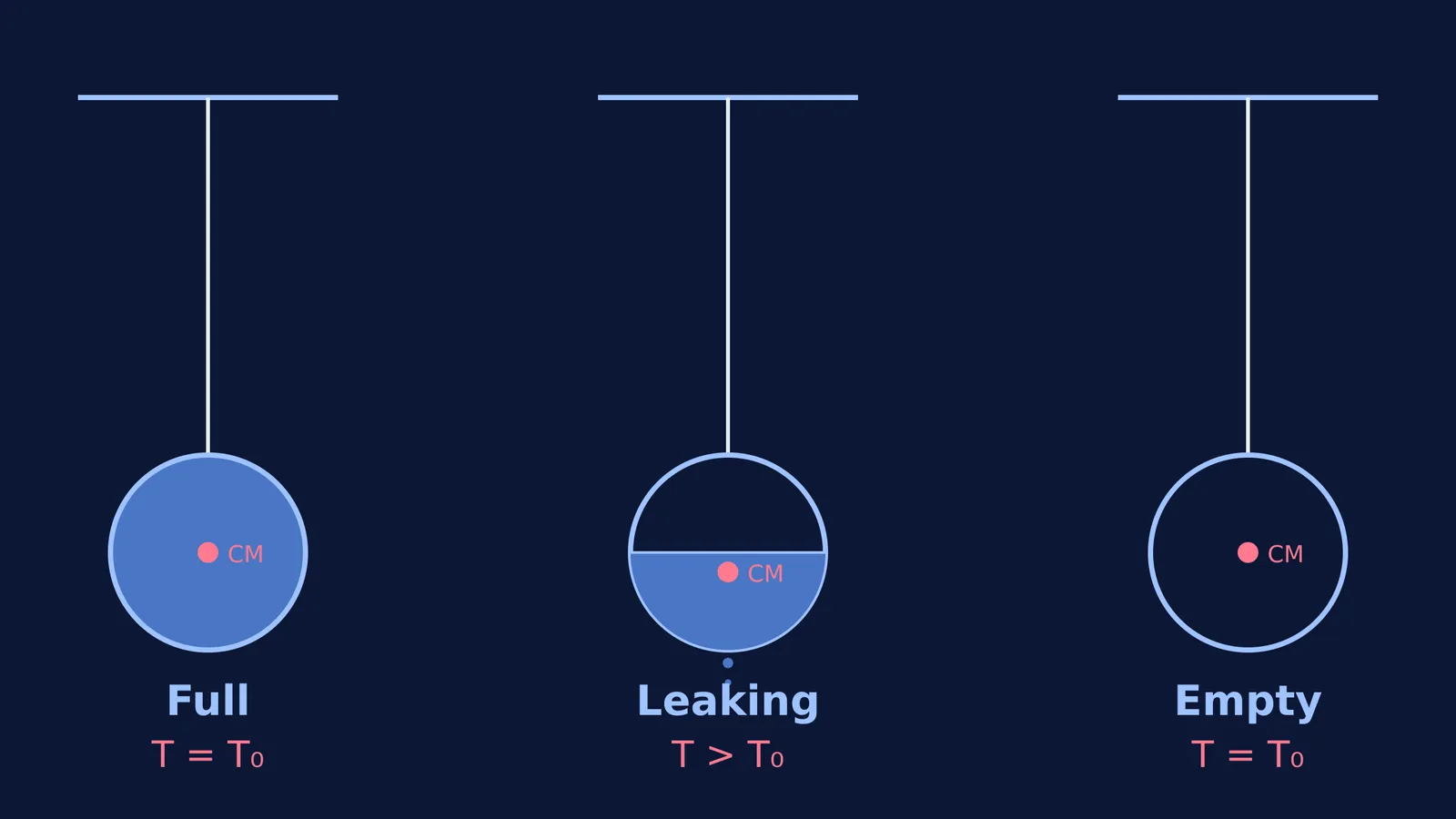
The full bob (T = T₀): When the spherical bob is completely full, the water is distributed evenly. The center of mass sits exactly at the geometric center of the sphere. The effective length is L₀, giving an initial time period of T₀.
The leaking bob (T increases): As water drains out the bottom, the water level drops. The mass of the remaining water is now concentrated in the lower half of the sphere. This pulls the overall center of mass downward, away from the pivot. Because the effective length L has increased (L > L₀), the time period T must also increase.
The emptying bob (T decreases): When the bob is almost entirely empty, the mass of the thin hollow shell starts to dominate the tiny remaining mass of the water. The center of mass begins to rise back up toward the geometric center of the shell. As L gets shorter, the time period decreases.
The completely empty bob (T = T₀): Once the last drop of water falls, the bob is just a uniform hollow shell again. The center of mass is perfectly restored to the geometric center. The effective length is back to L₀, and the time period returns to its exact original value T₀.
How to tackle trick questions?
Competitive exams love testing this concept because it forces you to drop the rote memorization of T = 2π√(L/g) and think about the physical reality of a moving center of mass. A student who only looks at the mass getting lighter might incorrectly guess the period changes linearly.
If you struggle to picture how physical systems change over time, the Fermi Problem Library has worked problems with a step-by-step solver that explains the reasoning rather than printing an answer. When you get stuck on a tricky mechanics problem—whether tracking the center of mass or calculating the string tension of a simple pendulum at any angle—Fermi's AI tutor works out what you already know and builds a plan for the session, drawing the figure on a board to show you exactly what is happening.
The leaking pendulum is a perfect reminder: in physics, equations are just the start. Always ask yourself where the variables in the formula actually live in the real world.


